AI Search vs SEO: Is It Really Different? (2026 Guide)
by The Final Code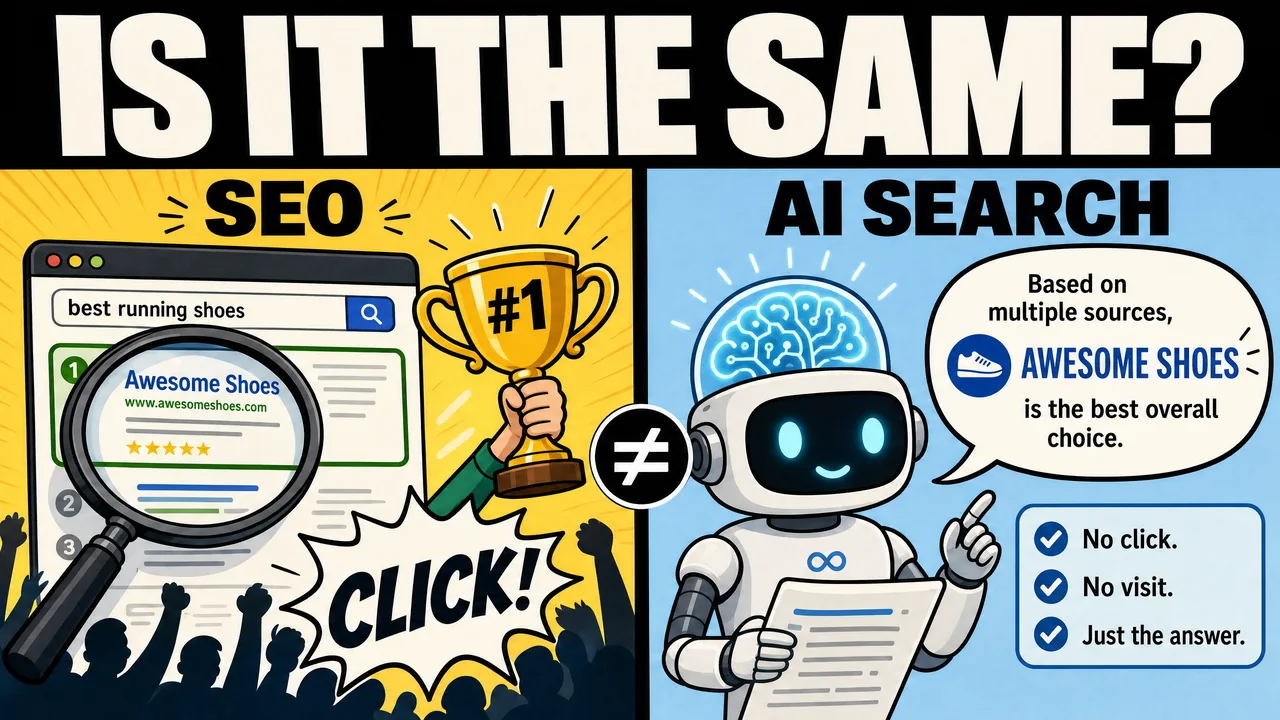
Is optimizing content for AI search different from SEO?
Short answer: Yes. A lot more than your SEO person is admitting.
Long answer: the foundations are the same — clean website, fast pages, real content, schema. But the goal changed. Old SEO got you the click. AI search wants something else entirely. (Stay with me here. This is the part most articles get wrong.)
This post breaks down the seven specific places SEO and AI search optimization actually split apart — and what that means for the next thing you publish.
The numbers behind the shift
Five stats. Read them in order. The story builds.
- 900 million — ChatGPT's weekly active users as of February 2026, up from 400 million a year earlier (TechCrunch, 2026).
- 93% — the share of searches in Google's AI Mode that end with zero clicks to any website (SemRush AI Overviews Study, 2025).
- 34.5% — the average drop in click-through rate for pages ranking #1 on Google when an AI Overview appears for the same query (SemRush).
- 18% — the share of all Google searches that now trigger an AI Overview, and rising. For long-tail queries, it's already 57%.
- 14% — the share of marketers actually tracking AI citation visibility, even though it's the fastest-growing source of first-touch discovery. (Yes, really. 86% of marketers are flying blind.)
Translation: the click is dying, the citation is replacing it, and almost nobody is measuring it. That last stat is the one that should ruin your week.
Has anyone tried optimizing content for ChatGPT search?
It's the question every marketer is quietly asking right now. The answers in the wild fall into two bad camps. Camp one says AI changes everything (it doesn't). Camp two says it's all the same (it really isn't).
The honest answer is in the middle, and it has seven specific shapes.
7 real differences between SEO and AI search optimization
1. SEO ranks pages. AI search quotes paragraphs.
This one is huge and almost nobody talks about it. Google ranks your page. ChatGPT and Gemini and Claude pull a single paragraph — sometimes a single sentence — from somewhere on your page, and quote it.
So the unit of optimization changed. SEO writers used to think "is this page good?" AI writers have to think "is every paragraph quotable on its own?"
If you have one strong page with three weak sections, SEO might still rank you. AI will skip you for a competitor whose every paragraph stands up by itself. (Yes, even paragraph 17.)
2. SEO rewards length. AI rewards density.
SEO blogs got long because longer pages tend to rank better on competitive keywords. So everyone padded. (You've read those 2,500-word pages with one real paragraph buried in the middle. We've all written them.)
AI flips this. AI is looking for the densest, fact-richest sentence that answers a question. A 50-word paragraph with five real facts beats a 500-word paragraph with one. The "filler" you used to add for length is now the thing that makes AI skip your page.
The fix isn't to write shorter posts — it's to make every paragraph carry weight.
3. SEO wanted you to be the destination. AI wants you to be the citation.
This is the big one. The light-bulb moment.
For 20 years, the entire SEO industry was built on a single goal: get the click. Rank, get clicked, convert. Everything — meta titles, CTR optimization, "low bounce rate," "time on page" — was designed to bring people to your website and keep them there.
AI search rewrites the goal. The buyer isn't visiting your site anymore. (See: 93% zero-click rate in AI Mode.) Instead, the AI reads your page on the user's behalf, decides if you're worth recommending, and quotes you in its answer.
So the new question isn't "did they click my page?" It's "did the AI say my brand name out loud?" Different metric. Different game.
If you're still measuring SEO success by clicks alone, you're measuring the wrong thing.
4. SEO hid the author. AI search demands one.
Old SEO playbooks treated content like a commodity. Author bylines were optional. Bios were footers. Most pages were anonymous "we" voice.
AI search broke that. Models cite content based partly on whether they can attribute it. A page that says "according to Jane Doe, a digital marketer with 15 years' experience in Ventura, CA," is dramatically more citable than the same content with no author at all.
This is the E-E-A-T thing Google has been pushing for a couple years — finally actually mattering, because AI agents won't quote a faceless website to their users. They want a name to point at.
Add real author bylines. With photos. With short bios. With links to LinkedIn. Yes, on every page.
5. SEO told you to keep readers in. AI rewards letting them out.
Counterintuitive. Stay with me.
Old SEO said: "Internal-link the heck out of your content. Reduce bounce rate. Keep readers on your site." External links were treated like leaks.
AI search rewards the opposite. Pages that openly cite outside sources — SemRush, Ahrefs, Statista, government data — get cited more by AI models, because the AI uses your sourcing pattern as a trust signal.
(Wikipedia is the most-cited source after Reddit, partly because every claim is sourced. The AI has been trained to like that.)
So link out. Cite your sources by name. The bounce-rate panic is over. Quality trumps stickiness.
6. SEO does keyword research. AI search does question research.
Keywords are still useful. But the unit of work has shifted from "what phrase do people type?" to "what question are they actually trying to answer?"
"AI search optimization" is a keyword. "How do I get ChatGPT to recommend my business?" is a question. The keyword tells you what to put in your meta title. The question tells you what to put in your H2.
(Quick aside: this is also why the FAQ section is now the most important block on a service page. AI loves a clearly answered question.)
Future-proof your content by writing each section as the answer to a complete question, not the rank for a single phrase.
7. SEO measured Google rankings. AI search measures brand mentions.
Google rankings are still measurable in tools like SemRush and Ahrefs. AI mentions are not, by default — which is why only 14% of marketers track them.
The new toolkit (Profound, Otterly, ZipTie, and a handful of others starting at $29-$99/month) shows you when ChatGPT, Perplexity, or Gemini mention your brand by name in an answer. That's the AI search equivalent of a Google ranking.
If you're not running one of these alongside your SEO tools, you're playing the 2026 game with 2018 dashboards.
The light-bulb moment most marketers are missing
If you only remember one thing from this post, make it this:
SEO measures eyeballs. AI search measures decisions.
Old SEO success looked like: "We got 50,000 visits this month." New AI search success looks like: "ChatGPT recommended us 1,200 times this month, and 800 of those people went straight to checkout without ever clicking a link."
The first metric is busy. The second metric is real revenue.
You won't see the second one in Google Analytics. You won't see it in Search Console. You'll only see it if you're tracking AI citations directly — or if your sales team starts hearing "I asked ChatGPT and it sent me to you" on calls.
(Speaking of which: ask your salespeople. Today. They already know. They're hearing it on calls and they're not telling marketing.)
What stays the same (don't burn down your SEO program)
Before anyone panics — most of what you built for SEO still works. Don't throw it out. The overlap is real:
- Site speed and mobile-friendliness. Both Google and AI crawlers reward fast pages.
- Schema markup. The same schema that helps Google show rich results helps AI parse your business.
- Real content with real answers. Both reward depth. (Just not padding — see point #2.)
- Local signals. Google Business Profile, citations, reviews. AI uses the same trust layer for local intent.
- Clean URL structure. Both crawlers prefer logical site architecture.
So the panic-pivot is wrong. The right move is to add AI-search thinking on top of solid SEO — not replace one with the other. (We work with clients on exactly this overlap inside our business consulting engagements, where the goal is to extend your SEO investment, not redo it.)
Your "do this week" list
Pick three. The whole list takes maybe four hours.
- Read your top blog post out loud. Find the three weakest paragraphs. Rewrite them so each one stands alone. (See difference #1.)
- Cut the fluff in your top service page. Replace the first 100 words with hard facts. (See difference #2.)
- Add an author byline + photo + 1-line bio to every blog post and service page. (Difference #4.)
- Add five sourced citations to your most important page. External links to SemRush, Ahrefs, government data, peer-reviewed studies. (Difference #5.)
- Convert one page's H2s into questions. Pick one service page. Make every H2 a real question your customers ask. (Difference #6.)
- Set up one AI-mention tracking tool. Profound or Otterly. 15 minutes. Then watch for a month. (Difference #7.)
- Ask one client how they found you. If even one says "AI," that's your signal to move faster. Real answer from a real client — like the kind we built for The Ventura Meat Company — tells you more than a dashboard.
FAQ
Is AI search going to kill SEO?
No, but it's reshaping it. SEO foundations (fast site, schema, real content) are the same. The optimization targets — what you're trying to win at — have changed.
Should I rewrite all my old content for AI?
No. Pick your top 5-10 pages and rewrite those. Most pages aren't worth the effort. (And honestly, a lot of old SEO content was written for a robot that doesn't exist anymore.)
Do AI search and SEO use different tools?
Mostly the same plus a few new ones. Keep SemRush or Ahrefs for keyword and rank tracking. Add a tool like Profound, Otterly, or ZipTie for AI-mention monitoring. The two work together.
What's the single biggest difference?
SEO got you the click. AI search wants you to be the answer the AI gives without sending the user anywhere. Different goal, different content.
How fast is this changing?
Fast. AI Overviews appeared on 18% of Google searches as of early 2026 — up from near zero two years ago. ChatGPT alone serves 900 million weekly users. Plan in months, not years.
Do I still need to blog?
Yes — possibly more than ever. Blogs are how AI learns what your brand thinks. But the way you blog needs to change. Shorter, denser, sourced, attributed.
Ready to rebuild your content for the AI era?
The buyers are already using ChatGPT, Gemini, and Perplexity to make decisions. The only question is whether your content is structured to be the one they pick.
If your site needs an AI-ready overhaul, we do exactly this work. Book a free 30-minute audit or call us at 805.243.8321. We'll tell you, in plain English, what to change first — and what to leave alone.