
An online store for wholesale distribution built like a warehouse

We show you where wholesale breaks a basic store, how the system that already runs your orders stays the one source of truth, and what it takes to serve your biggest accounts without them logging in.

Free, and we read it ourselves. No pitch, no obligation, and 805.243.8321 if you would rather talk.

30+ Years in business Websites and marketing, one crew 50+ Vehicle makes Fitment mapped for a brake manufacturer No Contracts Stop whenever you want 2 Offices Ventura and Long Island

Two catalogs nobody could find, and what changed

A manufacturer and a distributor, both selling parts nationwide. Both stores are live and both pages show the numbers.

Motorcycle brake manufacturer Zero orders in three months. Then a store that could take money.

No working checkout and no product content when they called. We rebuilt the catalog, the fitment system and the store, and the first organic orders arrived within days of launch.

389
orders in the first five months, against zero the year before
996
keywords ranking
34.4K
search impressions
Read the brake manufacturer case
Superlok USA, industrial fittings and valves A world-class product the engineers who needed it could not find.

Thousands of items on the shelf in Ventura, and for years the engineers searching for exactly those parts landed on somebody else. This is what happened once they became findable, part by part.

294 to 10,000+
search terms they now appear for
~50%
growth, on a base already in the tens of millions
Read the Superlok case study

Wholesale breaks a basic online store before lunch

A basic online store assumes one price, one buyer, and a short list of products. Wholesale breaks all of that:

  • You carry tens or hundreds of thousands of parts.
  • Every account sees its own contract price.
  • Buyers order on POs (purchase orders) and net terms, not just cards.
  • Much of your revenue still runs through reps and quotes.

So we build on the systems you already run. Your ERP (enterprise resource planning) owns orders, inventory and pricing, your PIM owns product data, your CRM owns the accounts, and the store reads from all three.

We have no platform license to defend, so we recommend the stack that fits your catalog, your ERP and your buyers.

Your store earns its keep when it answers one question. Will this part work on mine?

Many buyers order by what fits their vehicle or machine. Most distributor sites skip that question, so buyers give up and call your desk instead. We build that answer in:

  • For a motorcycle brake manufacturer, we mapped fitment across tens of thousands of part variations.
  • A buyer narrows to the exact part for their application before adding to cart.
  • The data behind it is the hard part. Get it wrong and buyers leave.
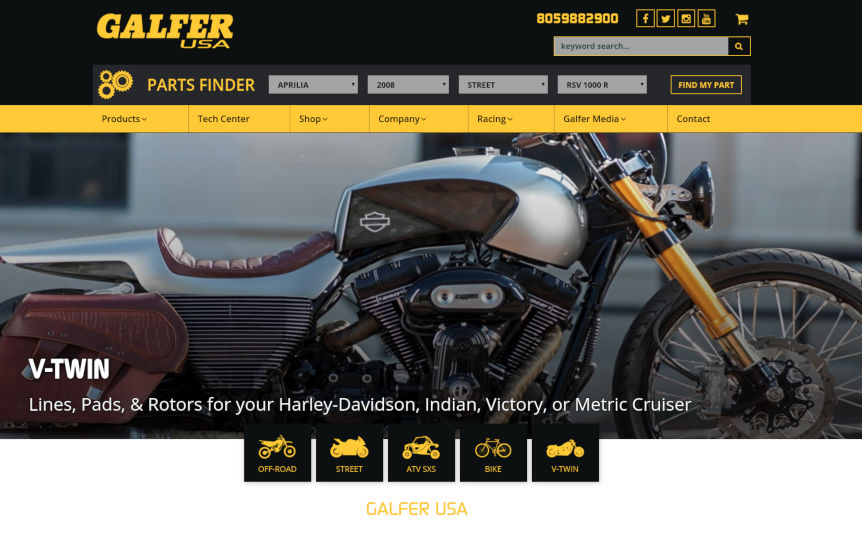
Home page of the motorcycle brake manufacturer's rebuilt store, with the fitment lookup

Your biggest accounts often will not log into your website

They buy through their own purchasing software, like Ariba or Coupa. That is fine. You can meet them there:

Punchout

A link that lets a buyer shop your catalog from inside their own purchasing tool.

eProcurement

Electronic procurement ties your store to those systems.

Live, account-priced

The buyer browses your parts, at their price, without leaving their tool.

Back into approval

The order drops back into their approval flow.

Distributors who plug in keep the enterprise accounts. For everyone else, smart search and part matching inside the store find the right item fast.

Here is what comes back to you before anybody touches your systems

Four things come back to you, in writing, and none of them ask you to move off the system you run the business on.

Where wholesale breaks the store

Account pricing, minimums, pack sizes and everything else a basic store was not built to hold.

Where your data disagrees

The places your site and your ERP say different things about stock or price, and which one your buyer is reading.

What your biggest accounts need

Whether they will use your website at all, and what punchout would take if they will not.

What it takes to build

The work in the order it has to happen, in writing, before you commit to anything.

Everything distributors ask us before they say yes.

Do we have to sign a contract?

No. There is nothing to sign and nothing to cancel. We scope the work and project the hours first, so the number reaches you in writing before you commit to anything, and it does not move quietly afterwards.

Do we have to replace our ERP?

No. When we replace an old site, your ERP and product data stay put. The new store is a fresh front end on systems you already trust, so you are not re-entering everything you own from scratch.

Do you work with distributors like us?

Manufacturers and distributors carrying very large catalogs. Account pricing, POs and net terms, fitment data and punchout is the shape of work we do, and the two cases at the top of this page are the kind of store we build.

How long does a build take?

It depends on the catalog and the integrations, and the report gives you the phases in order. The motorcycle brake manufacturer gave us 120 days for the catalog, the fitment system and the store.

The Truth About Wholesale Online

“A store built for card checkout on a few hundred items cannot hold wholesale. Bolting distributor rules on later is where most rebuilds quietly die.” The Final Code

We build on the systems you already run, so your parts, your prices and your accounts work online the way they work in the business. The report tells you what to build on and what carries over from your current site.


or call or text us
805.243.8321
A catalog that never loaded, and a nice logo? Free visibility report Call or text 805.243.8321 Get My Free Visibility Report