Proud sponsor, 2026
The Ventura County SCORE Awards. We would not have made it this far without Dan
Frederickson and SCORE.
See our story → Free, and yours in 48 hours
See who is outranking you
We run your site against the competitors taking your calls, and send back the pages costing you the work. No meeting, no pitch.
Built for buyers like yours
See what this work did for a company in your field
Same industry, same kind of buyer, same slow sale. The case studies carry the numbers that came out the other side.
No queue, no account manager
Get a principal on the phone, not a handler
The person you talk to is the person who does the work. California-based leadership, and someone at a desk on Eastern time.
Tell us what is not working and get a straight answer back, not a pitch deck.
Already a client with something that needs fixing today.
There are about a million dentists in the world and only about 8,000 endodontists. For fifty years a good share of them learned the hardest part of the job from Dr. Cliff Ruddle. We have been his agency since 1996.
When the travel finally caught up with him, we built him a television studio, a video platform, and a set of keys to the whole thing.We turn your vision into digital reality.
For fifty years, Dr. Cliff Ruddle taught the hardest part of dentistry in person, one room at a time.
Then a hall in India turned 300 people away at the door.
He bought the house next door. We took it down to nothing and built a television studio inside it, wired to a custom CMS and professional streaming, and then handed over the keys.
Twelve seasons and 100 episodes later, he has not boarded a plane to teach in years, and he owns every part of it.
Season and episode counts from the show’s own library. Held pending written approval: audience figures.
Dr. Cliff Ruddle trained at Harvard and has taught graduate endodontics at UCLA, UCSF, Loma Linda and Pacific. He did not only teach the work, he invented the tools for it, made in Switzerland under his own trademarks. Some of them are the most widely used instruments in the profession.
He lived on airplanes. Doctors flew in from every continent carrying broken teeth in their pockets to ask him what he would have done, and he would put the instruments in their hands and work with them until they knew what he knew.
He had a great business long before he had us.
Harvard · UCLA · UCSF · Loma Linda · Pacific · and a lecture hall on nearly every continent
The first problem we solved for him, back in the nineties, was a DVD. A hundred and eighty dollars, four days in the mail, and it usually landed about three days after the patient was already in the chair. So we built him a library he could point people to instead. He called it Just-In-Time Education.
Then he went to India, and 300 people were turned away at the door because the hall was not big enough. He called after that trip and said it had taken him 24 hours to fly home and three more days to recover, and that he did not know how much longer he could keep doing it.
That is the ceiling. Not talent, not demand, not material. One man, one room, and the number of hours he could stay in the air.

We told him to stop renting rooms. Do it as video, and the audience size is unlimited, and you can do it from where you are standing. He fell in love with the idea. We were going to shoot it in another building entirely until he decided he would rather buy the house next door to his own.
The contractor and the design. Taking the house down to nothing and building a studio in it.
The cameras and the hardware. Specified for an hour-long show that runs every week.
The training to operate all of it. So the family could run the room without us in it.
A desk rather than a lecture hall. He wanted something closer to a sports desk than a classroom.
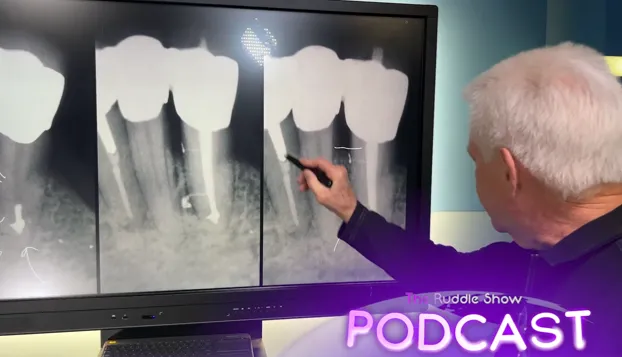
His daughter took the chair beside his. He sent his grandson to film school so the family could shoot it and cut it themselves. An episode runs about an hour: he walks a real case with the screen behind him, reaches for whatever instrument makes the point, teleconferences a guest in from anywhere in the world, and talks it through like a conversation rather than a dry academic lecture.
They can change absolutely anything on that site, at any time, without asking us. Every show, episode, podcast and resource page. The show notes, the transcripts, the related videos. And the code underneath all of it.
It is wired straight into professional streaming, so a file goes up once through their own control panel, gets encoded, and comes back attached to the right episode. No third-party player standing between the show and the people watching it.
Pages, shows, podcasts and sections, and the markup and styling underneath them. Everything is theirs to change.
Video goes up and encodes from the same panel, tied to the episode it belongs to. Upload once, attached correctly.
We taught it rather than kept it, which is the part most agencies quietly skip.
His library is his library. Nobody takes it down, and nobody puts an ad in front of a root canal.
Wiring a site into a video service is ordinary work, and we are not going to pretend otherwise. The genuinely hard question on a build like this is where to draw the line between what lives in code and what lives in a control panel the client can reach.
Draw it too tight and you have built yourself an annuity: every small change comes back to us, billable, and the client waits. Draw it too loose and you hand over controls nobody will ever touch. We drew it wide on purpose, and it cost us the easy recurring work.
He does not use every control we built. He uses the ones he needs, every Wednesday. The rest are there because the day he wants one, he will not have to call anybody, and after thirty years that is the part we would build the same way again.
The measure of a handover is not how much you built. It is how little the client needs you afterwards.
We built it so he would get found. When somebody asks an AI what it knows about Dr. Ruddle, or about Dr. Ruddle and a specific procedure, the answer is assembled from pages it can read and credit.
Episodes, transcripts and show notes sit on infrastructure he owns.
No platform policy change can retire fifty years of teaching.
Nobody sells a pre-roll against a root canal he is walking through.
Pages an answer engine can read, and attribute to him rather than a host.
How we approach AI search visibility › The platform side: software and integrations ›
He is in his late seventies. Twelve seasons and a hundred episodes later, he has not boarded a plane to teach in years.
The show reaches a profession that is only about 8,000 people wide, from a desk in a house on his own street, and he can do whatever he likes with any of it, because it runs on infrastructure the family owns.
Gate · held until written approval: the audience figure. We have a number for how much of the profession watches, and against a denominator of 8,000 it is a genuinely remarkable share, which is exactly why it needs confirming before it goes on a public page. Confirm which metric it is, the period it covers and the source, then it leads this section. No traffic or performance figures are published here in the meantime.
His was a room with 300 chairs and a flight home that took him three days to recover from. Demand was never the problem. The room was.
Yours might be a calendar, a phone that only rings during business hours, or a body of knowledge that only leaves your head when you are standing in front of someone.
He had a great business long before he had us. He just needed a way to hand it to everybody at once, and then to own the thing that did the handing.
If the limit on your business is the number of rooms you can stand in, that is a fixable problem.Pool service that went from 40 pools and one truck to 200+ pools and a fleet.
Booking SaaSBooking software their operators run through a packed season.
Industrial ecommerceA dead checkout rebuilt in 120 days, with orders within days of launch.
He had a great business long before he had us. He just needed a way to hand it to everybody at once, and then to own the thing that did the handing.
That is a fixable problem, and it is the kind of build we have been doing since 1996.