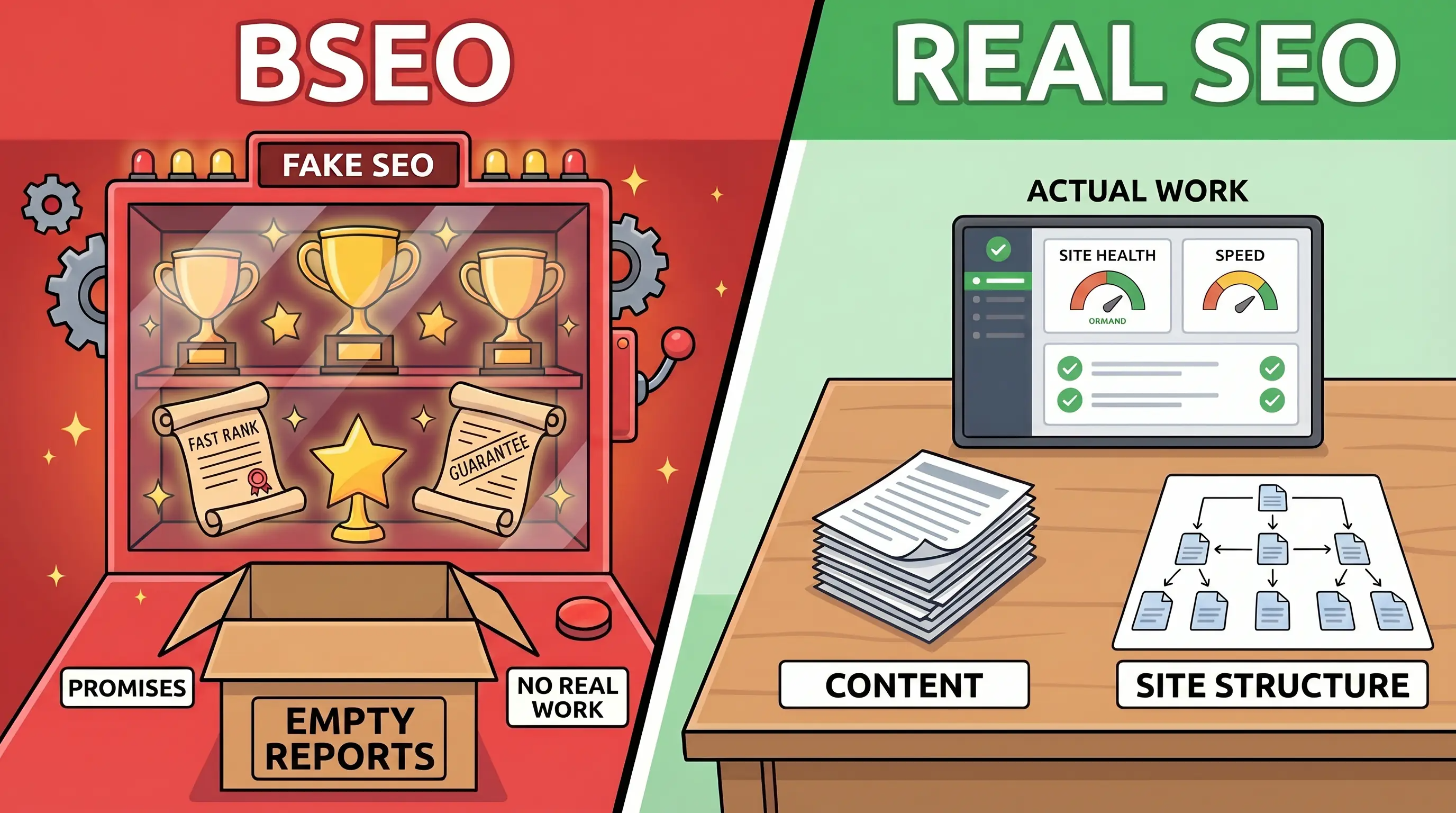
Cheap SEO: How to Spot BSEO Before It Costs You
Cheap SEO is where most bad SEO lives. A guy called us, and the first thing out of his mouth was, “I don’t even want to talk to you, but you’re a necessary evil. All you SEO companies do is lie.” He’d been paying his old agency every month for years. They kept telling him he was number one for this and number one for that, but when he actually looked, he wasn’t anywhere. We are an SEO company in Ventura County, and his story is the reason this post exists.
When he asked what they’d been doing all that time, the answer was nothing he could verify. No new content on his site, no new backlinks, no technical fixes. Just a check going out every month and a story coming back the other way.
What is BSEO?
BSEO is you not knowing what you bought. You bought something, and you don’t know what it is.
How many things do you buy without knowing what they are? Do you buy food without knowing what it is? Yet SEO is something people buy without knowing what it is, and then plead, “Well, I’m not a techie.” But you’re a business owner. If your ad was in the newspaper, or on a bulletin board, you would know how much it cost and what you expected from it. You wouldn’t just shrug, “Oh, I don’t know, all those dang SEO guys.”
The trouble with SEO in a can
It’s honestly sad to be in this business sometimes. What’s harder? Finding a good client who understands what actual SEO is and what effort it takes? Or dealing with all the people who just want to “get me some of that SEO in a can”?
They don’t give the provider anything, and the provider doesn’t even ask. Nobody asks, “What’s so great about you? What do you do? What are all the different parts of the term you’re after?” And nobody picks the target terms.
Take an owner we’ll call Greg. Greg told us his SEO company charged him sixteen hundred a month. We asked, “What content are they adding?” He said they told him they’d added a few words. The words were something no one has ever searched for.
So shame on you if you’re saying SEO doesn’t work. You didn’t put any effort into it, and it’s your company. That’s the most frustrating part. People who are so dismissive of what real SEO can do for them go off and pay seventy dollars a click instead.
Cheap SEO is snake oil
And then you see the ninety-nine dollar SEO. “We’re not making any money right now, so we can’t afford SEO, so we’ll just try this ninety-nine dollar SEO.” Now you’re trapped on a hamster wheel, buying magic beans, hoping for a beanstalk that’s going to take you to great riches.
You already know this one.You've seen the ad where a guy sprays something on a car that's completely oxidized, the paint's peeling, and like magic it all wipes off. You think, "That's such BS," because you're smart enough to know better. Then somebody says, "I'll get you SEO for ninety-nine dollars," and you think, "Yeah, maybe it'll work." You know it won't.
Most companies only want to spend a hundred, maybe five hundred dollars a month. So ask yourself honestly: what quality of SEO person, or pay-per-click person, are you going to get for that?
The cheapest packages usually come with the biggest promises. Google warns about exactly that in its own advice on hiring an SEO.
No one can guarantee a #1 ranking on Google. Beware of SEOs that claim to guarantee rankings, allege a "special relationship" with Google, or advertise a "priority submit" to Google.Google Search Central, Do you need an SEO?
Guaranteed SEO and cheap SEO are usually the same product. The guarantee is the sales pitch. The price is the bait.
The only magic is that you keep paying
Big directories and lead services charge businesses premiums every month. We try to give people what they need for less, and to educate the ones willing to learn. “How do I do this on my own? What is it these companies are doing that’s magic?” The only magic is that you keep paying them. That’s really the only magic we see.
That’s why BSEO exists: business owners want this work to be a black box. Nobody wants to learn what schema markup is or whether their domain authority went up. They want to write a check and have customers show up. That hope is the soft spot every BSEO agency exploits. The second you stop checking, they stop working, and the only thing still moving is your card on file.
What real search engine optimization actually looks like
There are three levers that move rankings, and any honest agency will tell you the same thing.
- Content. New pages, blog posts and updated service pages targeting real searches your customers type into Google.
- Backlinks. Other websites pointing to yours, earned through real outreach instead of bought from a link farm.
- Technical. Site speed, crawl errors, broken links, how the site works on a phone, schema markup and indexing.
That’s the whole list. There’s no fourth lever, no magic sauce. If your provider isn’t visibly touching at least two of those three every month, you’re not paying for a service. You’re paying for a story. We go deeper on what the work should include in what real SEO looks like.
Why most content gets no traffic at all
Here’s a number that explains why so many businesses feel ripped off. Ahrefs, the SEO tool company, studied the pages in its index and reported that “96.55% of all pages in our index get zero traffic from Google.”
That changes how you should judge a content plan. Cranking out posts nobody finds is one of the most common BSEO moves there is. The volume looks impressive in a monthly report. The traffic doesn’t exist. Pages with no links pointing at them, aimed at words nobody searches, are how a site becomes part of that number.
A real agency picks topics people actually search, earns links to those pages, and tracks whether they pull visitors. A BSEO agency hits publish and walks away. It’s also why a focused local SEO strategy beats a generic content dump, because local searches are ones you can verify and competition you can actually beat.
How do I know if my SEO company is doing anything?
You don’t need to be technical. You just need to be willing to look. Here’s the check you can run before you write the next check.
- Look at your published content. Open your blog and your service pages. When was the last new piece published? If the newest post is years old and you’ve been paying every month since, one of the three levers hasn’t moved.
- Ask for the backlink list. Request every backlink built in the last 90 days, with the actual URLs of the linking pages. A real agency keeps this in a tracker. A BSEO operation sends a screenshot of some vague third-party score.
- Ask for technical specifics. What technical work was done last quarter? “We fixed the broken links on your service pages and cut your homepage load time” is work. “We optimized your site for the latest algorithm update” is a sentence designed to sound like work.
- Set up Search Console and Analytics yourself. Both are free. Search Console shows the searches your site appears for, where you rank for each one, and how many clicks you got. If the chart has been flat for a year, your rankings have been flat for a year.
If your agency resists any of these or stalls on the data, that’s not a communication problem. That’s the answer.
Red flags that you're paying for BSEO
- Reports that only show wins. Every business has slow months. If every report is sunshine, somebody is curating reality before it reaches your inbox.
- You don’t own your own accounts. You should hold the logins for your Google Business Profile, Search Console, Analytics and your domain. If your agency won’t hand over access, that’s not a service relationship. That’s a hostage situation.
- Vague monthly summaries. “We worked on optimization this month” is not a deliverable. A deliverable names the page, the search it targets and what changed.
- Number-one rankings for words nobody searches. Ranking first for a phrase no one types is easy, and it makes a nice line in a report. Real keyword? Yes. Real searches? None.
- Same retainer for years, same number of pages. SEO is a content business. If your site has the same page count it had on day one, you can do the math on where the money went.
- Google gets blamed for everything. Algorithm updates happen, and real agencies adapt. BSEO operations use Google as a permanent excuse.
For the full list of warning signs, including the lead sellers posing as local businesses, see our 10 red flags your SEO company is a scam.
Why "spend more" is the BSEO closing move
You’ve been paying for a year, you don’t see results, you finally push back, and the answer is always the same: spend more. The retainer needs to go up. The package needs an upgrade. More money on the same thing that wasn’t working.
The reasonable question is: show me where I was when we started, and show me where I am now. If your provider stalls or changes the subject, you have your answer. It’s like buying new tires that look exactly like your old bald ones. The guy swears they’re brand new, but the car still slides in the rain.
Why Google punishes thin content
In March 2024, Google folded its helpful content system into its core ranking systems. Google’s own documentation says it “became part of our core ranking systems.” The kind of content that system is built to reward is original, written by someone who knows the subject first-hand, and made for people rather than for search engines.
That’s bad news for BSEO. Thin, generic, spun content doesn’t just fail to rank. A site full of it can drag down the pages you actually care about. Real content takes longer, because it has to show real knowledge and cover the question properly. That’s why a healthy SEO program produces fewer, better pieces, backed by technical work and real links.
Is digital marketing a scam? The honest answer
No. Real digital marketing is one of the most measurable kinds of marketing ever invented, which is the irony. Every ranking has a position you can check. Every visit has a source. Every conversion has a path you can follow, if anyone bothers to do the work and report on it honestly.
It becomes a scam when it’s sold as a magic black box you’re not supposed to question. The difference isn’t complicated. A legitimate agency welcomes you checking the work. A fake one resents the question and changes the subject.
You set yourself up for it, so stop
You have to take responsibility for not falling for the BS. “Whatever, I’m not a techie, I don’t know this stuff.” That excuse is exactly how people get taken advantage of. Those are the hardest people to help, because they don’t take the work seriously. They don’t understand how much work it is, or what it’s worth. They take it for granted.
You have three real options once you see what’s been happening.
- Audit your current company. Ask for everything above: content published, backlinks with URLs, technical fixes with specifics. Give them two weeks. If they can’t produce it, you have your answer.
- Get a second opinion. Have someone who isn’t your provider look at your Search Console data, your site structure and your content. The signs are visible, whatever story you’re being told.
- Switch. It’s hard only because of sunk cost. Walking away feels like admitting it was a waste. It was. Every extra month in a BSEO contract is a month you’re not building real rankings.
Send us your site. We will pull up what you rank for, what your current provider has actually changed, and what real work would look like from here. No charge, and no obligation. Or call or text 805.243.8321.
Get My Free Visibility ReportThe whole space feels mysterious because the people selling BSEO keep it that way. The real work is concrete. People search using words, you can look those words up yourself, and you can see where you show up and where you don’t. That’s what real search engine optimization is, and the moment you start asking for results is the moment cheap SEO stops working on you.