 CallRail
 Every call logged to the search that sent it, with the recording. You hear the engineer ask for the part.
Engineers search by grade, tolerance, standard and part number. We show you which of your parts rank for those searches, who is outranking you, and what it takes to pass them.
Find out if you're paying for SEO or BSEO.
Free, and we read it ourselves. No pitch, no obligation, and 805.243.8321 if you would rather talk.
One search, one page, four places to be on it
They type the spec. Here is what answers them before your site does.
Your product and spec pages are the most valuable pages you own, and most have not been touched since launch. Whether they rank comes down to how the data behind them is built.
By size 1/2 tube fitting
Tube size 1/2 in OD Found by "1/2 tube fitting"
By material 316L fitting
Material 316L stainless steel Found by "316L fitting"
By rating 6000 psi fitting
Pressure rating Up to 6,000 psi Found by "6000 psi fitting"
By standard ASTM A479 fitting
Standard ASTM A479 Found by "ASTM A479 fitting"
By competitor Swagelok alternative
Cross-reference Swagelok® equivalent Found by "Swagelok alternative"
The proof
Superlok USA keeps thousands of instrumentation fittings and valves in Ventura, California. In 2024 the site turned up for 294 search terms, most of them the company name. Today it turns up for more than 10,000, and the business is up roughly 50%.
| Measure | Figure | Against what |
|---|---|---|
| search terms, 2024 | 294 | Most of them the company name |
| search terms, today | 10,000+ | Including the comparison searches that name a competitor |
| business growth | ~50% | On a base already in the tens of millions |
The gray line is what you rent: clicks on your own part numbers, bought again every month at full price, gone the month the budget stops. The red line is what you own: spec pages that rank, still climbing in month twelve, and nobody told them the budget stopped.
Spec clicks cost more on paid search than almost anything else. That is the market telling you what they are worth.
Impressions are easy to sell and easy to inflate. Four tools run on your own accounts, so you can check the work against quote requests instead of reading a report about traffic.
CallRail Every call logged to the search that sent it, with the recording. You hear the engineer ask for the part.
 Microsoft Clarity
 Session recordings of real visitors on your spec pages, so you see where a buyer stalls before the quote form.
 Google Search Console
 Straight from Google: which part numbers and specs you appear for, and where you sit against the distributor selling yours.
 Google Analytics
 Each quote request carries the page and the search behind it, so the work is measured in RFQs and deal value, not visits.
Word for word. Read them all on Google
We are very pleased with the website that the team at the Final Code created for us and with the training they provided on how to control our site. Our customers are also impressed with our site and comment on how good it looks.Kaylor Painting Google review, Jul 9, 2016
I started my business about 6 months ago and couldn't get my key words anywhere in search engines after burning through a few hundred dollars trying google adwords with no results I went to the Final Code. Now I am on page one or two of every category I am attempting and moving up all of they time. Larry and his crew teach you what you need to maintain a competitive web site that brings results. They are fun to work with. You could spend thousands on an outside company to optimize your website of a fraction of that with Final Code and learn how to do it yourself. Highly recommend themNancy Barna Google review
This company saved my sanity! I was looking for a company that allowed me to have the freedom to do what I needed/wanted to do with my website and also offer excellent customer service. I struck gold! The Final Code team is super supportive. They never leave me hanging if I have questions or need assistance. Their software allows me complete control of our site. It has made having a website fun again! I would highly recommend them!Channel Islands Sportfishing Google review
Several web companies have created and hosted my website over the last 20 years. Never before have I received the service, support, and training that The Final Code provides. They respond immediately to my needs and sincerely want me to succeed. The Final Code has designed my site so that I have access to all my pages. I am able to make immediate changes to the text and images, whenever I desire. I love playing with my beautiful website and I love the Final Code for making it possible!!! PS I am grateful for the great response to my site from new clients. People are finally finding me because of The Final Code's SEO.Nomi Wagner Google review, Jun 29, 2016
Everyone at The Final Code has been so helpful .. Larry is always just a phone call away. Not being very computer savvy I am always relieved that Larry is willing and able to make the changes and additions to my website keeping all of my Surfcat Cafe & Adoptions followers up to date. As a nonprofit we were very grateful that they were understanding about our financial situation and were very reasonably priced. Thanks Final Code!! Leslie Weiss Surfcat Cafe & AdoptionsLeslie Weiss Google review, Jun 17, 2016
In our line of work we get SEO/Web Marketing calls all day and to say the least my least favorite of calls. However We have been working with the Final Code for Almost 2 years now and they are top notch in customer service and know exactly what they are doing. My SEO Stats prior to the final code i thought was impressive for a small company of our nature, however after the final code.. WOW. My numbers have almost tripled this year alone and the business reflects those numbers. The team at the final code is top notch and extremely friendly. With their web code program i can go in and create, edit and screw up any page of my website in a flash (not recommended!) and the best part is these guys are always right on the button to fix my mistakes same day. We have had a great working relationship and if you truly want Free Google Placing, SEO tracking and of course local 805 business they are the guys to contact. We highly recommend them!Channel Islands Helicopters Google review
Working with Larry and the rest of The Final Code team has been fantastic! We originally had our website built by an independent web developer and it was a nightmare dragging on for months. It got to the point where we fired the guy and started looking for a professional web development company to finish the project. We found The Final Code and from the very beginning the process went so smoothly and the website was up and running in just weeks! I’ve worked for and with other web development agencies before and by far The Final Code has exceeded all my expectations – very professional, quick turnaround times, and Larry was beyond knowledgeable on building the best website to attract the most traffic. The best part was how the website was built so I can maintain it myself and Larry is there to teach me all that I need to know. I highly recommend The Final Code for all your website needs!Macy Homes Google review, Jul 2, 2016
These guys are great! I have 5 million questions and they are quick to help. Check them out!Molly Carroll Google review, Feb 19, 2016
I was referred to The Final Code by a support person at Xero Accounting, an online accounting app I use and support for clients. I had a website up and running for over 2 years, and knew that little or no search traffic was driven to the site, datapro.la. I spoke first to Larry Murphy, and then with Carlo Godoy and James Nisky. They spent a good deal of time with me, going over what they offer, and after takig a look at my existing site, made some recommendations. I am quite computer-literate, but website-dumb. They were patient with me, explaining until I had a good preliminary understanding. Feeling that I was in good hands, I decided to move forward with them redoing, and educating me on how to redo what I could to the website. A great decision on my part, as this group has come through for me in a spectacular fashion. Although not complete, as ongoing tweaking by me, with their assistance, to optimize content, add blog material, etc., datapro.la has a much more professional look and feel, and more importantly, has added what it takes to drive traffic to the website. I cannot fully describe how very happy, and confident, I am dealing with this group. I know they have my back, and are very responsive to questions and requests. Stupid cliche, buy you are in good hands with The Final Code. It is a great feeling to know this is true.David Goldstein Google review
Everyone at The Final Code has been fantastic. I own a small beekeeping company. Almost all of my business comes from people google searching beekeepers, due to the nature of the trade. Initially I hired a company for $1200 who promised they could get me to the top of google. It was one guy working out of a library. He claimed it would be easy. I needed the work done in six months. He informed me that his method was a secret, and that he used hidden back links to boost my website. Eight months and $1200 later I was congratulated on reaching the fifth page on google, and the first page on bing. Not only was I out the $1200, but I also lost a year of revenue. I started taking work from my biggest competitors to get by since my phone was not ringing. They were getting all of the business in the area since my SEO guy failed. They were receiving twenty to fifty calls per day. I was lucky to even get one. In a final desperate move I asked The Final Code for help. The Final Code was very different than the previous company. I walked into their office. They offered no secret back links, no empty promises. They laid out everything they were going to do, and everything I had to do to improve my results. Within two months I had several key words on not only the front page of google, but a few of them were the top search result, and they had reports which allowed me to see all the key words I need to improve upon to continue growing. The difference in my business has been incredible. I went from nearly going bankrupt in December to hiring my first employee in June, and I am completely overwhelmed with business. The Final Code saved my business. I really can't thank them enough. To top it all off Larry and Amber have been a genuine pleasure to work with. I can't recommend them enough.Bryan Castro Google review, Jun 30, 2016
The Final Code was very patient in trying to fulfill all my requests. Carlo worked with me to set up my website for my tax preparation business and he also provided a good training session to manage my website. I feel confident in using my website and I know I can come to ask Carlo if I have any questions.Luis Huapaya Google review
My wife and I operate a company in Ventura County which provides assorted janitorial and commercial cleaning services. We contacted The Final Code because we had several existing websites and various online listings ran by several different people. Our online presence was a mess and were paying a web company for services we couldn't necessarily verify, we couldn't manage our own website if we wanted, we weren't sure if people were visiting our site and it wasn't a great feeling. We met with The Final Code to help us tie up all of those loose ends, built a new website for our company to attract more users to help generate more business. Thankfully, The Final Code was understanding and was able to work within our budget. We now have these issues resolved and the new site is climbing the Google rankings weekly and is now a page one on several main search terms. We received a lot of of valuable advice on SEO, search engine optimization, and they continue to work with us to progress upward in our online presence. I appreciate that The Final Code staff has been so patient and they are always available whenever we have questions or concerns. They have also trained us on how to update and edit our site so that we are free to make changes when necessary. One of the best parts of working with them is that I'm able to walk into their office and know I will be taken care of. This year The Final Code is building several new websites for separate organizations of ours and we're excited to continue collaborating with The Final Code! Thanks everybody for making our company online presence successful and helping to increase businessKen Duff Google review
Through my experience, web marketing companies are like used car salesmen... Thousands to choose from, difficult to trust, and are filled with empty promises. The Final Code is exactly the OPPOSITE! Larry, James, and Carlo are always fantastic to work with and know their business inside and out. From SEO to web marketing tactics, I trust them completely with the online presence of my company. They take their time to personally make sure that I am happy with their service and provide REAL statistics (not just Google analytics) behind any changes made to our site They provide valuable insight and ideas on how to grow your online presence and then can execute those ideas immediately (or train you on how to make changes yourself)!. The interface that accompanies their service is easy to use and gives you access to change / update anything that you would ever want to. I highly recommend The Final Code for any of your SEO / Web Marketing needs.Justin Engelbach Google review
Larry and the team at The Final Code in Ventura literally breathed life back into my business. At the time I hired The Final Code, I had invested thousands of dollars in ongoing website “optimization” with another company. Despite that effort, my law office website was nowhere to be found when it came to the core of my practice – potential clients searching for either criminal defense attorneys or DUI attorneys in my local area. As soon as The Final Code took over care of my website applying their innovative approach, I experienced a dramatic increase in the number of calls I received for DUI and all other criminal cases. I not only skyrocketed to the very top of DUI searches, I have maintained a consistent, top-ranked placement over the last six months. The Final Code team has a passion for helping clients that is evident in all they do. Larry, Carlo, James and team were always at the top of their game and, I felt, sincerely committed to helping me achieve real results. They went out of their way at all points to help me through the process, to aggressively make results-oriented changes, and to communicate with me in a way that made me feel valued as a client. Most importantly to me as a client, everyone at The Final Code conveyed to me that they truly cared about the welfare of my business and did so in an ongoing way. Recognizing the ever changing nature of internet marketing, the team at The Final Code has gone out of their way to keep my website fresh and at the top through expert monitoring and continual innovation. In the website business, the professionals at The Final Code are people of honor and that’s saying a lot. I whole-heartedly recommend The Final Code. You can trust the team to get you the results you want and to do so with dedication and integrity.Jennifer Zide Google review
Put your address in and we pull the part numbers, the spec phrases and the plain-English versions of both, then show you which ones you own today.
No pitch, no obligation, and nothing to sign. Or call 805.243.8321 and ask us straight out.
Four things, in writing, and yours to keep. Hand the lot to whoever you use now, with our blessing.
Every product and spec page you own, where it sits today, and who sits above it on each term. Often a distributor selling what you built: not better at making it, easier to find.
The numbers and spec phrases engineers actually type, with your position on each. Most are unclaimed.
How we would track calls and quote forms back to the search that started them, so the work is measured in RFQs, not visits.
What has to happen first, with the hours scoped, so the number is in front of you in writing before you decide anything.
 Long-Tail Keywords: Why "Kitchen Remodel Montecito" Beats "Contractor"Everyone wants to rank for the big word. The big word is a crowded room full of people who have not decided anything yet. The long, specific searches are where the buyers are, and almost nobody is standing there.Read it
  Keyword Search Intent: How Your Customers Actually Search in 2026Here is a truth that never changes: you cannot win at SEO until you know how your customers actually search. What changes constantly is the searching itself. People do not type the way they used to. So if your content still chases the old-school keyword approach, you are feeding the internet stale food, and the internet stops bringing you guests.Read it
 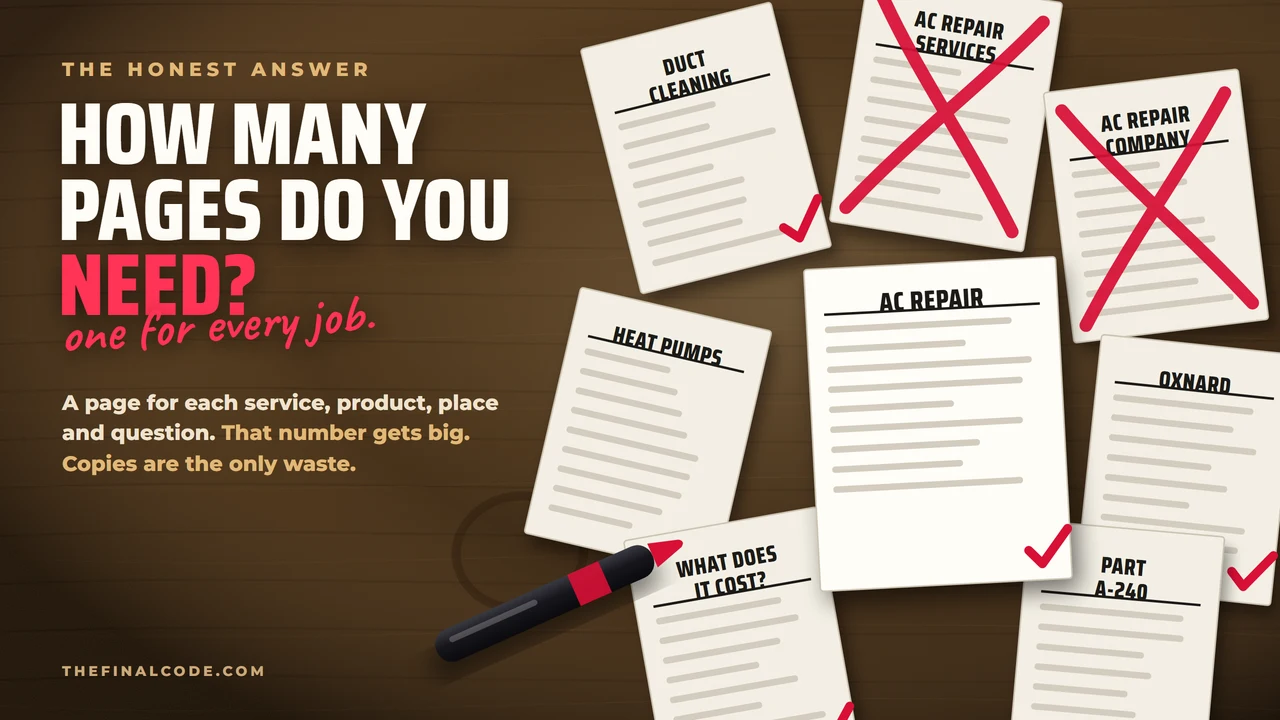 How Many Pages Do You Need to Rank? One for Every JobOne page for every genuinely different thing you sell, do, serve or get asked about. For some businesses that is a dozen. For others it is thousands. What it is never is the same page written four ways.Read it
 No. We do not hold anyone to a contract, and we never have. The work should keep your business, and the month it stops doing that you should be free to stop paying for it.
Yes. Superlok USA is one: 294 search terms in 2024, more than 10,000 today, and its case study shows the working.
Ads move this week. Search compounds: reachable spec terms land first, and every ranking page keeps earning on top of the last. Anyone promising page one by Friday is selling you a story. We tell you which terms are which up front.
Yes, by splitting the search ground rather than bidding against your own channel. Your site takes early research: how to spec it, which standard applies. Distributors keep the buy-now, in-stock queries. You catch the engineer first and still feed your partners.
The number comes in writing, scoped in hours, before you commit to anything. The report tells you what the work is; the quote tells you what it costs; you decide with both in hand.
Yes, and we would rather. On a video call, or in person if you are near Ventura, California, or out on Long Island, New York. You get the report either way, whether or not you hire us.
“A term with ten searches a month can be ten engineers with live projects. Volume is the wrong number when one quote covers a year of work.” The Final Code
Tell us the company and we do what we did for Superlok USA: pull the part numbers and spec phrases your buyers type, show which you own, and name the pages to fix first. No charge, no pitch, yours to keep either way.
Somebody is searching for exactly what you make, right now.
Get named in ChatGPT
  Perplexity
  Claude
  Gemini