Is Wix or Squarespace Bad for SEO?
A lot of small businesses in Santa Barbara run on Wix or Squarespace. Florists, photographers, studios, boutiques, wedding vendors. And sooner or later somebody tells them the reason they are not on Google is the platform. As an SEO company in Santa Barbara, here is our honest answer: usually, it is not.
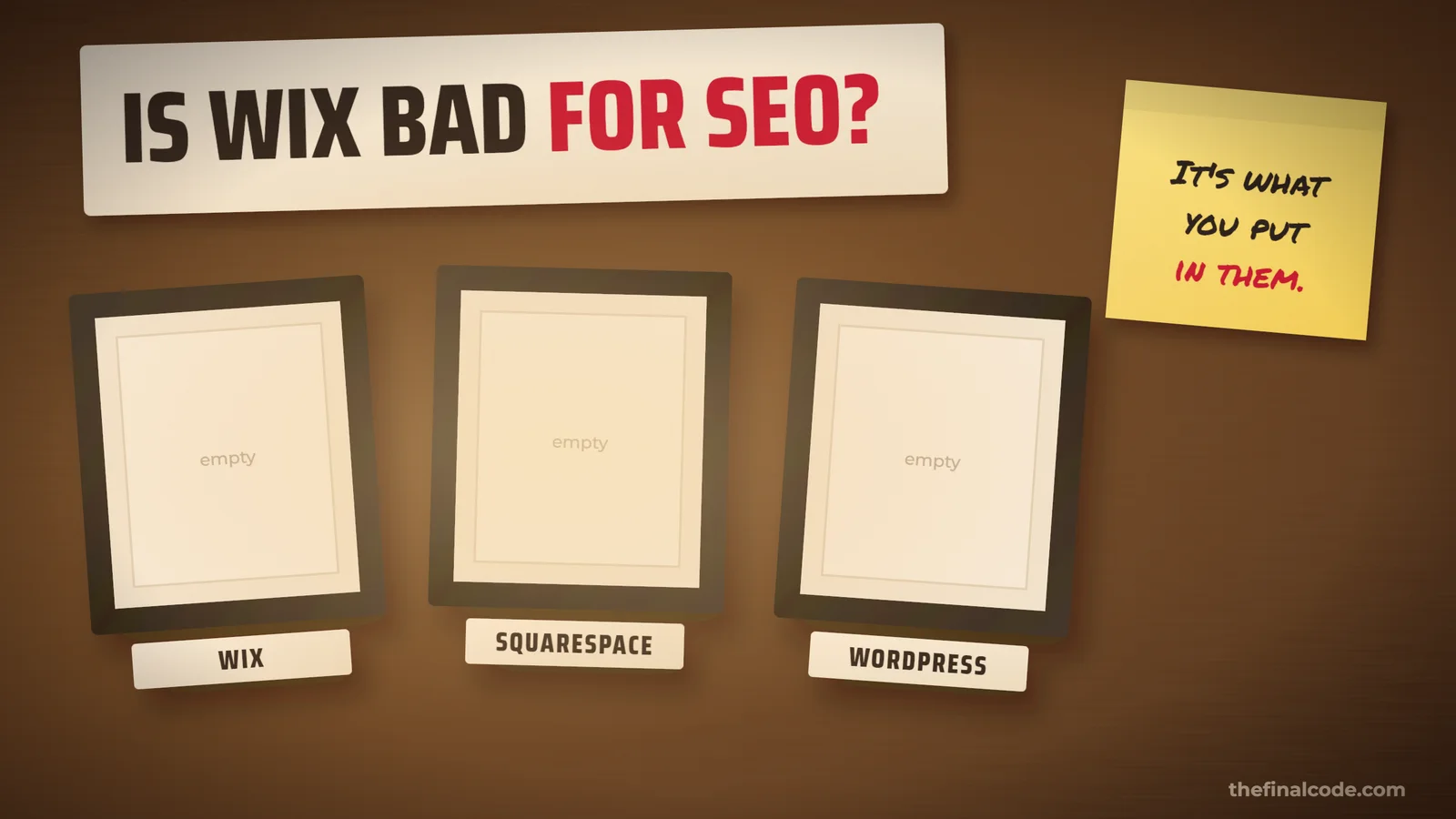
The builder is the lot. What Google ranks is the house you put on it.
Google reads the same things on every platform
When Google looks at a page, it does not care what built it. It reads the title, the words on the page, the headings, the descriptions of the images, and whether there is a page that answers the search at all. Google’s own starter guide says that on a content management system, which is what Wix and Squarespace are, you often do not need to touch anything technical.
If you use a CMS, you might not need to do anything technical to your titles, beyond just focusing on writing good titles.Google Search Central, SEO Starter Guide
“Beyond just focusing on writing good titles.” That is the whole story in one line. The box is there on every platform. The question is what you type in it.
| What Google reads | Wix | Squarespace | WordPress | Who writes it |
|---|---|---|---|---|
| Page titlesThe blue headline in the results | ✓ | ✓ | ✓ | YOU |
| DescriptionsThe two lines under it | ✓ | ✓ | ✓ | YOU |
| Headings and wordsWhat the page actually says | ✓ | ✓ | ✓ | YOU |
| Image descriptionsAlt text, so Google knows what the photo is | ✓ | ✓ | ✓ | YOU |
| A page for every serviceAdd as many pages as you need | ✓ | ✓ | ✓ | YOU |
Every one of these platforms has a place for every one of these things. None of them fills it in for you.
So when a site on Wix is invisible, it is almost always because the titles say “Home” and “Services”, the pages are three photos and a phone number, and there is one page trying to cover everything the business does. Moving that site to WordPress moves the same problems to a new address.
Where builders really do get in the way
That does not mean the platform never matters. It matters more as a business grows, and there are a few honest places where a builder can start to pinch.
- Heavy templatesBig image sliders, video backgrounds and animation look great in the demo and can make a page slow on a phone. That one is fixable on any platform, and we covered it in whether a slow website costs you rankings.
- Less control underneathA builder decides some of the technical details for you. For most small sites that is a blessing. For a big catalog or an unusual setup it can become a wall.
- Hard to leaveMoving off a builder means rebuilding the pages, and done carelessly that can throw away what the old site had earned.
- Lots of products, lots of pagesA business with a large catalog, parts lists or complex search usually outgrows a template and needs a site built for the job.
So should you switch?
Probably not yet. If your site is small, the first move is almost never a new platform. It is better titles, a real page for each service, words that match what your customers type, and photos with descriptions. Do that on the platform you already have, and see what moves.
Switch when the platform is what stops the work, not before. When that day comes, the move itself has to be handled with care, which is the whole subject of whether to rebuild your website or fix the one you have. And when a business has outgrown a template entirely, that is where our websites and ecommerce work comes in.
Send us your website, whatever it is built on. We will show you what Google sees today, what is missing, and whether your platform is part of the problem or just getting blamed for it. No charge, and no obligation. Or call or text 805.243.8321.
Get My Free Visibility ReportGoogle does not rank platforms. It ranks pages that answer the search. Build those, wherever you build, and you are doing the part of SEO that actually counts.