Can You Have More Than One Google Business Profile?
A physical therapist in Hauppauge signs a lease on a second office in Smithtown. By the end of the week she has three questions written on a sticky note. Does Smithtown get its own Google listing? Should each of her therapists have one? And her front desk wants to know why they can’t just add a “sports injury” profile while they’re at it. Can you have more than one Google Business Profile? Yes, when each one stands for something real: a staffed location, a public-facing department, an individual practitioner, or a brand that operates on its own. No, when it stands for a service, a town you drive to, or an address where nobody works.
Owners ask us this right before they expand, which is the best time to ask. As an SEO agency on Long Island, we would much rather set up a second location correctly than untangle one later. Below are Google’s rules, quoted from its own help pages. Where we’re giving our opinion, we say so.
When does Google allow more than one profile?
Google’s starting point is one. Its guidelines put it as a basic rule: There should only be one profile per business, as this can cause problems with how your information displays on Google Maps and Search.
Then the same page carves out the exceptions, and it names them in a single sentence: There are additional guidelines for multi-location stores (chains and brands), departments, and individual practitioners (such as doctors, lawyers, and real estate agents) below.
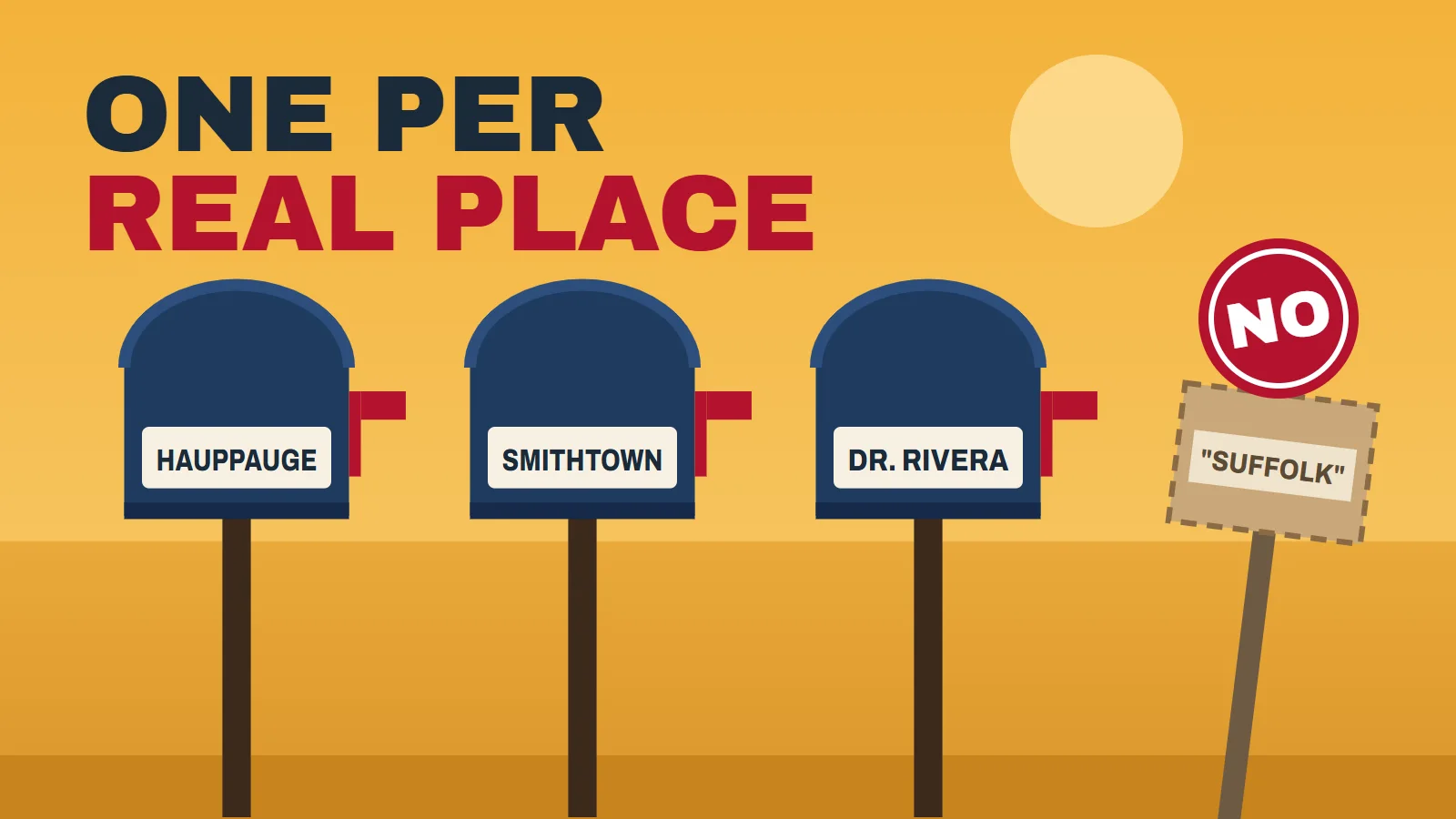
Think of it as a row of mailboxes. Each profile needs a real place, or a real person, behind it.
- Each staffed locationA real address where you serve customers.
- A public-facing departmentDifferent name, different category, operating as its own unit.
- An individual practitionerA doctor, lawyer or agent customers contact directly.
- A brand that runs on its ownTwo independent brands sharing one address.
- Each service you offerServices go on the one profile.
- Each town you drive toTowns go in your service areas.
- A new address after a moveEdit the address on the profile you have.
- An address nobody staffsVirtual offices and unstaffed desks don't qualify.
Our summary. Source: Google Business Profile Help, "Guidelines for representing your business on Google" and "Resolve duplicate profiles & ownership issues."
Does a second office get its own profile?
Yes, if customers can walk in and someone is there to serve them. The guidelines tell you to Create your Business Profile for your actual, real-world location.
A second real location is a second profile. The Smithtown office qualifies the day it opens with staff and a sign on the door.
What Google cares about next is that the two look like one business. Its chain rule is strict on names: All business locations within the same country must have the same name for all locations.
Google’s own example: all Home Depot locations should use the name “The Home Depot” rather than “Home Depot” or “The Home Depot at Springfield”.
So the new office is not “[Your Practice] Smithtown.” It carries the same name as Hauppauge. The one exception is real-world signage: If some of your locations consistently use a different name on their storefront, website, or stationery, these locations can use this different name.
Categories follow the same logic. Google says All locations must also have the same category if they provide the same service.
As we understand it, each new location is verified on its own until you’re large enough to verify in bulk, which we cover at the end. And if you’re moving instead of expanding, Google is plain about it: If your business relocates, do not create a new Business Profile for the new location. Instead, update the existing profile with the new address.
Can a doctor or a department have a separate profile?
Both can, under conditions. Start with practitioners. Google’s definition: An individual practitioner is a public-facing professional, typically with their own customer base.
It lists Doctors, dentists, lawyers, financial planners, and insurance or real estate agents
as examples. Physical therapists aren’t on that list by name. In our view a therapist who sees her own patients fits the definition, but Google doesn’t say so directly.
A practitioner earns a profile by meeting two tests: They operate in a public-facing role.
and They can be contacted directly at the verified location during stated hours.
Google rules out the people behind the counter: Support staff should not create their own Business Profiles.
From there, the answer depends on who else works at that address.
- No: support staffFront desk, billing, assistants. No profile.
- Yes, one of severalThe practitioner gets a profile, and the practice keeps its own.Dr. Jane Rivera
- Yes, the only one, at a brandOne shared profile, brand first.[brand/company]: [practitioner name]
Drawn from Google Business Profile Help, "Guidelines for representing your business on Google," section "Individual practitioners." The name in the middle box is a made-up example.
For a practice with several practitioners, Google’s two rules are: The organization should create a Business Profile for this location, separate from that of the practitioner.
and The title of the Business Profile for the practitioner should include only the name of the practitioner, and shouldn’t include the name of the organization.
The solo rule surprises people. If one agent works alone in a branded office, Google says it’s best for the practitioner to share a Business Profile with the organization.
Its example is “Allstate: Joe Miller”
. One profile, not two.
And one profile per person, not one per specialty: A practitioner shouldn’t have multiple Business Profiles to cover all of their specializations.
The same page shuts out one group entirely: Sales associates or lead generation agents for corporations aren’t individual practitioners and aren’t eligible for a Business Profile.
Departments get their own profile when they act like a separate business. Google’s test: Publicly-facing departments that operate as distinct entities should have their own page.
The name must differ from the main business, and Google adds Typically such departments have a separate customer entrance and should each have distinct categories.
Its acceptable examples include “Walmart Vision Center”
and “Massachusetts General Hospital Department of Dermatology”
. Its unacceptable examples include The hot food bar inside Whole Foods Market
. If you sell cars, Google says Auto dealers have specific and separate guidelines.
Read those before you split sales from service.
What about two brands under one roof?
Pick one name per profile, and only split when the brands truly run apart. Google’s rule: If your business location combines two or more brands, do not combine the brand names into a single Business Profile.
And: If the brands operate independently, you may use a separate profile for each brand at this location.
Google also lists co-located businesses that should each have a profile, such as A Pharmacy inside of a Supermarket/Grocery Store
. Its duplicates page sets the bar for any two businesses sharing an address. They can each have a profile if they’re Distinct businesses with different names and clearly visible differences in signage.
If Google merges them anyway and you appeal, expect to prove it: If both businesses serve customers at the same location, you’ll be asked to provide evidence of permanent signage that clearly shows both businesses.
In our view that signage line is the whole test. If a customer standing in your doorway couldn’t tell there are two businesses, Google won’t believe it either.
If you sell someone else’s brand, the brand doesn’t get a profile at your shop: use only the name of the business, excluding the name of the brand being sold
. The exception is a dedicated franchisee, who may use the underlying brand name when you create the Business Profile.
Can a service business get a profile for each town?
No. Picture an HVAC company in Hicksville that does plenty of work in Suffolk and wants a “Suffolk” listing to show up there. Google’s guidelines say Service-area businesses, or businesses that serve customers at their locations, should have one profile for the central office or location with a designated service area.
Suffolk goes in the service area, not on a second profile.
- Hicksville
- Levittown
- Huntington
- Commack
- Smithtown
- Ronkonkoma
up to 20 service areas based on the cities, postal codes, or other areas you serve.
- A separate location
- A separate service area
- Separate staff at that location
Google's pages disagree. One allows a profile per location with its own staff. Another says a service-area business gets one profile, period.
Town list is our example. Sources: Google Business Profile Help, "Guidelines for representing your business on Google" and "Manage your service areas for service-area & hybrid businesses."
The right column comes from the guidelines: If you have different locations for your service business, with separate service areas and separate staff at each location, you’re allowed one profile for each location.
The disagreement is real, and we’d rather show it than smooth it over. Google’s service-area page says flatly: Service-area businesses can only have one profile for the whole area that they serve.
How we’d read the two together: one shop and one crew get one profile, whatever the map looks like. If the HVAC company opens a real shop in Ronkonkoma with its own techs and its own trucks, the guidelines support a second profile. We’d still expect Google to look hard at it, given the other page.
What won’t work is renting an address to fake the second shop. Google’s line for service businesses: Service-area businesses can’t list a “virtual” office unless that office is staffed during business hours.
If you want to be seen in towns your profile doesn’t reach, paid search is the honest route. In our view that’s where Google Ads management earns its keep for service businesses, and Google notes You don’t need a verified account to run Google Ads location assets.
We’ll say it plainly. Some companies sell a “profile in every town” package. When those profiles get flagged, the owner usually learns what was bought only after the calls stop. BSEO is you not knowing what you bought.
What happens to the profile Google calls a duplicate?
Google is direct about the risk: Multiple profiles for the same business may mislead your customers and are against our policies.
Its duplicates page lists the triggers, including Multiple profiles have the same address.
and Multiple profiles exist for the same business that offer different services.
That second one is the “sports injury” profile from the sticky note. Google’s fix is to keep one profile: If you offer different services at your business, do not create separate Business Profiles for each service.
- Your situationWhat Google says
- You made a second one by mistake
If you created a duplicate profile by mistake, you can remove it without affecting your verified listing.
- Two copies of your business are on MapsRequest a merge through Google Maps.
All merge requests are subject to review.
- Google merged two real businessesAppeal through support.
both businesses must be eligible and distinct from one another.
- You opened a profile per servicePut the services on one profile instead.
Source: Google Business Profile Help, "Resolve duplicate profiles & ownership issues."
Two warnings from that page before you delete or merge anything. On removing: When you remove a duplicate profile, all content and linked managers will be removed, so make sure to remove the correct profile.
On merging: When 2 profiles are merged, their reviews are combined, but replies to reviews may be lost.
In our view the profile to keep is almost always the older one with more reviews, and we’d screenshot the replies on the other before a merge.
How do you run five, or fifty, locations?
With a business group. Google describes it simply: It’s like a shared folder for your profiles.
Once you have two profiles, the option appears: If you have 2 or more profiles, at the top right, select Create group.
Who gets in matters, because When you add another user, like a co-worker or agency employee, as a manager or owner to the business group, they can access all current and future profiles placed in the group.
At ten locations, bulk verification opens up. Google’s condition: Your spreadsheet has 10 or more profiles from the same business.
A few rules come with it. Duplicate, suspended, or disabled profiles don’t count towards the 10 Business Profile minimum.
Service businesses are out, since the business must not be a service-area business.
Agencies can’t pool clients: Agencies with more than one business in one account can’t bulk verify.
And Google checks your count against reality: The profiles added to your account must accurately reflect the size of your business.
Getting the structure right is most of the work. Matching names, matching categories, one profile per real place. That’s the base our local SEO work builds on for multi-location clients. In our view it matters past Maps, too. When someone asks an AI tool which practice nearby takes walk-ins, a clean set of profiles gives it one clear answer per location, which is where AI search visibility starts.
Sources: Google Business Profile Help, "Guidelines for representing your business on Google," "Resolve duplicate profiles & ownership issues," "Manage your service areas for service-area & hybrid businesses," "Create & manage business groups" and "Verify Business Profiles in bulk." All checked in November 2026.
Tell us your locations, your staff and the towns you serve. We'll tell you which profiles Google's guidelines support, which ones put you at risk, and how you compare with the businesses that outrank you nearby. No charge, and no obligation. Or call or text 805.243.8321.
Get My Free Market AssessmentWhen every profile matches a real place, SEO built around each location can do its job.