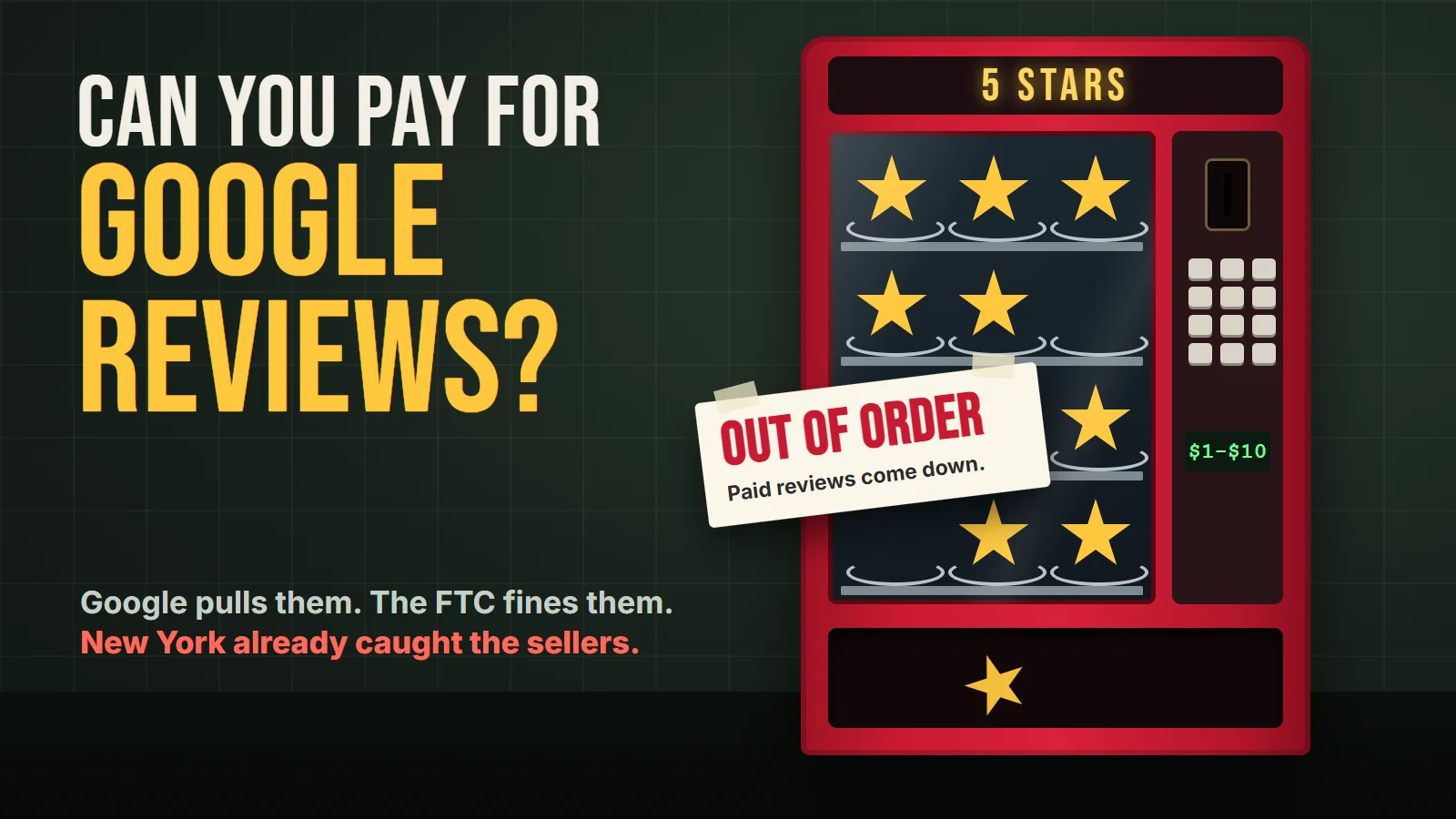
Can You Pay for Google Reviews?
The owner of a pool service in Smithtown opens an email on a slow Tuesday in November. “Real reviews from real accounts. Fifty five star reviews by the end of the month. Safe, guaranteed, no drops.” His competitor down the road has three times his reviews, and he’s been wondering how. Ten minutes later his office manager suggests something smaller: a card in every invoice, 10% off the spring opening for anyone who leaves a Google review. Can you pay for Google reviews? No. Google removes any review a business paid for, and it counts a discount, a free service or a gift card as payment. Buying fake reviews also breaks federal law, and New York’s Attorney General has already fined SEO companies for selling them.
Review schemes come up in almost every first call we have as a Long Island SEO firm, usually as “my competitor must be buying them.” Below are the rules from Google’s own policy pages, the FTC’s rule on consumer reviews and the New York Attorney General’s case files, quoted word for word. Where something is our opinion, we say so.
Is it legal to pay for Google reviews?
There are two rulebooks here, and they don’t draw the line in the same place. The FTC decides what’s illegal. Google decides what stays on Google. Google’s line is stricter.
On the federal side, the FTC’s rule on consumer reviews took effect in October 2024. It makes it an unfair or deceptive practice for a business to provide compensation or other incentives in exchange for, or conditioned expressly or by implication on, the writing or creation of consumer reviews expressing a particular sentiment, whether positive or negative
. So paying for five stars is out. Writing or selling a review that misrepresents That the reviewer or testimonialist exists
, or that they ever used the business, is out too.
Google doesn’t care about sentiment. Its tips page for owners says: Offering incentives, like free or discounted goods or services, in exchange for customers to post reviews, change reviews, or remove negative reviews is considered fake & misleading content and is strictly prohibited.
Its content policy puts Reviews or ratings that have been paid for, directly or in kind
on the list of fake engagement that is not allowed and will be removed.
- The offerFTC ruleGoogle
- Buying reviews from people who never hired youIllegalRemoved
- A gift card for every five star reviewIllegalRemoved
- 10% off for any honest review, good or badDisclose itRemoved
- Your manager reviewing the business without saying soIllegalRemoved
- Asking every customer, with nothing attachedFineFine
Our summary, not legal advice. Sources: 16 CFR Part 465, sections 465.2, 465.4 and 465.5; 16 CFR 255.2, Example 9; Google Business Profile Help, "Tips to get more reviews"; Maps User Generated Content Policy Help, "Prohibited & restricted content."
That middle row is where most owners get caught. The FTC’s guides on endorsements say that if a business did not require the reviews to be positive and the reviewers understood that there were no negative consequences from writing negative reviews, a clear and conspicuous disclosure of the material connection would be appropriate.
In other words, federally, a discount for an honest review can be legal if the review says so. Google still removes it. Its policy bans offering incentives in exchange for posting any review
, and the word that matters is “any.”
What counts as paying for a review?
More than cash. The FTC’s rule defines it: to purchase a consumer review means to provide something of value, such as money, gift certificates, products, services, discounts, coupons, contest entries, or another review, in exchange for a consumer review.
Source: 16 CFR 465.1(m).
Two on that list surprise people. “Contest entries” covers the monthly drawing for a free detail or a $50 gift card among everyone who left a review. “Another review” covers the swap: the plumber and the electrician who agree to review each other. Neither one feels like buying, and both are on the FTC’s list. Google’s version, Offer incentives – such as payment, discounts, free goods and/or services - in exchange for posting any review or revision or removal of a negative review
, covers the same ground.
The last half of Google’s sentence matters too. Offering a refund if a customer takes down a bad review is paying for a review. So is the free return visit that comes with “and maybe you could update your review.”
Can you pay your staff to collect reviews?
You can ask them to hand out the link. Google draws lines around how. Its policy names these as rating manipulation:
- Quotas.
Merchants requesting that staff solicit a certain number of reviews
- Name drops.
Merchants requesting that staff solicit reviews that include specific content, including content that identifies a staff member.
- The counter ask.
When soliciting reviews, merchants should not require or pressure users to leave ratings or write reviews while on the premises, nor should they request that specific content be included.
- Picking the happy ones.
Discourage or prohibit negative reviews, or selectively solicit positive reviews from customers
That second one catches a lot of good businesses. “If you liked Jake, mention him by name!” on a receipt is a request for specific content that identifies a staff member. A bonus for the tech with the most reviews that month is a quota with money on it. Our advice is to tie any bonus to the job, not the review.
Reviews from staff and family are their own problem. Under the FTC rule an officer or manager can’t write a review of their own business that fails to have a clear and conspicuous disclosure of the officer’s or manager’s material relationship to the business
, and managers who ask relatives or employees to post reviews take on the same disclosure duty. Google goes further: its policy bars content based on a conflict of interest, which can include current or former employment and family ties, whether or not anyone discloses it.
New York already caught SEO companies doing this
In a year-long undercover investigation, people from the New York Attorney General’s office posed as the owner of a yogurt shop in Brooklyn with bad reviews and called SEO companies for help. The office’s release says representatives from some of these companies offered to write fake reviews of the yogurt shop and post them on consumer-review websites such as Yelp.com, Google Local and Citysearch.com, as part of their reputation management services.
- Announced
- September 23, 2013, by the New York Attorney General
- Who
- 19 companies: SEO firms and the small businesses that used fake reviews
- What they paid writers
$1 to $10 per review
, to freelancers overseas- Penalties
ranging from $2500 to just under $100,000
, more than $350,000 in all- Laws cited
- New York Executive Law § 63(12) and General Business Law §§ 349 and 350
Source: New York State Office of the Attorney General, "A.G. Schneiderman Announces Agreement With 19 Companies To Stop Writing Fake Online Reviews And Pay More Than $350,000 In Fines," September 23, 2013.
It wasn’t only the SEO companies. A laser hair removal business with locations in the tri-state area hired an SEO company that posted fake reviews and, in the release’s words, instructed employees and friends to write fake reviews on consumer-review websites.
It also offered discounts on services in exchange for online reviews, without requiring the customer to disclose the gift in the review.
Another firm ran a “secret shopper” campaign
where reviewers got free or discounted service and were encouraged to post only if they were positive
.
The Attorney General’s office put it plainly: So-called search engine optimization (“SEO”) companies routinely offer online reputation management as part of their services.
That was 2013. The emails haven’t stopped. If an agency’s reputation plan can’t tell you where its reviews come from, that’s BSEO, and BSEO is you not knowing what you bought.
What does a bought review end up costing?
More than the invoice. In rough order, from what happens most often to what happens least:
- The reviews come downGoogle's policy says paid and incentivized reviews
are not allowed and will be removed from Maps.
- The profile stops collectingGoogle can block a profile from receiving
new reviews or ratings for set period of time
and unpublish the ones it has. - Customers see a warningOne listed restriction:
Business Profile will display a warning to let consumers know that fake reviews were removed
. - A regulator gets involvedThe FTC can seek civil penalties against knowing violators of its review rule, up to $53,088 for each violation at current rates. New York's Attorney General uses state false advertising law.
Sources: Maps User Generated Content Policy Help, "Prohibited & restricted content"; Google Business Profile Help, "Business Profile restrictions for policy violations"; FTC press release, "Federal Trade Commission Announces Final Rule Banning Fake Reviews and Testimonials," August 14, 2024; 16 CFR 1.98(d).
Step three is the one we’d lose sleep over. A missing batch of reviews is invisible to customers. A warning on the profile is the first thing they read, and it sits right above your phone number.
There’s also a cheaper way to lose. If you’re paying to be seen on Google, pay Google. That’s what ads are for, and spending on Google Ads management gets you a placement nobody can take back for breaking a policy.
How do you get more Google reviews without paying?
Ask everyone, every time, with nothing attached. The FTC rule spells out that its limits on bought and insider reviews don’t apply to reviews that come from a business making generalized solicitations to purchasers to post reviews or testimonials about their experiences
. Google’s policy describes the same thing as what owners should do: Solicit or encourage the posting of content that does represent a genuine experience, without offering incentives to do so or attempting to influence the rating or the contents of the review.
Google’s tips page gives the mechanics: To leave reviews, you can ask customers to visit a Google link or scan a QR code.
A message like this, sent to every customer after every job, is all it takes:
Hi Maria, thanks for having us out to open the pool today. If you have a minute, we'd appreciate a review of how it went: g.page/r/your-link. Any feedback helps. Tom, Pinecrest Pool Care
Illustration only. The business, names and link are made up.Notice what it leaves out: no star count, no “if you were happy,” no staff name to mention, no offer. It goes to the customer who complained about the cover, too. Google’s tips page backs that up: A mix of positive and negative feedback often feels more trustworthy.
Then make the ask easy to act on. Put the QR code on the invoice, the truck magnet and the leave behind. And give people something real to talk about. A short video of the finished job from our content and video work is a testimonial you can show on your own site. The FTC’s guides still apply to it: it has to be a real customer describing what really happened, and if they got anything for it, the video should say so.
Should you hire a company that promises reviews?
Only one that can’t promise a number. A legitimate review program sets up the asking and leaves the rating to the customer. So before you sign, ask three questions:
- Who writes the reviews? If the answer is anyone but your customers, stop there.
- Is there a guarantee on count or stars? Nobody can guarantee what a real customer will write.
- Will anyone be offered anything? A gift card, a drawing, a discount or a review swap all count.
Reviews are one piece of local SEO, and Google’s own ranking page lists them: More reviews and positive ratings can help your business’s local ranking.
The way to get more is boring, and it works because it’s boring. Every customer, the same link, every week.
Sources: Federal Trade Commission, Rule on the Use of Consumer Reviews and Testimonials, 16 CFR Part 465 (89 FR 68077, August 22, 2024), sections 465.1, 465.2, 465.4 and 465.5, via eCFR; FTC, Guides Concerning the Use of Endorsements and Testimonials in Advertising, 16 CFR 255.2; 16 CFR 1.98; FTC press release, August 14, 2024; Google Business Profile Help, "Tips to get more reviews," "Business Profile restrictions for policy violations" and "Tips to improve your local ranking on Google"; Maps User Generated Content Policy Help, "Prohibited & restricted content"; New York State Office of the Attorney General press release, September 23, 2013. All checked November 9, 2026. This is not legal advice.
Send us your business name and the town you work in. We'll look at your Google reviews next to the businesses that outrank you, tell you whether their counts look earned, and show you where your next fifty honest reviews should come from. No charge, and no obligation. Or call or text 805.243.8321.
Get My Free Market AssessmentHonest reviews build slowly, and SEO built on real work is what turns them into calls.