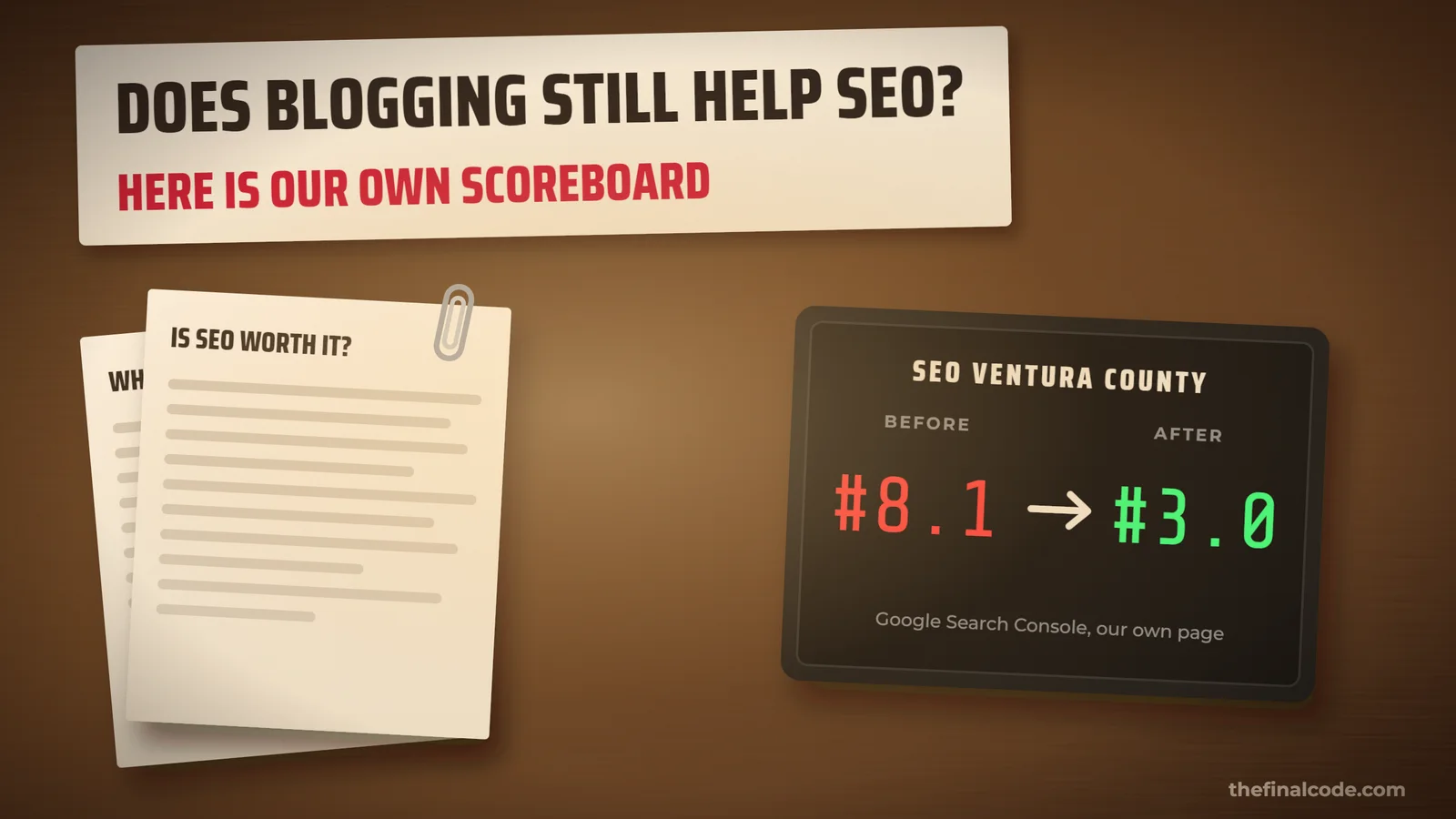
Does Blogging Still Help SEO? Here Is Our Own Scoreboard
Every few months somebody announces that blogging is dead. Usually it is somebody who stopped blogging. As an SEO company in Ventura County, we would rather show you numbers than argue, because we have been running the experiment on ourselves.
Our own scoreboard, straight from Google
Our Ventura County SEO page
Google Search Console, average position for our Ventura County SEO page, September 11 to 27 against September 28 to October 14, 2026. Lower is better: 1 is the top of the page.
Over that stretch the blog kept publishing, and 22 of the 40 posts in the run link to that Ventura page. The page climbed on every one of the searches above.
What that scoreboard does not prove
We could stop there and let you assume the blog did all of it. It would be a better sales pitch and a worse answer. So here is the fine print.
- The page was new too. It only started showing on Google around September 11, and young pages move around on their own.
- Google has not counted every post yet. 7 of those 22 posts were not in Google's index when we pulled the numbers, so their links have not been seen.
- Rankings move for more than one reason. We are not claiming the blog did it alone. We are telling you the page climbed while the posts went out, which is what a blog is supposed to help do.
Why blogging helps when it is done right
A good post earns its keep two ways. The first is that it gets found for its own question. Our post “What Is SEO Consulting?” showed up in Google searches 1,102 times, with an average position of 12.8 for “seo consulting”. “10 Questions to Ask Before You Hire an SEO Company” showed up 403 times. Same source, Search Console, September 1 to October 15.
Google says plainly which part of SEO matters most, and it is the part a blog is made of.
Creating content that people find compelling and useful will likely influence your website's presence in search results more than any of the other suggestions in this guide.Google Search Central, SEO Starter Guide
The second is that every post is a door to the page you actually want people on. The same guide notes that “the vast majority of the new pages Google finds every day are through links”. A post that links to your service page is telling Google where the important page lives, which is the whole idea behind internal links.
Here is what a post that pulls its weight looks like.
- A title that is a real questionThe words a customer would actually type.
- The answer up topIn the first paragraph, not after three about your history.
- One link to the page that sellsThe post answers; the service page closes.
- Proof from your own workA photo, a job, a number you can stand behind.
- A source anyone can checkIf it is a fact, say where it came from.
Why most business blogs do nothing at all
- The company picnic postNice day, lovely photos, and nobody has ever searched for it.
- Three posts in 2019, then silenceA blog that stopped tells a visitor the business might have too.
- No links to anythingEvery post is a dead end, so none of it helps the pages that make money.
- Fifty posts of generic fillerCopied ideas with nothing of yours in them. We covered why in whether Google penalizes AI content.
How often should you post?
Often enough to keep answering. We publish every day because we are testing it on ourselves, and most local businesses do not need that pace. One genuinely useful answer a week, linked to the right page, beats seven posts nobody needed. Writing the blog is one piece of the digital marketing we do; the pages it points at are the other.
Send us your website. We will look at what your posts actually show up for, which ones link to the pages that make you money, and which questions your customers are asking that you have not answered yet. No charge and no obligation. Or call or text 805.243.8321.
Get My Free Visibility ReportBlogging is not dead. Blogging without a reason is. Answer the questions your customers ask, point every answer at the page that sells, and keep going. That is still how SEO gets built.