Does Google Penalize AI Content? What Google Actually Says
If you have asked ChatGPT to write a blog post for your business and then sat there wondering whether Google will punish you for it, you are in good company. As an SEO company in Santa Barbara, we would rather show you what Google actually wrote than hand you our opinion, so here it is.
The short answer is no, and Google put it in writing
Rewarding high-quality content, however it is producedGoogle Search Central Blog, Google Search's guidance about AI-generated content
That is a heading Google chose for its own guidance on AI content. Further down the same page, it answers the question head on.
Appropriate use of AI or automation is not against our guidelines.Google Search Central Blog, same page, in its questions and answers
Not against the guidelines. Nothing in that guidance says a page loses points because a machine helped write it. Google is asking the same question it has always asked: does this page help the person who searched?
Who typed it is the wrong question
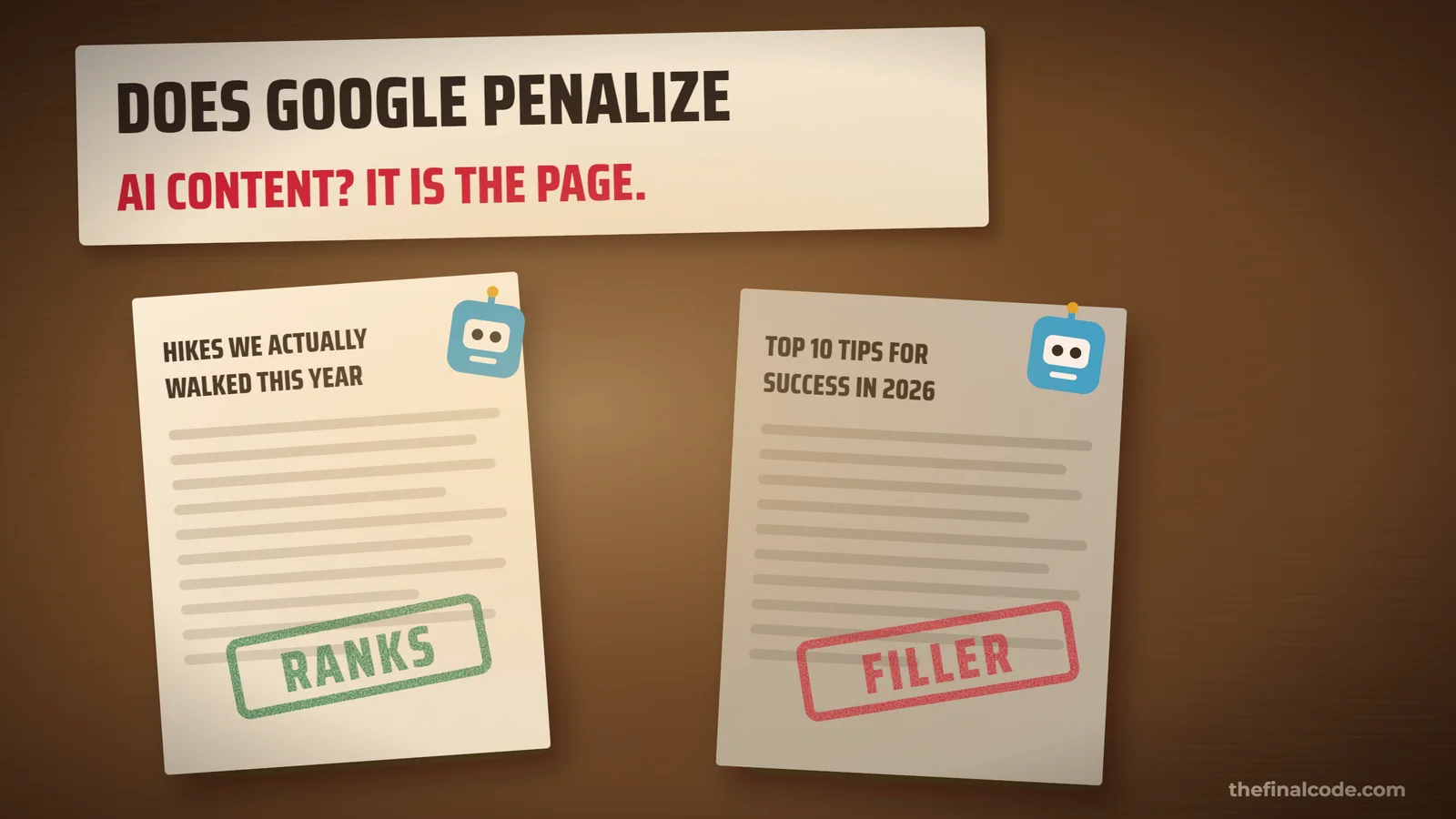
Picture every page on the internet sorted two ways. Across the top, who wrote it. Down the side, whether it is worth reading.
Read it down, not across. The row decides; the column does not.
A lazy page written by a person sinks just like a lazy page written by a bot. A genuinely useful page has a shot either way. The tool was never the problem. The filler was.
What actually gets you in trouble
Google does have a line, and it is drawn around what a page is for, not who wrote it. Its spam policies call it scaled content abuse.
Scaled content abuse is when many pages are generated for the primary purpose of manipulating search rankings and not helping users.Google Search Central, Spam policies for Google web search
The same policy adds three words that settle the whole debate: “no matter how it’s created.” Here is what crossing that line tends to look like for a small business.
- Pages by the hundredGoogle lists this one by name:
Using generative AI tools or other similar tools to generate many pages without adding value for users
. - Town pages that only swap the city nameFifty copies of one page with Goleta, Montecito and Carpinteria dropped in. We covered why that backfires in whether Google penalizes duplicate content.
- Facts nobody checkedAI tools can state a wrong price, a wrong law or a made-up statistic with total confidence. Your name is on the page, not the tool's.
- Posts that say what everybody saysTen tips anyone could have written, with nothing from your own work in them. Nobody needs a fifty-first copy.
How to use AI without getting burned
- Let it draft, never let it decideAn outline, a first pass, a cleaner sentence. That is a fair job for a tool.
- Add what only you knowThe job you finished last week, the question a customer asked at the counter, the photo you took on site. No AI has those.
- Check every fact and every numberIf you cannot point to where it came from, it comes out.
- Put a real person behind itExperience and expertise are what Google looks for, which we unpacked in why Google trusts some businesses more.
- Read it out loudIf it sounds like a brochure nobody would say to a customer's face, rewrite it until it sounds like you.
One more thing worth keeping separate. Whether AI helped write your page is one question. Whether ChatGPT and Google’s AI answers name your business when somebody asks is a different one, and it is the one we work on in AI search visibility.
Send us your website. We will look at the pages you are counting on, tell you which ones Google is likely to see as thin, and show you what to add so they earn their place. No charge and no obligation. Or call or text 805.243.8321.
Get My Free Visibility ReportUse the tool. Just do not let it be the only thing on the page. A page full of what only you know is good SEO, whoever typed the first draft.