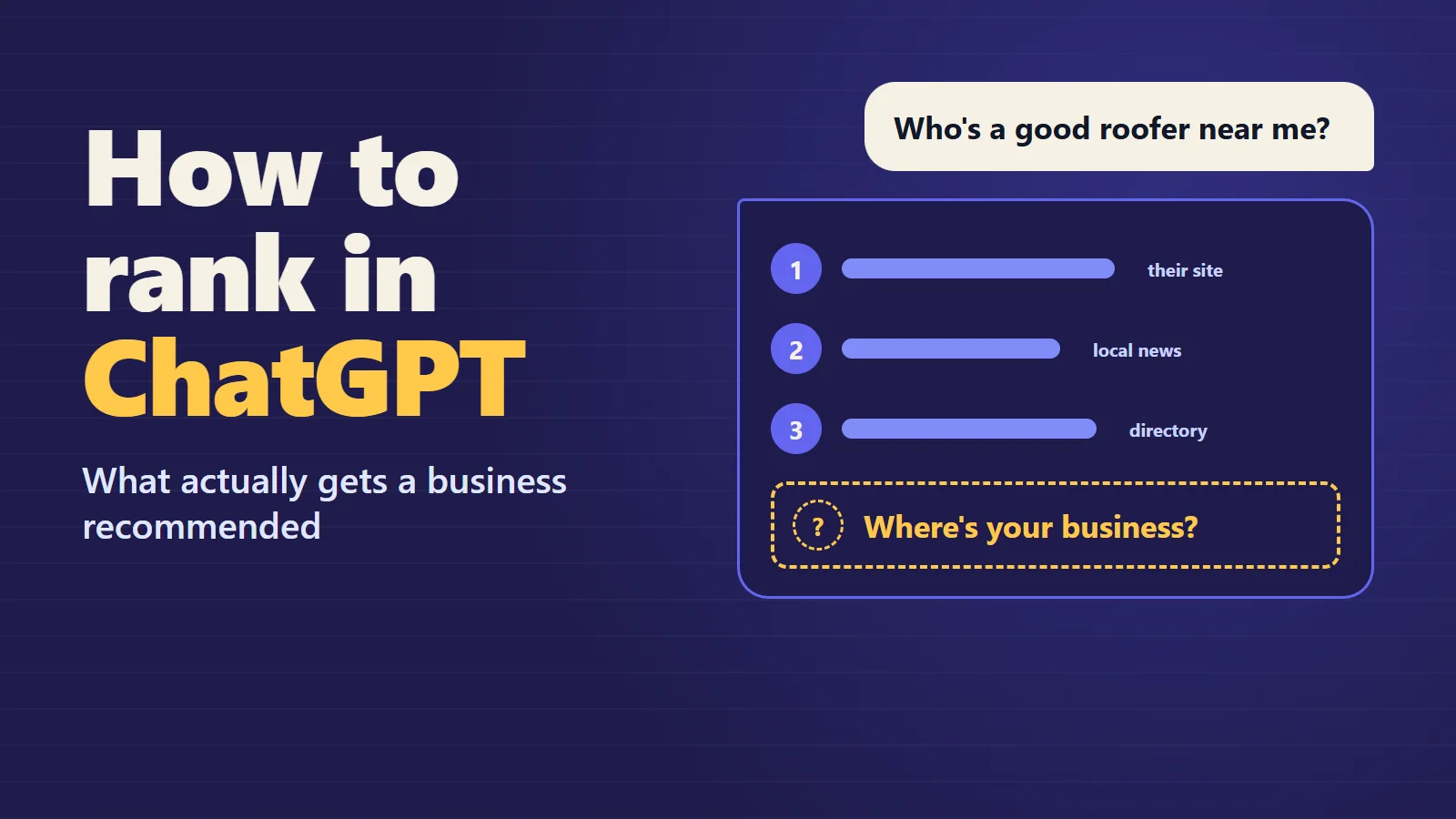
How to Rank in ChatGPT: What Actually Gets a Business Recommended
It usually happens late at night. You type your own trade and your own town into ChatGPT, the way a customer would, and it answers with a tidy little list. Three businesses, a sentence on each, a few sources underneath. None of them is you. One of them opened last year.
The next morning there is an email in your inbox offering to get you “ranked in ChatGPT.” Before you answer it, it helps to know how the thing actually picks names. We do search marketing for Long Island businesses and for companies all over the country, and this is the question we get most right now. So let’s take it apart using what OpenAI says itself.
The promise ChatGPT won't make itself
OpenAI’s help page on searching the web with ChatGPT has a section called “Make your website available in search results.” It is two sentences long:
“ChatGPT ranks search results using multiple factors intended to help users find relevant, reliable information. Placement is not guaranteed.”
OpenAI Help Center, “Searching the web with ChatGPT,” checked October 2026If the company that builds ChatGPT won’t guarantee your placement, an agency can’t either. And there is a second problem with “ranked.” In a study published in January 2026, Rand Fishkin of SparkToro and Patrick O’Donnell of Gumshoe had about 600 volunteers run the same 12 prompts 2,961 times through ChatGPT, Claude and Google’s AI. Their finding: “there’s a <1 in 100 chance that ChatGPT or Google’s AI, if asked 100X, will give you the same list of brands.” The same order was closer to 1 in 1,000.
So there is no fixed number-one spot to buy. There is only how often you show up when people ask. A pitch that promises a position is selling something that does not exist. That is BSEO in its newest suit: you not knowing what you bought.
What happens between the question and the answer
When ChatGPT searches the web, it doesn’t send your customer’s words anywhere as typed. OpenAI says it “typically rewrites your query into one or more targeted queries” and sends them to search providers. Its own example: someone asks for “good restaurants near me,” ChatGPT works out from the IP address that they’re in San Francisco, and searches “top restaurants San Francisco.” The providers it names on that page are Microsoft and Shopify. Then it reads what comes back and writes the answer, with citations.
- The question
who's a good roofer near meTyped by your customer, in their words, not yours. - The rewrite
best roofing contractor Huntington NYChatGPT adds a rough location from the IP address and turns the question into search queries. - The search
search providers + OAI-SearchBot's own crawlResults come back. Pages ChatGPT cannot crawl are not in the running. - The part you influenceThe pages it readsYour website, what other sites say about you, the directories that list you. This is where the answer comes from.
Built from OpenAI's help page on searching the web with ChatGPT. The two queries are our illustration of the pattern in OpenAI's own restaurant example.
Notice what is missing from that trip: a place to pay. OpenAI’s shopping help page says product results “are selected independently by ChatGPT and are not ads.” Ads in ChatGPT exist, but OpenAI keeps them separate from the answer.
Which pages get read and quoted
The best look at local answers we found comes from BrightLocal. In November 2024 its team ran 800 local business searches in ChatGPT, across 20 industries and 20 US cities, and logged the first ten sources on each. Business websites were 58% of the sources. Mentions of businesses on other sites were 27%. Directories were 15%. For ready-to-buy searches, as opposed to how-to questions, business websites made up 72%.
It’s an older snapshot and ChatGPT has changed since, so treat the shares as a sketch, not a law. But the shape is the useful part: your own website is the single biggest thing ChatGPT reads, and the rest is what other people publish about you. From the customer’s side, it looks something like this:
A few local options that do full replacements:
- Company A handles tear-offs and re-roofs across Huntington and Northport.companya.com
- Company B was profiled for its storm work last winter.local news
- Company C lists asphalt and metal replacements with written warranties.companyc.com
Not named: the company whose site says "serving the area" and never names a town.
An illustration, not a real answer. The green sources are pages the businesses wrote themselves.
How can I improve my brand's visibility in ChatGPT?
Five moves. None of them needs a secret method, and every one of them leaves something you can look at.
- Let OAI-SearchBot in.OpenAI's crawler page says "we recommend allowing OAI-SearchBot in your site's robots.txt file." It's separate from GPTBot, which collects training data. OpenAI says "each setting is independent," so you can block training and still be searchable. Changes take about 24 hours to register.
- Say the town, the job and the proof on your own pages.A page per service you want to be named for, with the towns you work in written out, and the facts a customer would ask about: materials, warranties, licenses, how long it takes. That is the page ChatGPT reads when the question is ready-to-buy.
- Get written about where ChatGPT looks.Local news, trade associations, supplier and manufacturer dealer pages. In BrightLocal's data, a quarter of sources were other sites mentioning a business.
- Keep your listings matching.Same name, address, phone and services on every directory and on your Google Business Profile. OpenAI says ChatGPT may get nearby business listings from third-party providers, so the listings feed the answer too. This is plain local SEO, and it still matters.
- If you sell products, feed the catalog.OpenAI says merchants on Shopify are already connected "through Shopify Catalog," and invites other merchants to send it a product feed directly.
If you want someone to do this for you, call it what it is: ChatGPT SEO, with work you can see. And if what you need is a guaranteed spot in front of a buyer this month, that exists too. It’s called an ad, and Google Ads management will put you there while the slower work builds.
The ten-minute test you can run tonight
Because the answers shuffle, one search proves nothing. Fishkin’s own advice is to track how often you appear across many runs, not your position in any one of them.
Write down five questions a real customer would ask, in their words, not yours. “Who fixes flat roofs in Massapequa” beats “best roofing company.” Open a fresh chat for each one, ask it three times, and count how many of the fifteen answers name you. Write down who else gets named, and which sources sit under them. Do it again in a month.
That count is your number. If someone sells you ChatGPT work, it is the number they should be moving, with the same questions asked the same way. If their report shows a “ranking” from a single search, you already know what that’s worth.
Send us your website. We will show you what ChatGPT, Gemini, Copilot and Perplexity answer when somebody asks for what you sell, word for word, who they name instead, and which sources they lean on. No charge, and no obligation. Or call or text 805.243.8321.
Get My Free Visibility ReportChatGPT reads the web and repeats who looks like the clearest, best-documented answer. Being that answer is the same job good SEO always was.