Is SEO Worth It?
If you understand what SEO is and what it does, if you use it right, if you have somebody who actually knows how it is supposed to work, and if you are able to check it correctly, then yes. It is worth it.
Let us do a comparison. There is only one Google. Somebody goes to Google and types: I am looking for a local plumber.
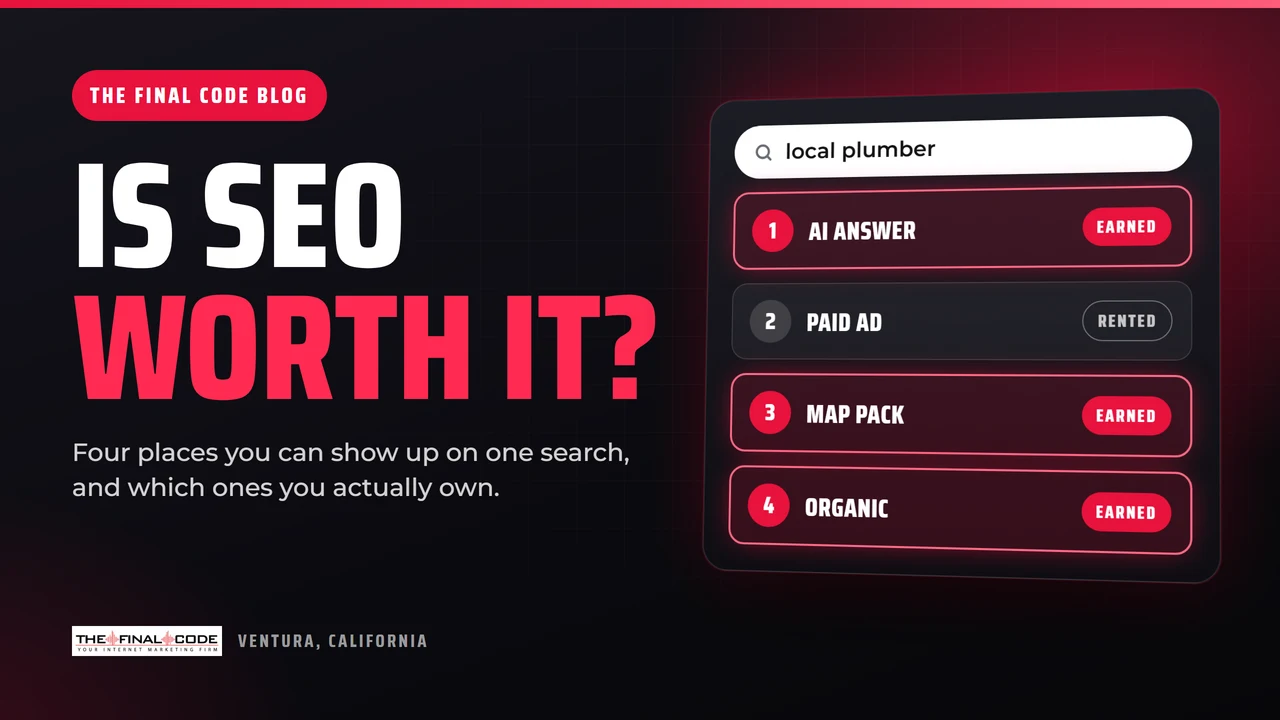
Watch what they see, top to bottom. There are four places you can be.
- 1The AI answerTwo or three names, picked from what it read about you on your site and off it.Earned
- 2The paid adThree lines, paid for every click, gone the day the budget stops.Rented
- 3The map packThree businesses on a map, decided by where the searcher is standing.Earned
- 4The organic resultsWhoever has the best answer for the words that were typed.Earned
One: the AI answer
What is AI? AI is reading SEO. On your site and off it. It assesses everything, compresses it, and says here are the two best choices. Sometimes three.
If you are one of those, you have a good leg up on your competitor before anybody scrolls.
Off your site means your Google Business Profile, your reviews and the directories that list you. On your site means pages that say plainly what you do, where you do it and why somebody should pick you. When those two agree with each other, an AI tool has something solid to repeat. When they do not, it names somebody else. Being one of the names AI gives is built on exactly the same work as ranking.
Two: the pay-per-click ad
This is where you pay a lot of money. Often for a three-line ad, competing against everybody else trying to buy "local plumber" in your city.
These can run up to forty dollars a click. Because people click them, and they call, because they need a plumber right now.
Forty dollars a click. Hold onto that.
An ad is an auction. Every plumber bidding on that phrase pushes the price up for everybody else, and you pay each time somebody taps, whether they call you or hit the back button. Ads have their place, especially while your pages are still earning their way up. Run well, with Google Ads management that watches what every click turns into, they bring calls in this week. But the moment the budget stops, so do you.
Three: the map pack
Very difficult to be in the zone of the exact customer looking for you at that moment. It depends on them being close to your office or your Google Business Profile address. And then they have to Google a word you are actually indexed for in that profile.
So: did you put your SEO in your Google Business Profile too, or not?
Everywhere matters. Every location matters. Location, location, location, because if you are not there, somebody else is. There could be 25 quadrants in a medium-sized city, and you want to show up in all of them.
A quadrant is one point on a grid laid over the city. The same search typed from each point can show a different three businesses, so a company can be first downtown and missing two miles away. That is the work behind Primary Pool Services, a pool company that is now first in 24 of 25 places across Thousand Oaks for "swimming pool service near me."
Four: the organic spot
Where Google puts whoever has the best information for that search term. Organically, meaning you earned it.
What does Google want? Google wants you to keep using Google. Hand you filler and ads every time and you will switch to Bing or DuckDuckGo and off you go.
That is why the organic spot is the one you keep. Nobody bids on it. It goes to the page that answers the question best, and it stays with that page for as long as it is still the best answer.
So what does a good page look like?
Somebody types local plumber. You explain that you are a local plumber. Which cities. Which services. Check out my ratings, people say I am really great at this. I am available 24/7.
Here are the main things people have problems with, all under 24-hour emergency services:
- Clogged toilet
- Clogged sink
- Water heater not working
- Flood
And here are jobs I have actually done.
Now Google says, you know what, that is a good answer. You go here.
Is it worth it? I would have paid forty dollars a click if I had not written that content.
How long would it take to write it?
Well, that is always the problem, isn't it. Because you are too busy. Too lazy. I am not technical. I am not a writer.
But you are the one who does the job. If I ran into you on the street and asked what to do about a clogged sink, you would ramble about it for ten minutes.
Maybe you just need help getting it on the page, because telling those stories is organic. You are placing it in the organic area to get found and qualified by Google, because you wrote more content related to that than your competitors did.
Let them be lazy. Let them make excuses. Let you make the money.
Get up and tell some stories. There are hundreds of terms and hundreds of stories, and your website should show everybody that you have weathered the storm and people still buy from you because you are the best at it.
Now run the ad scenario
You buy an ad. Say five dollars a click. How many people even see it, next to the map, the organic and the AI? Your ad sits there going look at me, look at me.
Finally somebody clicks. And it goes where? Your dusty old web page, because you never made a landing page using the keyword they typed. You lose them right there.
People clicking pay-per-click have the shortest attention span of almost anybody on the internet. So when they land you have to say: look, you found it. Show them a picture and the word. They are in the right place.
You just bought yourself two more seconds. Dance, baby, dance.
Say something useful. Get their attention. Show them you are qualified to handle their problem.
Pay for every visitor, send them to a page that was never written for what they typed, and pay again tomorrow for the next one.
Write the page once, for the words people actually use, and let it keep bringing people in long after the day you published it.
You are going to need a lot of stories
Because there are a lot of terms. So many cultures, education levels and locations that the vernacular is crazy. Ask ten people to search for a pair of red shoes with a leather sole and a white strap and you will get ten different searches.
Do not take the easy way out and just rent a click. Write a good piece of content and it sits there in infamy, your first line of marketing defense.
Or you are not there. And you are invisible.
And eventually you become invisible financially, too.
One last thing
How many clicks do you get from your SEO pages? Have you ever calculated the value of each one the way you do a Google pay-per-click?
Here is how to do it. Open Google Search Console and find how many clicks a page earned last month. Look up what an ad click costs for the same words. Multiply the two. If a page brings in 200 visitors a month for searches that cost forty dollars a click, that page is doing eight thousand dollars of advertising every month, and nobody sends you a bill for it.
In our experience, people pay 20 to 50 times more through pay-per-click to get a customer than they would have if they had just sat down and told a story.
And it takes time. Google said so itself, in its own advice on hiring help:
"In most cases, SEOs need four months to a year to help your business first implement improvements and then see potential benefit."
Maile Ohye, Google, How to hire an SEO
That is the honest trade. An ad works this afternoon and stops the day you stop paying. A page takes months to earn its place and then keeps it.
So is it that difficult?
It is not. Sometimes you just need help. You may know lots of stories and not know how to tell them, or not know how to display them in a way that keeps them funny, or makes them serious, or gives them a deeper touch.
That is what we do all day, every day at thefinalcode.com. See it in our case studies, or on the SEO services page.
Give us a call. It is always a free consultation. If we are not good enough, move along. That is why we do not have contracts.
Do not be the one thing that stops you from getting ahead.
1300 Eastman Ave, Ventura. Tell us the search you would pay forty dollars a click for, and we will show you where you stand on it today and what it would take to own it.