What Is a Content Audit?
A content audit is where you go verify that all of your content is helping you and not hurting you. You check that what you published is relevant to the keywords people use to look for you, and that each piece, when it is representing one of those keywords, is doing a good job. Not just informative. Not drivel. Then you weigh it all out to find out whether you are on track with the amount of content and the type of content your website should have.
Why bother
Because the content on your website is what represents you to the people who might buy from you. Content is king, as they say.
But if you put content on your website and it is drivel, people are not going to read it. Even if Google indexed it.
So why did you do it?
And most of it never gets that far anyway.
Your content should sound like somebody who cares
Anybody running a business should be passionate enough about it to say what they do, why they do it, where they do it, and why they do it better. Do you do it a little bit cheaper? A little bit faster? A little bit higher quality?
There is some niche you believe you bring to this market. Your content should reflect that.
Somebody should look at your content and think: that is the company I have been looking for.
We see the same two things over and over
One. Nobody ever writes any content. They put up a website in 1998 and they are still wondering why people do not look for them.
Two. Their competitors are constantly beating them, posting on social media, talking about this stuff. And the reasons are always the same three. I am too shy. I am technically challenged. I am just too busy, and I never get it done.
And that is why you lose the content battle.
Two scenarios
340 blogs, and a team. That team sits there constantly talking about what is cool about them. They post it on the website, share it on social media, shoot video and put it on YouTube.
They try to shortcut the process and pay a huge bounty instead, marketing through pay-per-click, through Google, for the same terms.
There are lots and lots of giant companies where that is all they do. They generate content all the time about why people should want their product or service. That is why you hear about them, and see them, and know their names.
That is called marketing.
You are constantly letting people know that you are here, that you are available to be bought from, and that you have the best there is.
Here is the thing, though. You cannot take that term and use it in a sentence about your business.
Try this at home
Think about one search term. The one where, if only you could have it, your business would turn around overnight.
Now use that term in a paragraph. About your business.
Go
Having a problem writing this? Now imagine 700 words at least. Then four, five, ten times a week.
But that is what the big companies do. That is why they hire agencies, and why a lot of them carry huge internal staffs just to generate content. Because roughly 14 billion searches will happen on Google today, and that is a bounty of potential clients waiting. You just need to dangle your carrot in front of the right stream.
Not a number we invented. Google said in March 2025 it sees more than 5 trillion searches a year, which works out to about 13.7 billion a day.
It cannot be done overnight, and it cannot be done half-heartedly.
What we look for when we audit
Every page gets read against one question: who was this written for? Google publishes the same test in its own guidance, and it is blunt about it. One of the questions it tells you to ask yourself is "Is the content primarily made to attract visits from search engines?" If the honest answer is yes, Google's advice is to reevaluate how you are creating content. What it says it wants instead is work that is "written or reviewed by an expert or enthusiast who demonstrably knows the topic well". That is a low bar for somebody who actually does the job for a living, and an impossible one for anybody who handed it to a content mill.
Then we look for your pages fighting each other. Three posts about the same service, written years apart, all aiming at the same term. Google calls these duplicate or very similar pages, and its own documentation says to pick one and point the rest at it, with a redirect or a canonical tag.
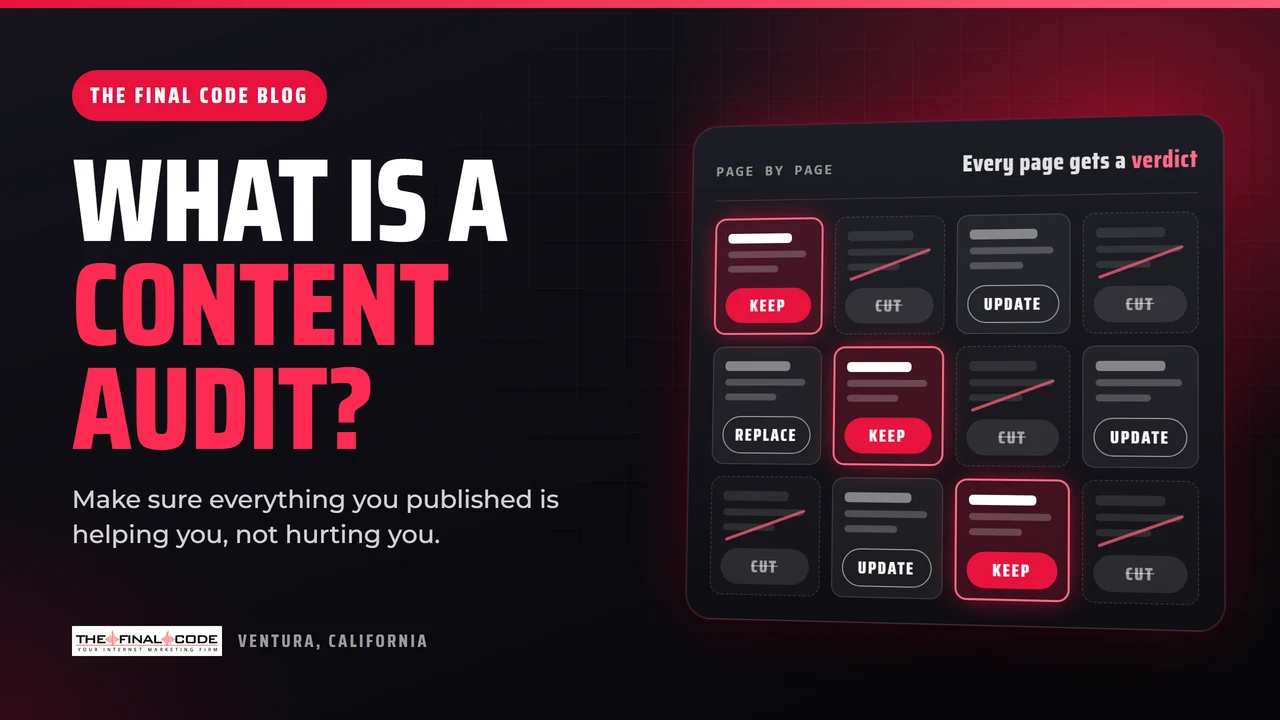
And then we count. How many pages do you have, how many of them earn a click, and how many have not been touched since the year they went up. Every page comes out of that with one of four verdicts, and there are only four.
Check your own content for free
We are not going to send you off to a scanner built to sell you somebody else's content services. Use Google's own tools.
- Google Search Console. Free. Clicks, impressions, click-through rate and average position for every page, plus which pages Google excluded and why.
- The site: search. Type site:yourdomain.com into Google. If that number is far smaller than the pages you have, that is a problem worth a phone call.
That shows you what is happening. It will not tell you what to do about it.
If you do not have a good content plan
Then maybe you should meet with the people at thefinalcode.com. We are very creative about this. We come up with different ways to look at you and different ways to present what you do, for manufacturers and distributors, home service companies, and plenty in between.
We will do competitor comparisons and find out what you are saying versus what your competitor is saying. What could you be saying better about yourself? Where should you be saying it? And how often should you be saying it, in order to get these people to turn their heads and look over here?
See how it turns out in our case studies, including the pool company that went from 40 accounts to more than 200. More on the writing itself under content marketing and SEO.
1300 Eastman Ave, Ventura. Tell us the one term you could not write a paragraph about, and we will tell you what it would take to own it.