What Is Generative Engine Optimization (GEO)? A Plain-English Guide for Business Owners
Generative engine optimization (GEO) is the work of getting your pages quoted and cited when an AI engine like Perplexity, Gemini or Google’s AI Mode writes an answer, rather than just listed underneath it. It is also the third acronym in a row on marketing proposals: first SEO, then AEO, and now a “GEO package” with its own line and its own monthly fee.
We get asked about it on calls with owners all the time, from search marketing for Long Island companies to manufacturers out west. The good news about GEO, unlike most of the alphabet soup, is that it did not start in a sales deck. It started in a research paper. So we read the paper.
The paper that named GEO
“GEO: Generative Engine Optimization” was posted in November 2023 by six researchers, most of them at Princeton and IIT Delhi, led by Pranjal Aggarwal, and presented at ACM’s KDD 2024 conference. They built a test set they called GEO-bench: 10,000 search queries, including real ones people typed into Bing and Google, plus questions from Reddit, Perplexity and a few other places.
The setup was simple. For each question, they pulled the top five Google results and had an AI model (GPT-3.5) write an answer from them, with citations. Then they picked one of the five sources at random, had an AI rewrite it nine different ways, and measured how much of the new answer came from that source. Their main score counts the words in the answer that cite the page, weighted so that a mention near the top counts more.
The nine rewrites, scored against the untouched page:
What each rewrite did to a page's share of the answer
Position-Adjusted Word Count on the GEO-bench test set. Higher means more of the AI's answer came from the rewritten page.
The paper's top fourBelow the untouched pageUntouched page (19.3)
Source: Aggarwal et al., "GEO: Generative Engine Optimization," KDD 2024, Table 1 (arXiv 2311.09735v3, June 28, 2024). Lab test: GPT-3.5 answering from the top five Google results.
What actually moved in the GEO study
Four things, and none of them are tricks.
Quotes from credible sources. The best single rewrite. Adding a relevant quotation lifted the score from 19.3 to 27.2.
Real numbers instead of adjectives. “Statistics Addition” swapped vague wording for figures wherever it could. The authors sum up their top three this way: “adding relevant statistics (Statistics Addition), incorporating credible quotes (Quotation Addition), and including citations from reliable sources (Cite Sources).” Those three, they write, “achieved a relative improvement of 30-40%” on the main score.
Saying where your facts come from. Cite Sources did well alone and better in pairs. On a smaller 200-question run, the paper found it “significantly boosts performance when used in conjunction with other methods (Average: 31.4%).”
Clean, readable writing. Fluency and plain language gave what the paper calls “a significant visibility boost of 15-30%,” which it reads as a sign that engines “value not only content but also information presentation.” The best pair it tested was fluency plus statistics.
Two results matter just as much. Keyword stuffing, the oldest trick in SEO, scored below the untouched page; the paper says it offers “little to no improvement.” And making the copy sound more “persuasive and authoritative” showed “no significant improvement” overall. Shouting does not get you quoted.
The finding most worth a small business owner’s attention: the gains were biggest for pages that ranked lower. In one test, citing sources gave the fifth-ranked result “a substantial 115.1% increase in visibility,” while the top-ranked page lost 30.3% on average.
The fine print nobody puts on the invoice
This is a good paper. It is also a lab test, and the authors say so. The engine was GPT-3.5 reading five pages, built in 2023. The rewrites were done by an AI, scored partly by an AI, and the queries lean heavily informational: 80% of GEO-bench, by the paper’s own count, with only 10% transactional, the “who can install this for me” kind of search that pays your bills.
They did try it on a live engine, Perplexity. But Perplexity does not let you choose its sources, so they uploaded the page text as files and had it answer from those, on 200 questions. Quotation Addition won again, with a 22% improvement, and keyword stuffing did 10% worse than doing nothing. Useful, but it skips the hardest part of the real world: getting your page picked as one of the sources at all.
And in their own limitations section: “methods may need to adapt over time as GEs evolve,” and “we didn’t evaluate how GEO methods affect search rankings.” So when somebody sells you GEO as a proven formula, ask which engine, which year, and which test.
Where GEO is just SEO in a new jacket
Every engine in that paper found its sources the same way: a search engine went first. That is still how it works. Google says its AI Overviews and AI Mode may use “query fan-out,” running several related searches, then pick supporting web pages. To be eligible, a page “must be indexed and eligible to be shown in Google Search with a snippet.”
“You don't need to create new machine readable files, AI text files, or markup to appear in these features. There's also no special schema.org structured data that you need to add.”
Google Search Central, “AI features and your website,” updated December 10, 2025Ahrefs checked how often Google’s AI cites pages that already rank. In 1.9 million citations from 1 million AI Overviews, 76.10% of cited pages ranked in Google’s top 10, and 14.40% did not rank in the top 100 (Louise Linehan, Ahrefs, July 21, 2025). Ranking still does most of the work of getting in the door.
So split it this way. Getting found is SEO: crawlable pages, a Business Profile that matches your site, links, the boring parts. For local companies most of that lives in local SEO. Getting quoted once you are found is where GEO adds something: how the page is written.
The same paragraph, rewritten to be quoted
Take a paragraph every service company has somewhere on its site:
Before
We're the area's most trusted name in commercial roofing. Our experienced team delivers quality work on every job, big or small, and customers love our service.
- No fact an engine can repeat
- No source
- All adjectives, the "Authoritative" style the paper found didn't help
After
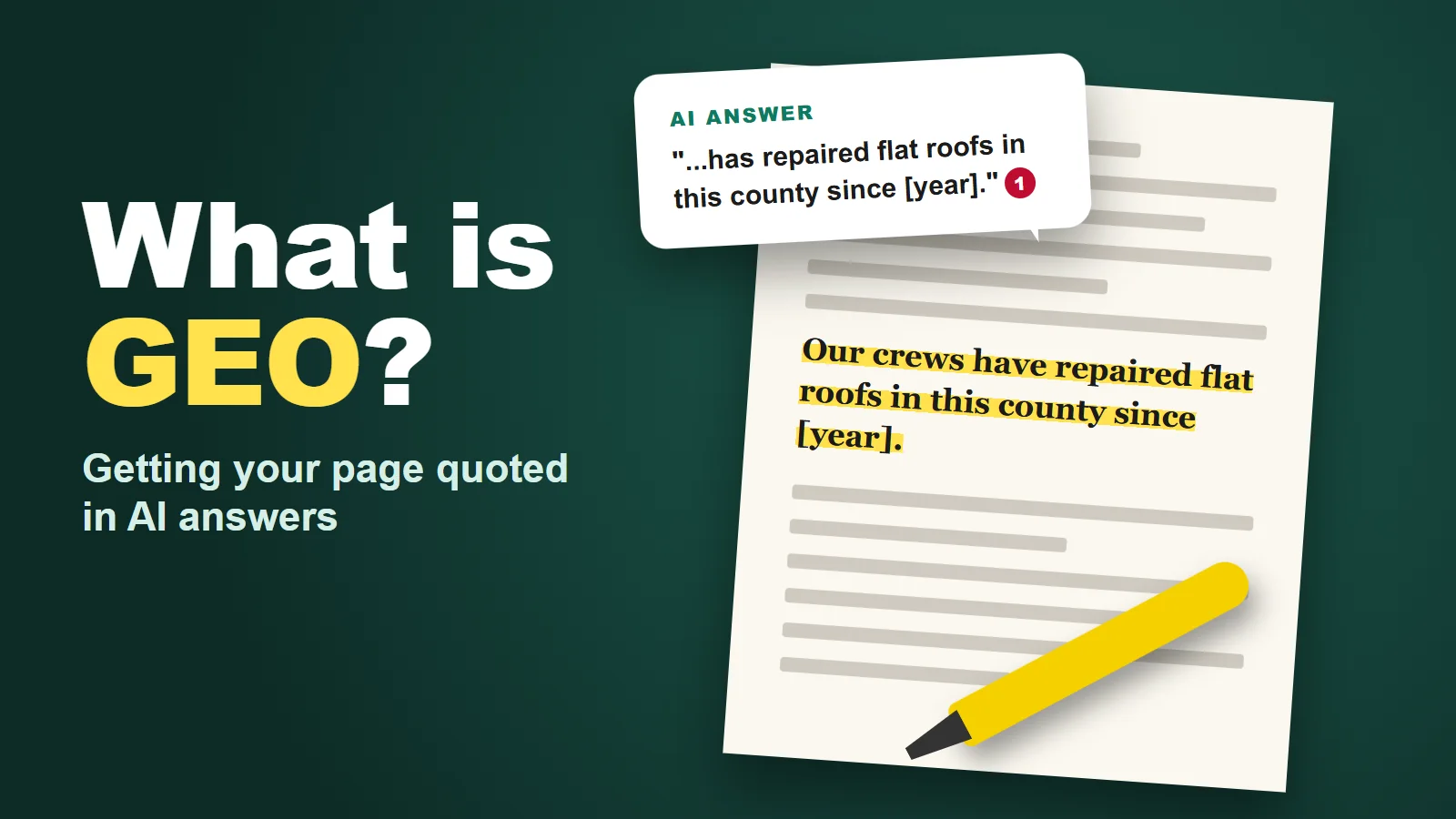
[Company] has installed and repaired flat commercial roofs in [county] since [year], with [number] roofs completed last year. Our crews are certified by [manufacturer], which lets us offer its [length] warranty, per the manufacturer's own terms.
- Real numbers you can back up
- A named source
- Short sentences that stand on their own
A template, not a real company. Fill the brackets only with facts you can prove.
That is most of GEO writing, in one box. The same goes for video: a transcript with real numbers and named sources gives an engine something to quote, which is why we fold it into content and video work instead of selling it separately.
Buying a GEO package without buying BSEO
BSEO is you not knowing what you bought. A GEO package is a fresh place for it to hide, because the results are hard to see unless someone shows you. Before you sign, ask for four things:
- The pages. Which ones get rewritten, by address, with before and after copies.
- The facts. Where every new number and quote comes from. If the answer is “the AI wrote it,” walk away.
- The search basics. Proof your pages are indexed and crawlable. No ranking, no citation.
- The answers. The same buyer questions asked of the same engines, saved monthly, so you can see if you went from missing to quoted.
A good GEO agency will show you all four without being asked twice. If you get “our method is proprietary,” that is the BSEO talking.
Send us your website. We will show you what ChatGPT, Gemini, Copilot and Perplexity answer when somebody asks for what you sell, word for word, which sources they cite instead of you, and what your pages are missing. No charge, and no obligation. Or call or text 805.243.8321.
Get My Free Visibility ReportSEO, AEO, GEO: three names, one job. Be the page worth quoting, and make sure the engines can find it. That is what real SEO services were always for.