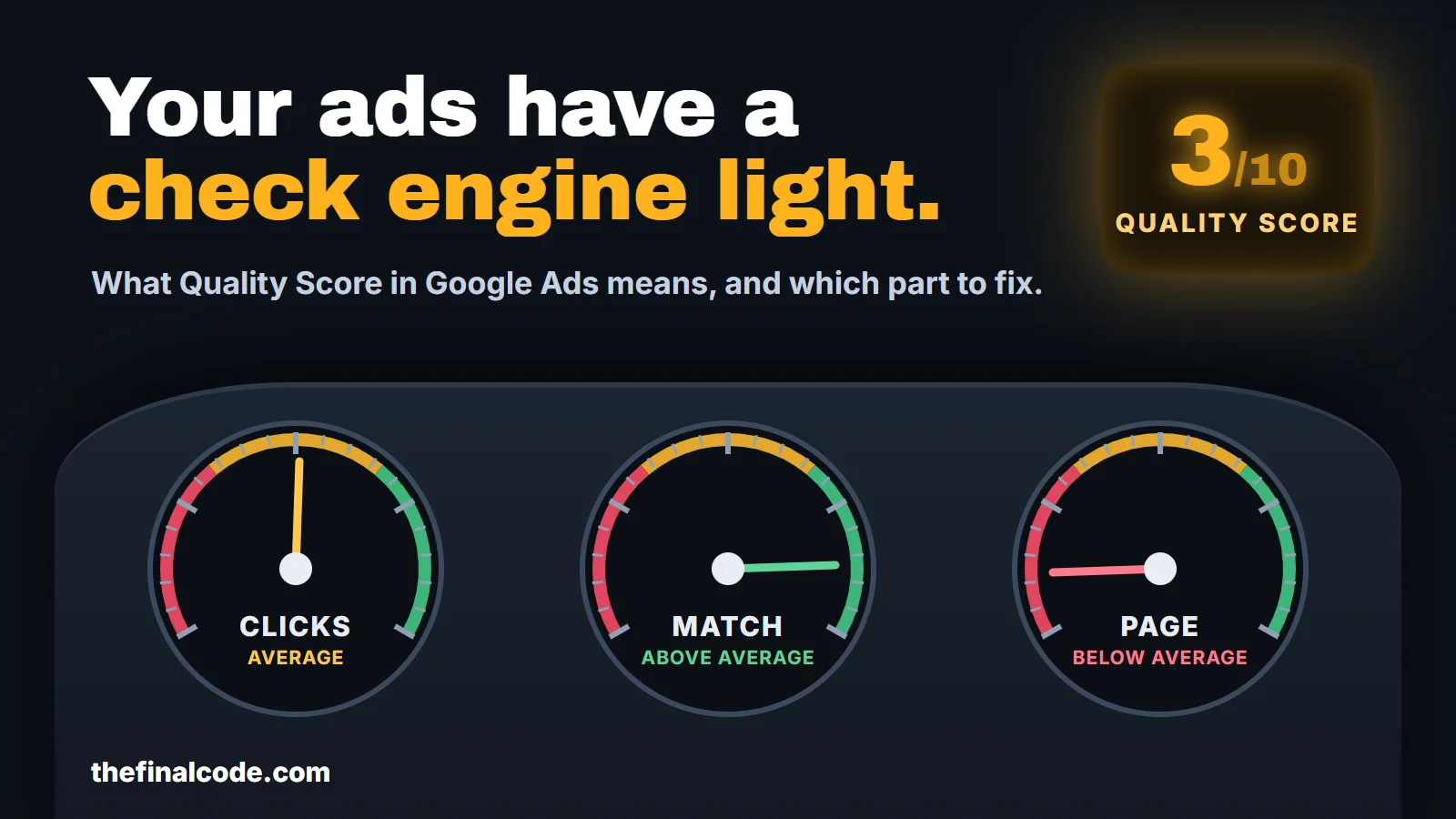
What Is Quality Score in Google Ads?
A man who runs a drain cleaning company finally opens his Google Ads account himself. He adds a column called Quality Score to his keyword report, and next to “drain cleaning,” the keyword that brings in most of his calls, it says 3. He wonders if he’s been paying extra this whole time, and if he should fire someone. So what is Quality Score in Google Ads? It’s a grade from 1 to 10 that Google gives each of your keywords. It shows how your ad and the page it sends people to compare with other advertisers who showed up for the same search. It’s built from three parts: how likely people are to click your ad, how well your ad matches the search, and how useful your landing page is. It’s a report card. It isn’t the auction. The auction runs on a different score called Ad Rank, and it’s figured fresh on every search.
That difference matters, because a low number means something real, and the fix is almost never the one people try first. When we run Google Ads management for a business, we read Quality Score as a list of clues, not a number to push up. Every rule below comes from Google Ads Help, quoted word for word. Where something is our opinion, we say so.
What does the 1 to 10 number actually measure?
Google’s own description is short: Quality Score is a diagnostic tool meant to give you a sense of how well your ad quality compares to other advertisers.
Diagnostic is the key word. It’s like the check engine light. It tells you where to look, and it doesn’t make the car go.
Every keyword gets its own score. Google says This score is measured on a scale from 1-10 and available at the keyword level.
So one ad group can hold a keyword with a 9 and another with a 3, and both can be true at once. Higher is better, and Google says what a high score means: A higher Quality Score means that your ad and landing page are more relevant and useful to someone searching for your keyword, compared to other advertisers.
Notice the last three words. You’re graded on a curve against everyone else who bid on the same search. Google says each part of the score is based on a comparison with other advertisers whose ads showed for the exact same search over the last 90 days.
A decent ad can still score low if the competition on that search is very good.
- Expected CTRWill people click your ad?Below averageAverageAbove average
- Ad relevanceDoes your ad match the search?Below averageAverageAbove average
- Landing page exp.Does your page help after the click?Below averageAverageAbove average
Our drawing of an example keyword. The three parts and their three statuses come from Google Ads Help, "About Quality Score for Search campaigns." Google doesn't publish how the parts add up to the number, so read the three rows, not just the big digit.
To see yours, go to Keywords in the Campaigns menu, click the columns icon, open the Quality score section, and add Quality Score, Exp. CTR, Ad Relevance and Landing Page Exp. Those four columns tell you more than the number alone.
What are the three parts of Quality Score?
Google builds the score from three components and grades each one Above average, Average or Below average. Below is each one in Google’s words, with what it means for a business owner.
Expected clickthrough rate. Google defines it as The likelihood that your ad will be clicked when shown.
It’s a guess about the future, not your actual click rate. Google says the status has also been adjusted to eliminate the influence of ad position and other factors that affect prominence and visibility, such as assets.
So you can’t fake it by buying the top spot. The question is simple: when people see this ad next to the others, do they pick it?
Ad relevance. Google’s definition: How closely your ad matches the intent behind a user’s search.
Intent means what the person wants. Someone typing “emergency drain cleaning” wants a truck tonight. An ad that talks about yearly maintenance plans misses that, even if the word “drain” is in it.
Landing page experience. Google’s definition: How relevant and useful your landing page is to people who click your ad.
This one is about your website, not your ad. Google adds that Landing pages with higher ratings are usually well organized and have text that relates to a person’s search terms.
Send a drain cleaning click to a homepage about every service you’ve ever offered, and this part usually suffers.
In our experience, landing page experience is the part owners skip, because it lives on the website and the ad account feels like a separate world. It isn’t. Google grades both.
How is Quality Score different from Ad Rank?
This is where most of the confusion lives. Quality Score is a summary you can see. Ad Rank is the score that actually decides the auction, and it never shows up as a number in your account. You only see its results, in where your ads land on the page. Google is direct about it: Quality Score is not an input in the ad auction.
Its definition page says the same thing another way. Quality Score is not used at auction time to determine Ad Rank.
Ad Rank is figured live. Google says Ad Rank is calculated every time a user does a search and is recalculated for different positions on the search results page.
Google lists the pieces too: At a high level, Ad Rank scores are based on 6 factors
. They are your bid, the quality of your ad and page, the minimum thresholds, how close the competition is, the context of the search, and the expected impact of your assets, like a phone number or extra links.
So why care about Quality Score at all? Because both scores look at the same kind of quality. Google says the Ad Rank math uses auction-time quality that can include auction-time measurements like expected CTR, ad relevance, and landing page experience, among other factors.
And it says Our assessment of the quality of your ad is summarized in your Quality Score
. The report card and the race grade the same skills. One looks back at the last 90 days. The other judges you in the moment of each search.
- When it's figuredFrom past searches that exactly match your keyword
- Where you see itA column in your keyword report, 1 to 10
- In the auction?No. Google says it is not an input
- Its jobTells you which part to fix
- When it's figuredEvery single search, again for each spot on the page
- Where you see itNot as a number. You see its results in your top of page metrics
- In the auction?Yes. It decides each auction
- Its jobDecides if your ad shows, and where
Our drawing. Sources: Google Ads Help, "About Quality Score for Search campaigns," "Quality Score: Definition" and "About Ad Rank."
Put plainly, chasing the number in the column does nothing by itself. Making the ad and the page better for the person searching is what wins the auction, and the column is how you find out which one needs work.
Does a low Quality Score cost you more per click?
Often it does, through the quality underneath it. Google’s definition page says Higher quality ads can lead to lower prices and better ad positions.
Its Ad Rank page puts it more plainly: Higher quality ads can often lead to lower CPCs.
CPC is cost per click, what you actually pay each time someone clicks.
Google also describes what low quality looks like on your bill: If your ads are low quality, you may find that your actual CPC is close to your maximum CPC even when there is low competition for the search terms that triggered your ad.
In plain words, you end up paying close to the most you said you’d pay, even when few others are bidding. If your average cost per click sits near your bid on a quiet keyword, that’s a sign worth checking.
Quality also decides what extras you get. Google says ad quality affects Whether assets show
, and explains that some assets only appear above the search results and need high enough quality to get there. Those are the call buttons and extra links that make an ad bigger on the page.
Which part is low, and what should you change?
Start with the three status columns, not the number. Google’s own advice is to treat the score as a general indicator of which areas to focus on to improve ad quality, rather than a score to be optimized.
Each Below average status points at a different fix.
- Expected CTR is lowPeople pass over your adChange the ad text.Google's list includes
Be more specific in your ad text.
andHighlight a unique benefit of your product or service, such as free shipping.
For a service business, that benefit might be same day visits or upfront pricing, if those are true for you. - Ad relevance is lowThe ad doesn't fit the searchSplit up crowded ad groups.If one ad has to cover twenty different keywords, it can't match all of them. Google says to
Split these ad groups into multiple ad groups that are a better match to the user’s searches.
Its example is a jeweler who keeps engagement rings and wedding bands in separate groups. - Landing page is lowThe click lands in the wrong placeSend the click to the matching page.Google's example: if someone searches for flannel shirts and clicks your flannel shirt ad,
the landing page they go to should feature your flannel inventory.
Google also listsImprove loading speed.
and making the site work well on phones.
Source: Google Ads Help, "5 ways to use Quality Score to improve your performance." The service business examples are ours.
Two warnings from Google keep owners from overdoing it. First, the landing page doesn’t need to repeat the search like a parrot: Keep in mind, the word-for-word phrase from a search term doesn’t need to be on your landing page.
It needs to deliver what the person wanted. Second, more clicks aren’t always better. Google says There may be times when a more specific ad leads to lower CTRs, but higher conversion rates.
An ad that says your price up front might get fewer clicks and more real jobs. We’d take that trade every time.
If you sell online, the landing page part is usually the biggest win. Sending a product search to a category page with the right products on it, instead of the homepage, is one of the first things we check when we do ecommerce marketing.
What won't raise your Quality Score?
A lot of the usual moves do nothing to it. Google lists them itself, so you can skip them.
- Raising your bidGoogle says
The amount you bid may affect your Ad Rank, but it doesn’t impact the assessment of your ad quality.
More money can help you win a spot. It doesn't raise the grade. - Changing match typesGoogle says Quality Score is based on past exact searches of your keyword,
therefore changing keyword match types will not impact Quality Score.
- Moving things aroundGoogle says
Moving an ad group with the same ads and keywords to another campaign or account does not impact your ad quality.
Rebuilding the same ads somewhere new is not a fresh start. - Showing your ad more oftenGoogle says how often ads show depends on your bids, budget and competition,
but it does not affect your ad quality.
- Getting more conversionsGoogle says
Your reported conversions do not impact your ad quality.
Sales are the goal, but they don't feed this score.
Sources: Google Ads Help, "About ad quality" and "About Quality Score for Search campaigns."
One more thing that confuses people. If the Quality Score column shows a dash instead of a number, nothing is broken. Google says it means there aren’t enough searches that exactly match your keywords to determine a keyword’s Quality Score.
And if you pause a keyword, its score freezes. Google says Paused keywords will retain whatever scores they had when they were last active.
So an old paused keyword with a bad grade isn’t hurting anything today.
Should you try to get every keyword to a 10?
No, and Google says so. Quality Score is not a key performance indicator and should not be optimized or aggregated with the rest of your data.
Its ad quality page repeats it: Use Quality Score to diagnose low quality ads, rather than trying to optimize the 1-10 score you receive.
That gives you a simple test for anyone you pay to run your ads. If their report brags about an “average Quality Score” across your whole account, they’re doing the exact thing Google says not to do. A useful report names specific keywords with a Below average part, says which part, and says what was changed. If you get a vague promise to “raise your scores,” that’s BSEO, and BSEO is you not knowing what you bought.
In our view, the work that fixes landing page experience pays you twice. A page that clearly answers one search is the page Google can rank for free, the same kind of page that helps you rank in the map pack with local SEO, and the kind of page AI answers can quote, which is the focus of our AI search visibility work. You pay for the click once. The page keeps working.
Sources: Google Ads Help, "About Quality Score for Search campaigns," "Quality Score: Definition," "5 ways to use Quality Score to improve your performance," "About ad quality," "About Ad Rank," "Ad Rank: Definition," "Expected clickthrough rate: Definition" and "Landing page experience: Definition." All checked November 28, 2026.
Send us your website and tell us what you're running. We'll show you which keywords have a weak part, whether it's the ad or the page, and what we'd change first. No charge, and no obligation. Or call or text 805.243.8321.
Get My Free Market AssessmentA better ad lowers what you pay per click, but only while you’re paying, and SEO that earns clicks for free keeps working after the budget stops.