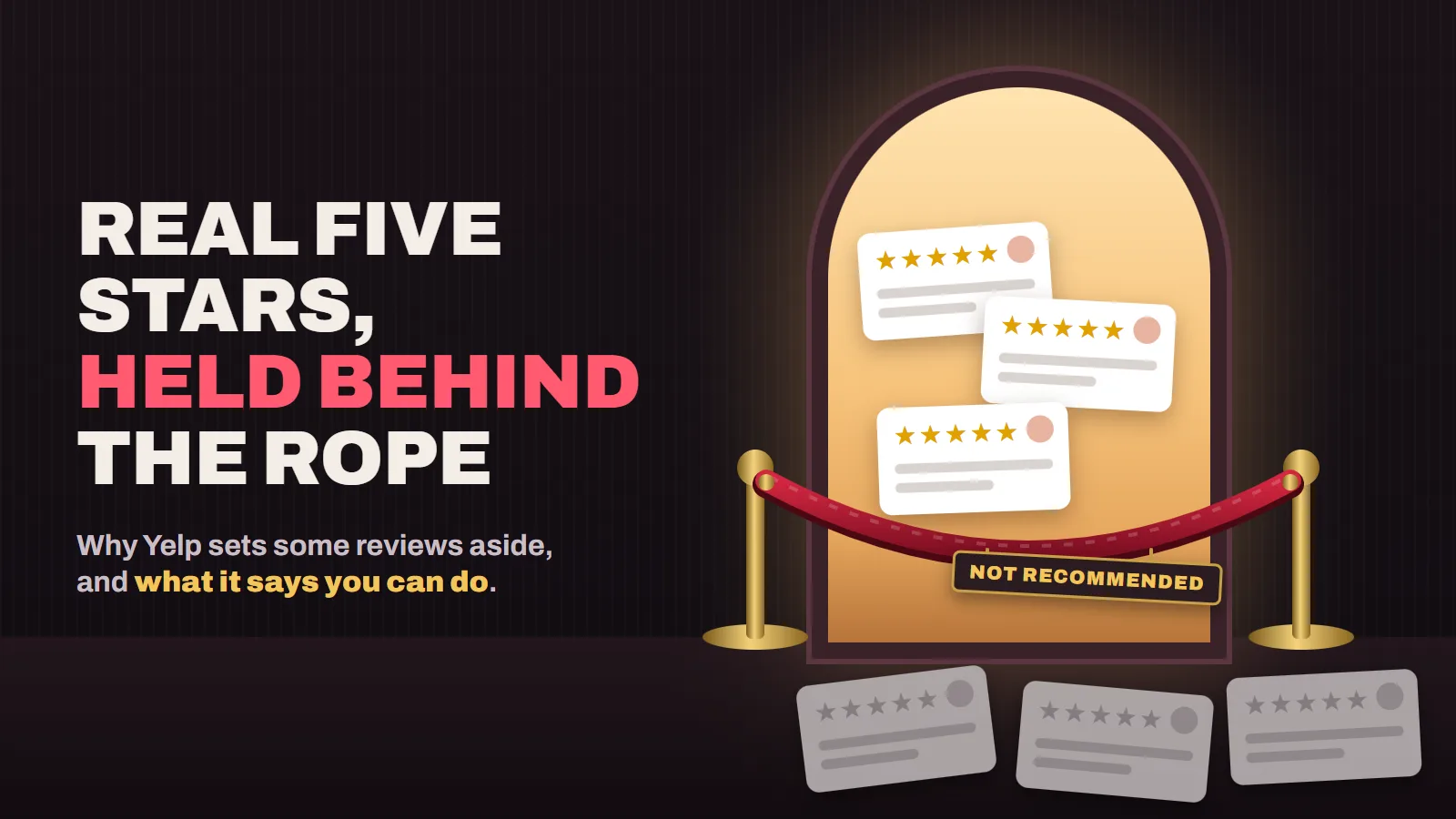
Why Are My Yelp Reviews Not Recommended?
A customer who’s been coming in for years stops at the counter and says she finally left you five stars on Yelp. You thank her, and that night you open the app to read it. The count hasn’t moved. You scroll the whole page and it isn’t there. Then, at the very bottom, in small grey type, you find a link to reviews that are “not currently recommended,” and hers is sitting in that pile with a handful of others from people you know are real.
Short answer: Yelp runs automated software over every review, and it holds back the ones it can’t vouch for yet, often because the reviewer is new to Yelp or because the review looks like the business asked for it. Those reviews stay readable but don’t count toward your stars or your review count. It’s one of the questions we hear most as a Santa Barbara SEO team, and everything below comes from Yelp’s own support pages, Trust & Safety site, blog and Terms of Service.
Where does a not recommended review actually go?
It isn’t deleted. Yelp’s recommendation software page says Reviews that are not recommended are still accessible via a link at the bottom of a business’s Yelp page, but they don’t factor into the business’s overall star rating or review count.
Yelp’s support center puts the same rule even more plainly: Only the star ratings of recommended reviews are used to calculate the business’s overall rating.
- Shown on your business page
- Counts toward your star rating
- Counts toward your review count
- Can be moved to not recommended later
- Behind a link at the bottom of your page
- Left out of your star rating
- Left out of your review count
- Still on the reviewer's profile, and can move back
Sources: Yelp Trust & Safety, "Recommendation software"; Yelp Support Center, "Do reviews that aren't currently recommended impact the business's star rating?" and "Does Yelp recommend every review?"
You’re not alone in having a pile. Yelp’s support page on the subject says Across Yelp’s platform, about three quarters of all reviews are recommended.
Turned around, that’s roughly one review in four sitting where yours are. The same page adds that Not recommended reviews can also be seen on a reviewer’s profile page.
So your customer still sees her review on her own profile, which is why she thinks it posted.
What Yelp's software is weighing
Yelp says the software evaluates every review based on hundreds of signals of quality, reliability, and user activity on Yelp.
It doesn’t publish the full list, but its Trust & Safety page names four things it looks for:
- Conflicts of interestReviews
it suspects were written by people with undisclosed ties to a business, including competitors, disgruntled employees, friends, or family.
- Solicited reviewsReviews
that it suspects the business owner or an employee asked for.
- Reliability
Potentially unreliable reviews include those written by less active users that it doesn’t know enough about to recommend their opinion to our community.
- Usefulness
The software looks for useful reviews and tries to exclude unhelpful rants or raves
, plus irrelevant information.
Source: Yelp Trust & Safety, "Recommendation software," section "Some of what the recommendation software looks for."
The third one explains most of the calls we get. A loyal customer who opened a Yelp account just to review you looks, to the software, like a stranger. Yelp says so directly: Sometimes, a review appears in the “not recommended” section simply because the software doesn’t know enough about the reviewer to recommend it.
Its support article on the question gives two more examples: Some reviews are less reliable (like ones we see originating from the same IP address) and some suggest an unfair bias (like the ones written by a friend of the business owner).
There’s a newer filter too. Yelp’s Content Guidelines say reviewers shouldn’t use third-party AI tools and chatbots to create reviews or other content, including using such tools to draft or revise content.
In its 2025 Trust & Safety Report, Yelp counted nearly 500,000 suspected AI-generated reviews filtered out
that year. If you’ve ever handed customers a suggested review to paste in, stop.
How often does Yelp re-sort the reviews?
Yelp doesn’t publish a schedule. What it says is that the software runs and learns regularly, evaluating signals across the hundreds of millions of reviews on Yelp, so reviews can move from not recommended to recommended (and vice versa) over time.
Another support page says reviews may become recommended or not recommended in the days, weeks, or even months after they were first posted.
That cuts both ways. Your customer’s review can move up on its own if she keeps using Yelp and the software gets to know her. Yelp says the reviews it recommends can change over time as Yelp’s software learns more about the reviewer and the business.
And a review that’s counted today can drop out next month, even an old one. When Yelp retuned the software in 2017 to focus harder on solicited reviews, its blog said the change would catch them including reviews previously contributed
.
Yelp also doesn’t claim the software is always right. Its Terms of Service, in the section businesses agree to, say the Recommendation Software may sometimes suppress legitimate reviews or fail to detect illegitimate reviews.
So yes, a real review from a real customer can be in the wrong pile, and Yelp has said in writing that it happens.
Can a phone call or an ad budget move a review?
No, on both counts. Asked whether staff can step in, Yelp’s answer is No. No employee at Yelp has the ability to override the decisions that the software makes. This approach is deliberate to avoid conflicts of interest.
Calling support to get a specific review moved isn’t something they can do.
Money doesn’t do it either. Yelp’s Terms say any purchase of advertising or other paid features from Yelp does not and will not influence the Recommendation Software
. Its support center adds that There’s also no connection between the time a business starts, stops, or declines to advertise, and the placement of reviews in the recommended or not recommended sections for that business.
If your reviews shifted right after you cancelled a Yelp ad contract, Yelp’s position is that the timing was coincidence.
That leaves the people who sell a way to “unfilter” Yelp reviews. If Yelp’s own employees can’t move a review, an outside company can’t either, and the Terms bar businesses from trying to circumvent Yelp’s Recommendation Software
. Paying for that is BSEO, and BSEO is you not knowing what you bought.
Why Yelp says don't ask for reviews
This is where Yelp parts ways with Google, and it trips up owners who’ve been told for years to ask every happy customer. Google’s help page on getting reviews says To leave reviews, you can ask customers to visit a Google link or scan a QR code.
Yelp’s Content Guidelines say the opposite: Businesses should never ask customers to write reviews.
And the business section of Yelp’s Terms lists, among the things a business agrees not to do, solicit or ask for reviews from your customers
.
Yelp’s reason, from its Trust & Safety page: Reviews that consumers write when asked to do so tend to be biased compared to reviews that consumers are motivated to write on their own.
It also points out that Businesses are also likely to only ask for reviews from customers they know will give them a great rating.
The cost isn’t only the review itself. Yelp’s support center warns that asking is likely to cause our software to not recommend them and may harm your business’s placement in Yelp’s search results
. Yelp’s “Don’t Ask for Reviews” page spells out how far the rule goes:
- Asking customers, mailing list subscribers, friends or family to review youAgainst the rules
- Staff competing to collect reviewsAgainst the rules
- A survey or contact form that ends with "now review us on Yelp"Against the rules
- Freebies, discounts or payment for a reviewAgainst the rules
- Offering anything to have a review changed or removedAgainst the rules
- You or your staff reviewing, or reacting to reviews of, your own businessAgainst the rules
- A "Find us on Yelp" sticker at the door or on the truckYelp suggests it
- Replying to reviews, publicly or by messageYelp suggests it
- Asking how a new customer found youYelp suggests it
Sources: Yelp Support Center, "Don't Ask for Reviews"; Yelp Terms of Service, business terms; Yelp Content Guidelines; Yelp for Business, "How to get Yelp reviews without asking" (March 7, 2025).
Notice the survey row. Yelp’s wording is Don’t ask for reviews after requesting customer feedback in other places like surveys or contact forms.
Plenty of review software sends a happy customer straight from a feedback form to Yelp. On Yelp, that flow is the exact behavior the software is built to catch.
Freebies, discounts and Yelp's consumer alerts
Asking gets reviews set aside. Paying for them can get a warning put on your page. Yelp describes a Consumer Alert as a warning message displayed over the reviews of a business’s Yelp page that informs users when we’ve detected abnormal activity or attempts to mislead them.
Two of the alert types are about reviews a business tried to buy or arrange.
The first is the Compensated Activity Alert. Yelp says When we have evidence that someone has offered cash or other incentives in exchange for a review, we display a Compensated Activity Alert on the page.
The second is the Suspicious Review Activity Alert, which Yelp says can include large numbers of reviews coming from a single IP address, or reviews from users who may be connected to a group that coordinates incentivised fake reviews.
Yelp’s Terms define incentives broadly: discounts, freebies, refunds, gift cards, contest entries, offers, or deals
. Its Content Guidelines also tell businesses not to use messages or public replies to offer an incentive to change a review.
In 2025, Yelp says it placed 491 Compensated Activity Alerts and Suspicious Review Activity Alerts on business pages
. That’s a small number next to the size of Yelp, but if you’re one of them, the warning sits over your reviews where every shopper meets it before they read a word.
Yelp myths, checked against Yelp's own words
Owner forums are full of theories about the filter. We checked the common ones against what Yelp has actually published:
- Reviews from brand new Yelp accounts get filteredYelp says soYelp names reviews from
less active users that it doesn’t know enough about
as a reason. It doesn't say every first review is held back, or how active someone has to be. - Stop advertising and your reviews dropYelp says noYelp's support center and Terms both say advertising has no connection to which reviews are recommended.
- Yelp filters more good reviews than bad onesPartlyYelp says the software works
regardless of how many stars a user chooses
, but also thatmany of the reviews in the not recommended section tend to be some of those positive reviews
, because people write more positive reviews to begin with. - Reviews posted on your shop's Wi-Fi get flaggedPartlyYelp lists reviews
originating from the same IP address
as less reliable. It doesn't mention Wi-Fi or in-store tablets specifically. Our take: a counter tablet for reviews is a bad idea on Yelp twice over, because it's also asking. - Support can move a review if you callYelp says noNo Yelp employee can override the software, by Yelp's own account.
Sources: Yelp Trust & Safety, "Recommendation software"; Yelp Support Center, "Why would a review not be recommended?," "Does Yelp recommend more positive or negative reviews?," "Do businesses that advertise on Yelp get special treatment by the recommendation software?"; Yelp Terms of Service.
What to do instead of asking
Yelp’s own advice is to earn reviews people write unprompted. In its 2025 piece on getting reviews without asking, Yelp suggests great service, replying to reviews, a “Find us on Yelp” sticker for your storefront or service vehicle, and using its free tools like check-ins and Request-a-Quote. It also offers a line its owners use in place of asking: when a customer says they found you on Yelp, one New York City locksmith replies, Yelp helps our business so much. I’m so glad you found me there.
That thanks them without asking for anything.
Replies are worth the time. Yelp’s guidelines say Direct messaging is often the best way to resolve a dispute with an unhappy customer, but you can also address issues publicly by posting a public response to a review.
Answer the recommended reviews and the ones in the other pile too, because anyone who clicks that link at the bottom sees how you handle people.
Photos help more than most owners think. Yelp says 93% of consumers say that photos and video are important when choosing a business on Yelp
, and suggests service businesses ask clients if they can take before and after photos of the job. Real job photos and short clips that work on Yelp, Google and your own site are the kind of content and video we make for clients, and they pull weight on every one of those pages.
Then keep Yelp in proportion. It’s one listing among many. Your name, hours, phone and services should match on Yelp, Google, Apple Maps and your site, and Google is the platform where Google’s own rules let you ask happy customers for a review. That’s the steady, unflashy work of local SEO. And if a thin Yelp rating is costing you calls this month, our view is that money is better spent on a well-run Google Ads campaign on your core services than on anything that promises to change what Yelp’s software does, since Yelp says neither its staff nor its own ads can.
Sources: Yelp Trust & Safety, "Recommendation software," "Consumer Alerts" and "2025 Trust & Safety Report"; Yelp Support Center, "Why would a review not be recommended?," "Does Yelp recommend every review?," "Do reviews that aren't currently recommended impact the business's star rating?," "Why do reviews change from recommended to not currently recommended and vice versa?," "Does Yelp allow employees to manually override the recommendation software?," "Do businesses that advertise on Yelp get special treatment by the recommendation software?," "Does Yelp recommend more positive or negative reviews?" and "Don't Ask for Reviews"; Yelp Content Guidelines; Yelp Terms of Service (effective January 1, 2026); Yelp Official Blog, "Don't Ask For Reviews: Why Yelp Does Not Recommend Solicited Reviews" (January 18, 2017); Yelp for Business, "How to get Yelp reviews without asking" (March 7, 2025); Google Business Profile Help, "Tips to get more reviews."
Send us your website. We'll look at your Yelp page and your Google profile side by side, check that your details match everywhere you're listed, show you where you appear on the map in the area you serve, and tell you what we'd do next. No charge, and no obligation. Or call or text 805.243.8321.
Get My Free Market AssessmentYelp, Google and the rest all reward the same thing in the end, a business real customers talk about on their own, and that holds up best inside SEO built on what the platforms actually publish.