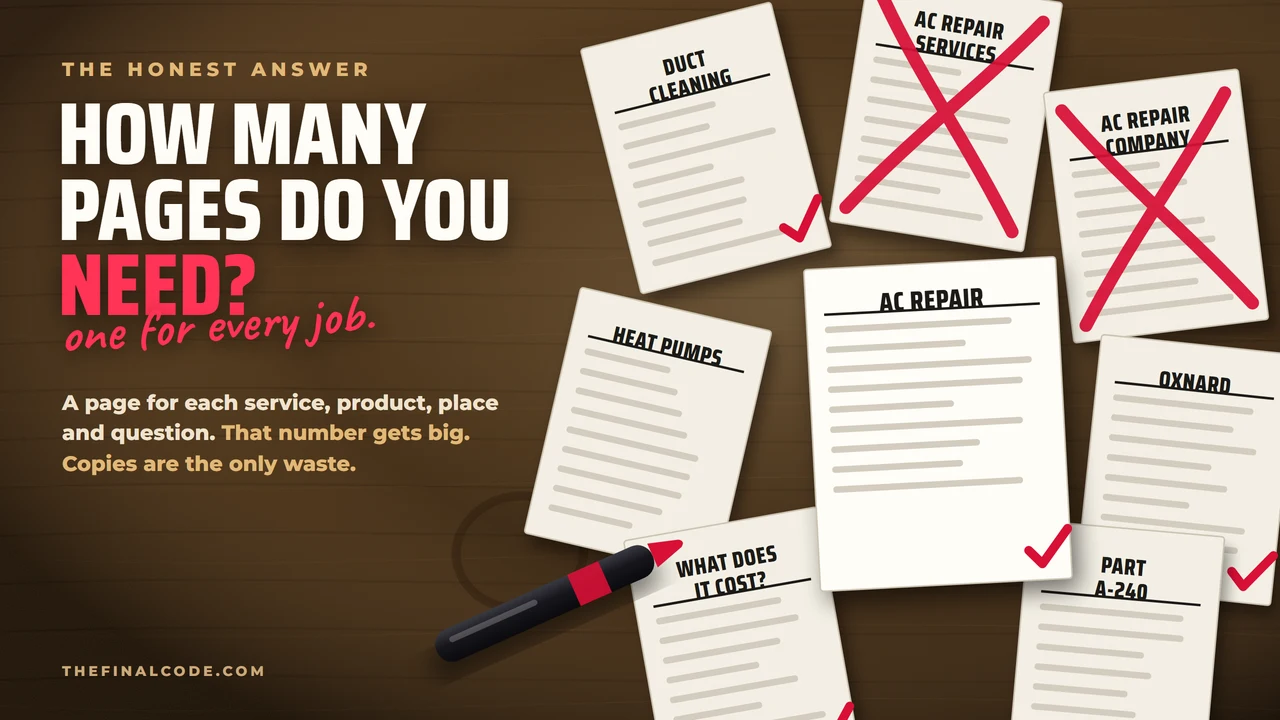
How Many Pages Do You Need to Rank? One for Every Job
SEO One page or four How to tell
Somebody has told you your website needs more pages. Maybe a competitor has ninety and you have twelve. So the plan is a page for every service, in every town, in every combination, and by Friday you have forty new pages that nobody will ever read. We work as an SEO company in Ventura County, and we get asked for exactly this about once a week.
Here is the honest answer. There is no target number. Every page on your site is an employee, and every employee needs a job nobody else is doing. One per job and you can run a big staff, happily. Put four people on the same job and they get in each other's way, which is precisely what near identical pages do to each other in Google.
So your number depends on how many genuinely different things you sell, do, serve and get asked about. That is usually more pages than a small site has, not fewer. The forty page plan only goes wrong when thirty of them are the same page wearing a different hat.
One page for every genuinely different thing you sell, do, serve or get asked about.
What a page has to do to earn its place
Before you write anything, hold it up against this. If a page cannot pass all three, it does not need to exist, and forcing it out will usually cost you something you already had.
- Answer a search somebody actually types. Not a clever phrase you invented in a meeting. Something a real person would put into Google at 7am with a problem.
- Say something no other page of yours can say. If you can only write it by rearranging a page you already have, you do not have a second page. You have a copy.
- Be somewhere you would happily send a customer. If you would be embarrassed to text somebody the link, Google is not going to send strangers to it either.
Plenty of pages pass that test. A separate service, a separate product line, a town you genuinely work in, a question customers ask every week: each is a different job and earns a page of its own. What fails is the copy, and copies are what quietly hold a big site still while a smaller one eats its lunch.
Every page is a front door
Owners picture visitors landing on the homepage and working their way in. Almost nobody does that. People arrive from a search, straight onto whichever page answered it, and that page is the only thing they see before deciding whether you are worth calling.
So every page is a separate entrance built for a separate arrival. Somebody searching a brand, somebody searching a part number, somebody searching a town, somebody typing a question at 11pm: four different people who need four different doors. One page cannot hold all four without turning into a list of everything you have ever done.
A service you do differently
Not a synonym for another service. Different work, different steps, different price.
A product, a line, a single part
Buyers search the exact thing by name. The exact thing needs somewhere to land.
A place you truly work in
Not every town you would drive to. The ones where you can say something that is not true at home.
A question you get weekly
If you answer it on the phone ten times a month, it has earned a page of its own.
An industry you serve differently
When the work, the words and the proof all change, the page changes with them.
Count those honestly and the number climbs fast. That is the good kind of climbing.
Why four copies lose to one page
Now the other direction. Say you fix, install and service the same equipment, and somebody writes four pages for it: repair, installation, service, and maintenance. Same crew, same van, same job.
That is not four doors. It is one door with four signs nailed to it.
Now Google has four candidates for the same search and has to decide which one to show. Your links, your mentions and your history get divided between them. Each one gets a quarter of what a single strong page would have had, and a quarter of a vote does not win anything.
Everything pointing the same way
One address to link to, one page to improve, one thing Google has to understand. It gets your whole vote.
The same vote, split four ways
Four weak pages competing with each other, four things to keep updated, and Google guessing which one you meant.
This is the same trap as writing a page for every town you drive to, which is the whole argument in ranking in more than one city. Geography there, services here, identical mistake.
Google has a name for the bad version
When the pages exist only to catch searches, rather than to help whoever lands on them, Google calls it doorway abuse and treats it as spam.
"Doorway abuse is when sites or pages are created to rank for specific, similar search queries. They lead users to intermediate pages that aren't as useful as the final destination."
Google Search Central, spam policies for Google web searchTheir own examples include pages built for specific regions or cities that funnel people to one place, and batches of nearly identical pages. Which is a fair description of the forty pages somebody just told you to write.
The four that should have been one
- Emergency AC repair
- AC repair services
- Air conditioning repair company
- 24 hour AC repair near me
One page, with the four questions answered inside it, beats four pages each answering one badly. When you merge them, point the old addresses at the survivor so nothing you already earned gets thrown away. Skip that step and you get the drop we walked through in why rankings fall after a change.
One page for every job. Six jobs, six pages. Ninety thousand parts, ninety thousand pages. What never works is one job written four ways, because those four spend their lives arguing with each other.
So what is your number?
Count the jobs and you have your number. One page for each service you genuinely do differently. One for each product line, and in a catalog, one for each item. One for each place you truly work in rather than merely drive to, which is the whole idea behind local SEO in Ventura County. One about who you are, one to reach you, and one for each question customers keep asking on the phone.
Add it up and most businesses land somewhere bigger than the site they have and smaller than the site somebody tried to sell them. The difference is never the count. It is whether each page was built for a real arrival or generated to hit a number.
When thousands of pages is exactly right
If you sell parts, the same rule gets big
The rule does not flip at scale, it multiplies. A distributor with ninety thousand part numbers genuinely needs ninety thousand pages, because each part is a different thing a buyer searches for by name, and a page for one part is useless for another. That is not thin content. That is a catalog, and every page in it is a front door.
The difference is that each of those pages says something real and specific: the size, the fit, the spec, the price, what it replaces. It passes the same three tests as any other page. It just passes them ninety thousand times.
That work is its own discipline, which is why we treat it separately under product catalog ecommerce and SEO for manufacturers.
The twenty minute page audit
Do this before you write anything new
- List every page you have. Out loud, in a spreadsheet, on a napkin. Most owners are surprised by what is on their own website.
- Write the one search each page is for. If two pages get the same search, you have found a pair fighting each other.
- Read each page as a customer. If it tells you nothing you could not guess, it is not a page, it is a placeholder.
- Merge the duplicates into the best one, and point the old addresses at it so the credit follows.
- Then list the doors you do not have. The services, products, places and questions with no page of their own. That list is usually longer than the merge list, and it is where the growth is.
Most sites come out of that with a shorter list of duplicates and a longer list of pages worth building, which is the right trade in both directions. That is the everyday work inside our SEO program.
If you are in Ventura County
We have looked at a lot of local sites doing SEO for businesses across Ventura County, and the same two things turn up together: a few pages saying the same thing in slightly different words, and no page at all for half of what the business actually does. Merge the first, build the second, in that order.
Send us your website. We will tell you which pages are earning their place, which ones are competing with each other, and which doors you are missing entirely. Free, no contract, and it is yours either way.
Get My Free Visibility Report Or call or text 805.243.8321