Why Did My Rankings Drop? How to Find Out What Changed
SEO The drop The date The suspect
You were on page one last month. Today you are somewhere below a directory, two competitors and a man selling the same thing out of his truck. We work as an SEO company in Ventura County, and this is the phone call we get most often, usually on a Monday, usually from somebody who has not slept.
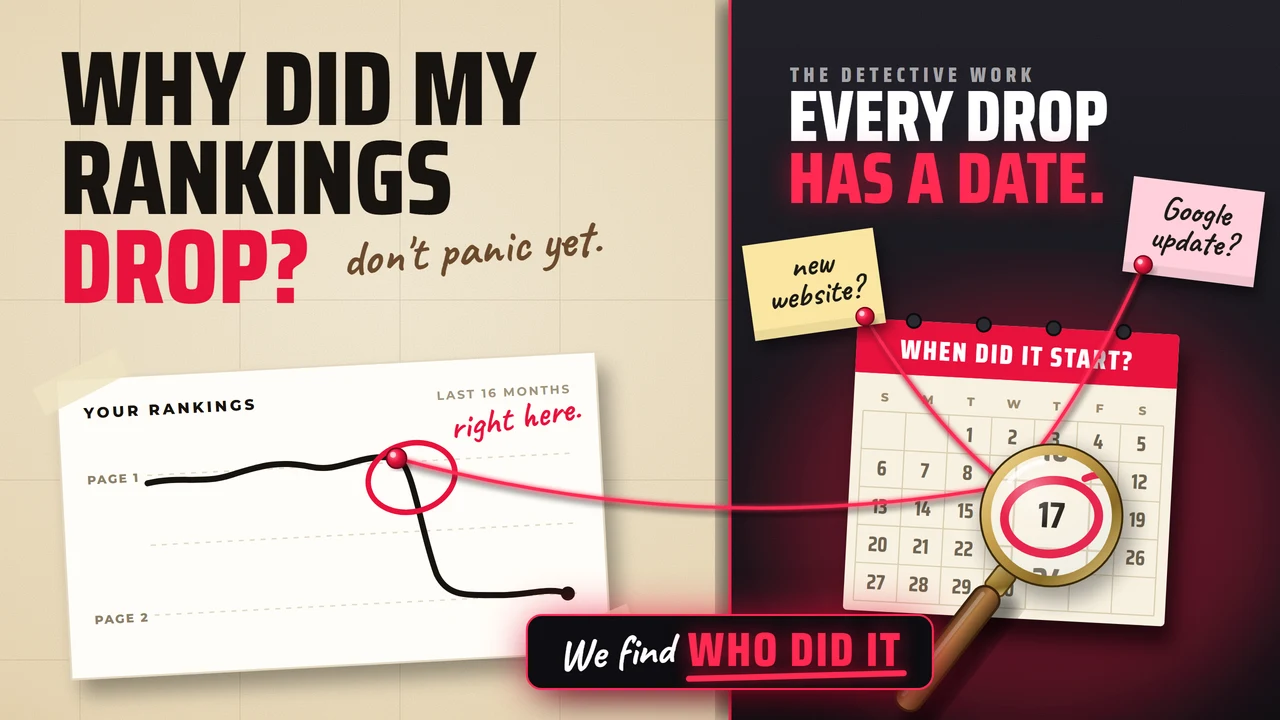
So first, the good news. A rankings drop is almost never a mystery. It is a crime with a date on it. Find the date and, more often than not, the suspect is standing right next to it holding the knife.
The bad news is that most people skip that step. They panic, rewrite the homepage, change the title on every page, fire somebody and add a blog. Now there are five new suspects and nobody can tell which one did it.
- Victim
- Your rankings. Last seen on page one, looking healthy.
- Reported by
- You, after searching your own business name at 11pm.
- Evidence
- A bad feeling, a quiet phone, and a screenshot of page two.
- Missing
- The date it happened. Without it, everything below is a guess.
Is it actually a drop?
Before you call anybody, make sure there has been a crime at all. Rankings move around every day. Not because anything is wrong. Because Google is constantly reshuffling results, testing things and adding new pages to the pile.
"Small fluctuations in position can happen at any time (including moving back up in position, without you needing to do anything)."
Google Search Central, debugging drops in Google Search trafficTwo more ways to fool yourself. If you checked from your own office, logged into your own account, the number you saw was never real to begin with. We wrote a whole post on why you're not ranking where you think you are. And if you only noticed because one keyword slipped from third to fifth, that is weather, not climate.
A real drop looks different. The phone gets quieter. The contact form goes still. Lots of searches fall at once, not one. That is worth chasing.
Google publishes the list of suspects
This part surprises people. Google has a help page on exactly this, and it names the usual causes plainly: an algorithm update or a spam or security problem, seasonality, a technical issue on your site, and a glitch in the reporting itself. We split a couple of those apart, because owners recognize them faster that way.
The redesign
New website, new pages, new addresses. Old pages that used to rank now go nowhere, and nobody pointed the old address at the new one.
The tellThe drop starts within days of launch.
The broken switch
One setting tells Google to ignore the site. It gets left on after a build, or a plugin flips it. The whole site fades out, quietly.
The tellEverything falls together, not just a few pages.
The update
Google changes how it ranks pages, sometimes in a big announced update. Pages that were thin, vague or copied tend to get found out.
The tellThe date lines up with an update Google announced.
The calendar
Fewer people search for pool service in January. Your ranking may be fine. There are just fewer people looking.
The tellThe same dip shows up this time last year.
The newcomer
You did not get worse. Somebody else got better, or a new competitor opened with a sharper page for your best search.
The tellOne name keeps appearing above you.
The broken ruler
The rankings are fine. The tracking is not. A tool changed how it counts, or the tracking code fell off the site.
The tellTraffic "dropped" but the phone is ringing the same.
Notice what is at the top. Not Google. You. In our experience the drop most owners blame on Google turns out to be something that changed on their own website, often something they paid for. If you are planning a new site right now, read should you rebuild your website or fix it before anybody deletes a page.
Find the day, and the day names the suspect
Every suspect on that list leaves a different kind of footprint, and the footprint is shaped by time. So the whole investigation is really one question: when did it start?
The place to answer it is Google Search Console. It is free, it is Google's own record of how your site shows up, and if nobody has ever set it up for you, that is the first thing to fix. Open the Performance report, set the date range to the last sixteen months, and look for the day the line changes shape. Google's own guide recommends exactly that range, so you can see the drop in context instead of in a panic.
- A few weeks beforeAnything change? New website, new plugin, new host, a developer "cleaning things up".
- The day it startsCircle it. Everything else hangs off this date.
- The same weekDid Google announce an update? Did a competitor launch? Did the tracking change?
- The same time last yearCompare year over year. If the dip was there last year too, it is the calendar, not a crime.
- Since thenIs it recovering, flat, or still sliding? Each one points somewhere different.
A drop without a date is a rumor. A drop with a date is a lead. Most of the work of fixing it is done the moment you know when it started.
What to do in the first hour
Before you change a single thing
- Do not touch anything yet. Every change you make now is a new suspect, and it muddies the one real clue you have.
- Check that the site is actually there. Load it on your phone, off the office wifi. Click around. It sounds silly until the day it is the answer.
- Open Search Console and find the date. Last sixteen months, then compare to the same period last year.
- Ask what changed around that date. Your web person, your marketing person, your nephew. Somebody always changed something.
- Check the phone and the form, not just the chart. If leads are steady, the problem may be the measuring, not the rankings.
- Write down who is above you now. Names, not positions. That list tells you whether you fell or someone climbed.
That is an hour of work and it will tell you more than a week of guessing. If you get to the end and the answer is a competitor who simply outdid you, our post on why your competitor outranks you lays out the honest reasons, in the order they usually turn up.
Once you know who did it
Each suspect has its own fix, and none of them is "write more blog posts and hope".
If it was the redesign, the old addresses need to point at the new ones, page by page, and the pages that used to rank need their content back. If it was the switch, flip it and ask Google to look again. If it was an update, the pages it hit usually need to become genuinely more useful than the ones that passed you, which is slower but it sticks. If it was the calendar, relax and plan for next year. If it was the ruler, fix the tracking and breathe.
And if the drop began when a batch of near identical pages went up, the fix is subtraction rather than addition, which we lay out in how many pages you need to rank.
That is the everyday work inside our SEO program, and for businesses that live on nearby customers, inside local SEO, where the map results can move for reasons all their own. For a sense of what the climb back looks like when it is done properly, the Primary Pools story is a pool company right here in the county.
If you are in Ventura County
We are in Ventura, on Eastman Ave, and we have been untangling drops like this for local businesses for a long time. Most of them were not mysterious. They just needed somebody to put the date on the calendar and ask the boring question: what else happened that week?
Send us your website and roughly when things got quiet. We will look at where you actually rank today, what changed around the date it started, and what it would take to get back. Free, no contract, and it is yours either way.
Get My Free Visibility Report Or call or text 805.243.8321