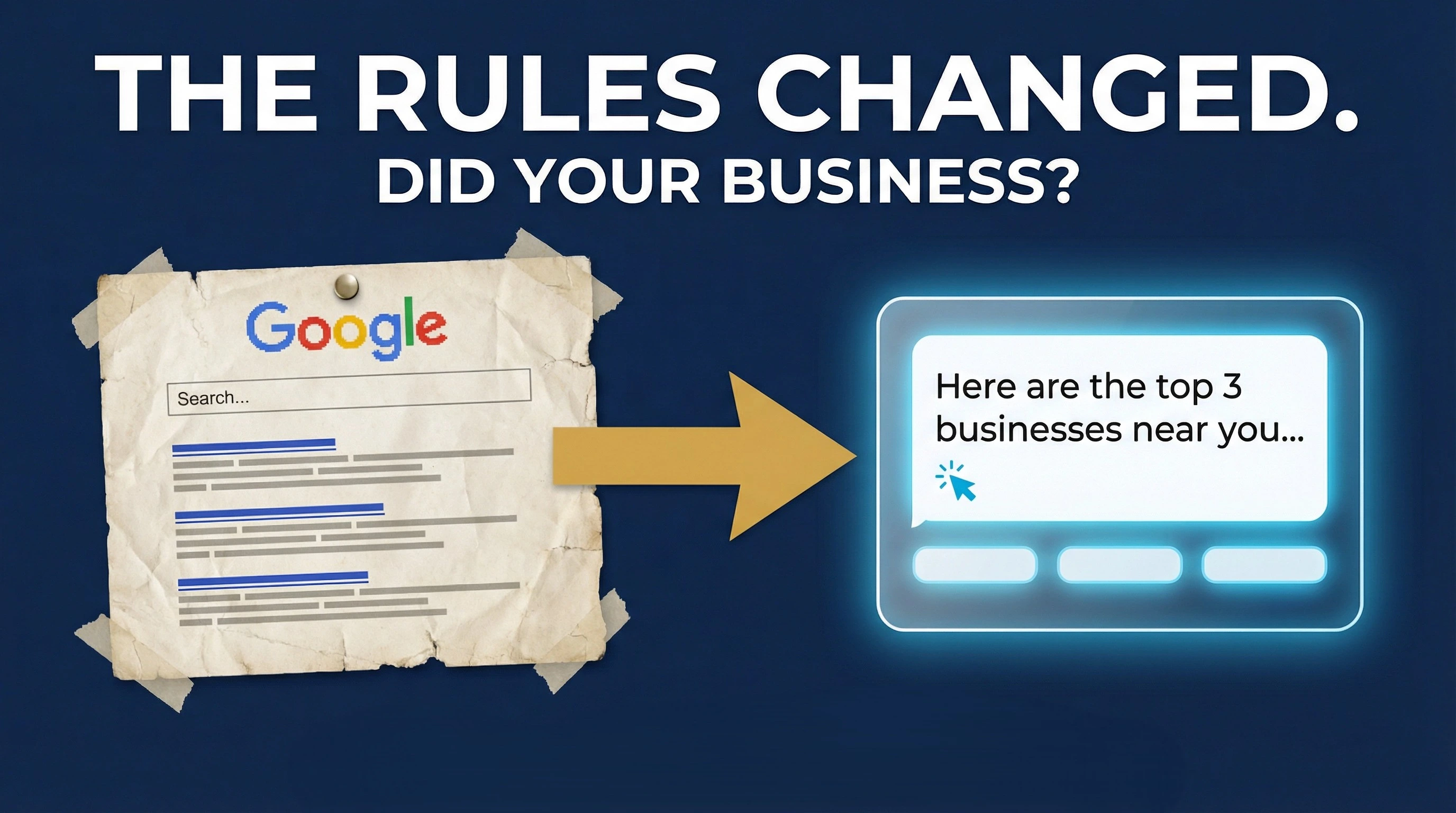
How to Show Up in AI Search: What Every Local Business Needs to Know Right Now
If you have been in business long enough, you have seen this movie before. The rules change, the platform shifts, and the businesses that adapt early win. Those that wait around and hope it blows over lose ground they often never get back.
We have been doing this for over 20 years. We have helped national brands and local businesses survive Google's Panda update, the Penguin rollout, the rise of mobile search, the explosion of the Map Pack, and every core algorithm update in between. We have seen a lot of "game-changers" come and go.
This one is not going away.
The way people find businesses online has fundamentally changed. Not incrementally, not in a "we'll see how it plays out" kind of way, fundamentally. And if your digital marketing strategy was built for the search landscape of 2020, you are already behind.
This guide is going to walk you through exactly what is happening, why your traffic may be quietly dropping, and what you actually need to do to show up in AI search results across Google, ChatGPT, Perplexity, and every platform your customers are using to find businesses like yours.
The Google SERP Doesn't Look Anything Like It Used To
Let's start at the beginning, because a lot of business owners are confused about something simple: why does it feel like my rankings dropped even though I haven't done anything wrong?
You didn't do anything wrong. The page changed around you.
It used to be clean. Ads on top, your organic results underneath. That was the deal. Then Google introduced the Local Map Pack, and suddenly three businesses with strong Google Business Profiles were sitting above every organic result on the page. If you weren't in the Pack, you were getting pushed down.
Then came featured snippets, People Also Ask boxes, knowledge panels, and a dozen other SERP features that ate into the real estate that organic results used to own.
Now, in 2026, the new shiny spot at the very top of the page belongs to AI Overviews. Before the ads. Before the Map Pack. Before your organic listing. The AI answers the question first, and according to Pew Research, only about 8% of users click on a traditional link when an AI summary is present. Without a summary, that number nearly doubles to 15%.
That is not a small shift. That is the entire game changing in front of your eyes. A well-executed search strategy today has to account for all of these layers simultaneously, not just the blue links at the bottom of the page.
Why Are People Using ChatGPT Instead of Google to Find Businesses?
This is the question we hear from business owners constantly, and it is a fair one. For two decades, Google was the undisputed front door to the internet. You optimized for Google, you got found. Simple.
That relationship is evolving fast.
A 2025 survey of over 1,100 U.S. adults found that 21.9% of consumers now prefer ChatGPT for discovering nearby businesses, rapidly catching up to Google's 31.7%. Among "Heavy AI Users". People using AI tools daily, which now represents about one-third of all American consumers, 27.1% said they rely on ChatGPT for local discovery, compared to 29.7% for Google.
And it is not just ChatGPT. Gemini (10.9%), Google's own AI Overviews (10.1%), and Microsoft Copilot (6%) are all playing a growing role in how consumers find and evaluate local businesses. The search landscape is no longer a single platform. It is an ecosystem.
The reason people are gravitating toward AI tools is simple: conversational search feels more natural. Instead of typing "plumber Dallas," someone asks ChatGPT, "Who is the best emergency plumber in Dallas that can handle a slab leak on a Sunday?" The AI gives a direct, synthesized answer. No scrolling through ten blue links. No ad-heavy results page. Just an answer.
If your business is not part of that answer, you are invisible to a growing segment of your market.
Most Small Business Websites Are Invisible to AI. Here's Why
On Reddit's r/DigitalMarketing, one of the most upvoted threads in the past year asks: "How do small businesses even show up in ChatGPT or AI search? I tried asking for the best natural skincare brands in my area, and mine didn't show up at all. Is there something I'm supposed to register for?"
There is no registration. But there is a reason it is not showing up.
AI models do not crawl the web the same way Google's traditional algorithm does. Google's bot visits your page, reads your keywords, evaluates your backlinks, and assigns a ranking. Generative AI models are synthesis engines. They generate answers by synthesizing information from sources they have determined to be credible, consistent, and well-represented across the web.
If your business only exists on a five-page website with thin content, no structured data, inconsistent directory listings, and no mentions on authoritative third-party sites, the AI cannot verify your existence with enough confidence to recommend you. It is not that the AI dislikes you. It simply does not have enough evidence to trust you.
The three core reasons most small business websites are invisible to AI:
1. Inconsistent or missing business information. If your name, address, and phone number appear differently on Yelp, Google Business Profile, your website, and your Facebook page, the AI sees conflicting signals. Conflicting signals equal low trust. Low trust equals no mention.
2. Thin, generic content. AI systems are trained to cite sources that provide clear, specific, authoritative answers. A homepage that says "We offer quality services at competitive prices" tells an AI absolutely nothing. It cannot cite that. It will not cite that.
3. No structured data. Schema markup is code that speaks directly to machines. It tells Google, ChatGPT, and other AI systems: "This is a local HVAC business, located at this exact address, serving these specific zip codes, with a 4.8-star rating from 312 reviews." Without it, the AI has to guess what you are. And it will not guess in your favor. This is one reason why keeping your website properly maintained and technically sound is more important now than ever.
How to Show Up in AI Search Results: The Actual Strategy
Here is what works. Not theory. Not speculation. The actual framework we use for our clients, built from two decades of watching search evolve and adapting before the competition does.
Step 1: Build a Citation Footprint the AI Can Trust
If you don't tell the internet who you are, what you do, and where you do it, how is any AI supposed to know? This is not a rhetorical question. It is the core of AI search visibility.
AI models synthesize answers based on consensus. The more consistently your business information appears across trusted, high-authority sources, the more confident the AI becomes in recommending you. Start with the big ones: Google Business Profile, Yelp, Bing Places, Apple Maps, Facebook, and your industry-specific directories. Then expand to data aggregators like Neustar Localeze and Foursquare, which feed information to dozens of secondary directories. Every listing needs to be identical, same business name, same address format, same phone number, same hours.
This is not glamorous work. It is foundational work. And it is the kind of work that separates businesses that show up in AI results from those that don't.
Step 2: Create Content That Answers Real Questions
AI Overviews and ChatGPT are conversational by design. The queries triggering them are not short-tail keywords; they are questions. According to SEMrush, over 88% of searches that trigger Google AI Overviews have informational intent. Your customers are asking questions before they buy, and AI is answering them.
To show up in those answers, you need to be the most helpful piece of content on the internet for your specific niche. Not the most keyword-stuffed. Not the most generic. The most genuinely useful. This is the foundation of every SEO program we build for our clients, content that earns its place as the best available answer.
Create dedicated blog posts, FAQ pages, and service pages that directly answer the specific questions your customers are asking. Use clear headings framed as questions. Write in plain, direct language. Provide specific, actionable answers. When your content gives a clear, factual response to a specific problem, AI engines are highly likely to scrape and cite your page.
Step 3: Implement Schema Markup and Structured Data
This is the part most small businesses skip, and it is costing them visibility they do not even know they are missing.
Schema markup is structured data code that you add to your website. It tells search engines and AI systems exactly what your business is, where it is, what it does, and why it should be trusted. For a local business, the most important schema types are LocalBusiness schema (your name, address, phone, hours, and service area), FAQPage schema (which marks up your FAQ content so AI can directly extract and cite your answers), Review schema (which surfaces your star rating and review count), and Service schema (which explicitly lists what you offer and where you offer it).
This is one of the technical elements we handle as part of our web development work, because when it is done correctly, it creates a direct line of communication between your website and every AI system that is trying to understand your business.
Step 4: Build Real EEAT: Not the Checkbox Version
Google's EEAT framework (Experience, Expertise, Authoritativeness, and Trustworthiness) is the standard by which both Google and AI models evaluate whether your content deserves to be cited. Google is actively cracking down on generic, AI-sounding content that checks boxes without providing real value. If your content reads like it was generated by a machine and reviewed by no one, it will be treated accordingly.
Experience means your content reflects real, first-hand knowledge, specific projects completed, specific challenges solved, specific results delivered for clients. Not "we have years of experience." Actual stories.
Expertise means your content goes deeper than a surface-level overview. The level of specificity that comes from genuine expertise is exactly what separates authoritative content from generic content in the eyes of AI systems.
Authoritativeness means other credible sources are talking about you, press mentions, industry associations, local news coverage, and high-quality backlinks. When AI models see that multiple trusted sources reference your business, it validates your authority.
Trustworthiness means your website is technically sound, your reviews are strong and recent, your contact information is clearly displayed, and your content is accurate. This is also where professional web design plays a bigger role than most people realize, a site that looks credible and loads quickly sends strong trust signals to both users and AI systems.
Step 5: Use the Terms That Actually Bring You Customers
One of the biggest mistakes businesses make is targeting keywords that sound impressive but don't convert. You want to rank for the terms that your actual customers are typing when they are ready to spend money.
This requires real competitor analysis. Who is currently showing up in the AI results for your most valuable service queries? What language are they using? What questions are they answering that you are not? Before you spend a dollar on content or optimization, you should know exactly what terms are driving business in your market and who is currently winning those terms. That intelligence shapes every decision that follows.
For businesses selling products online, this analysis extends to your ecommerce presence as well. AI tools are increasingly being used to research and compare products before purchase, and the businesses with the most complete, well-structured product information are the ones getting cited.
The Bigger Picture: What Happens If You Wait
AI search traffic is up 527% year-over-year. SEMrush projects that website traffic from AI search may surpass traffic from traditional search engines entirely by 2028. The businesses that build their AI visibility now will own that traffic. The businesses that wait will be playing catch-up in a much more competitive environment.
We have seen this pattern before. The businesses that claimed their Google Business Profile early dominated the Map Pack. The businesses that built mobile-optimized sites before Google's mobile-first indexing update had a significant head start. The early movers in every major search shift have consistently outperformed the late adopters.
This is that moment. And the window to get ahead of the competition is still open, but it is closing.
What Should I Do First? (The Honest Answer)
The honest answer is that you need to understand where you currently stand before you do anything else. You need to know which AI platforms are mentioning your business, which are not, what your competitors are doing that you are not, and what the highest-value opportunities are in your specific market.
At The Final Code, we run a free market assessment for businesses that want to see exactly what is working, what is not, and what is next. You will get a full assessment of where you are, where you are supposed to be, what terms would actually bring you business, and who is currently beating you in the results. Everything should make sense before you spend a dollar.
Ask for the report, or call or text us today at 805-243-8321. We'll help you make the last piece fit.
Frequently Asked Questions
Does my Google Business Profile help me show up in AI search results?
Yes, significantly. Your Google Business Profile is one of the most trusted data sources that Google's AI Overviews pull from when generating answers about local businesses. A complete, verified, and actively managed profile (with accurate hours, services, photos, and recent reviews) dramatically increases your chances of being cited in AI-generated local results. It also feeds into the broader citation ecosystem that ChatGPT and other AI tools use to verify business information.
How long does it take to show up in AI search results?
There is no guaranteed timeline, but businesses that implement a comprehensive AI visibility strategy (consistent citations, structured data, authoritative content, and strong EEAT signals) typically begin seeing measurable improvements within 60 to 90 days. AI models update their training data and retrieval systems at varying frequencies, so some platforms may reflect changes more quickly than others.
Is traditional SEO still worth doing?
Absolutely. Traditional SEO and AI search optimization are not mutually exclusive. They are deeply interconnected. The same signals that help you rank in Google's organic results (quality content, authoritative backlinks, technical health, local citations) are the same signals that help AI models trust and cite your business. A strong traditional SEO foundation makes AI optimization significantly more effective.
My competitor is showing up in ChatGPT results, and I'm not. What are they doing differently?
In most cases, it comes down to three things: they have more consistent and widespread business citations, their content is more specific and question-focused, and they have more authoritative third-party mentions across the web. A competitive analysis can identify the exact gaps between your current visibility and theirs, and that is exactly the kind of work we do as part of our digital marketing engagements.
The Final Code is a full-service digital marketing agency with over 30 years of experience helping local businesses and national brands build marketing strategies that are ready for what's coming next. We have worked with businesses across industries to navigate every major shift in search, and we are ready to help you navigate this one.
Call or text: 805-243-8321 | Get your free market assessment