Read Your SEO Contract Before You Sign It, Clause by Clause
The salesperson has been on the call for forty minutes, and it went well. Before you hang up, a signing link lands in your inbox. Twelve pages, a green button that says Sign, and someone on the line saying “it’s our standard agreement.” Most owners click. A year later they find out what “standard” meant.
That’s BSEO in its purest form: you not knowing what you bought, in writing, with your signature at the bottom. Whoever you hire, including our SEO team on Long Island, the contract is the only part of the deal you can still change before it starts. Read these eight clauses first.
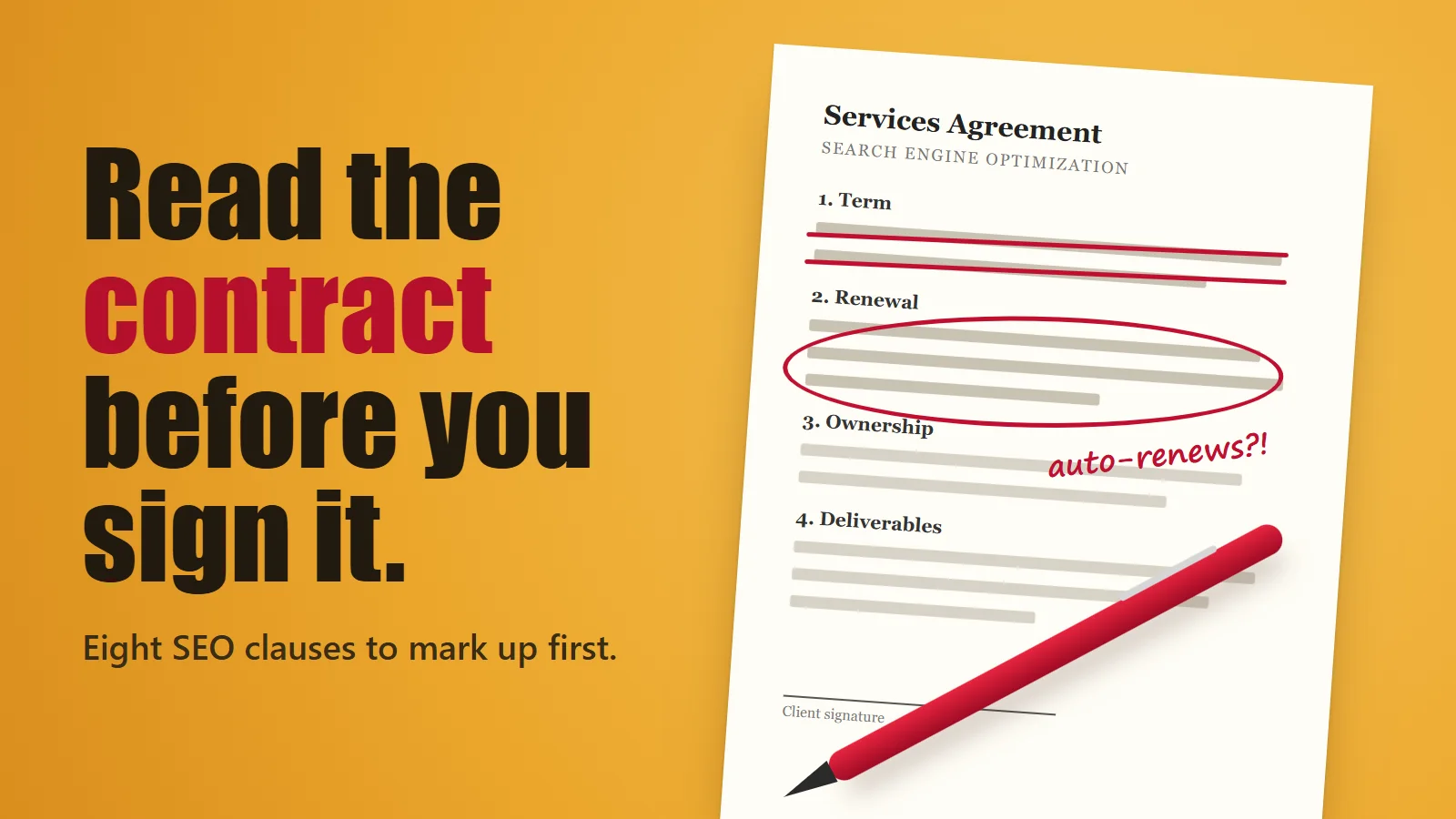
Eight clauses, marked up in red
Every wording below is an example we wrote to show the pattern. None of it is quoted from a real company’s contract.
-
The term
Example to strike
Client agrees to an initial term of twelve (12) months. Fees for the full term are due regardless of early termination.A year of fees owed before you've seen a month of work.Example to ask forMonth to month after an initial period of 90 days. Either party may end the agreement with 30 days' written notice.
-
Auto-renewal
Example to strike
This agreement renews automatically for successive twelve-month terms unless cancelled in writing no fewer than 60 days before the renewal date.Miss one date on the calendar and you've bought another year.Example to ask forAfter the initial period, the agreement continues month to month. Provider will email Client 30 days before any price change.
-
Cancellation and early-termination fees
Example to strike
Upon early termination, Client shall pay a fee equal to the remaining monthly fees, plus any setup fees waived at signing."Waived" setup fees that come back the day you leave were never waived.Example to ask forClient may cancel by email to a named address. Client pays only for work completed through the end of the notice period. If ad spend is billed through Provider, it is listed separately from the management fee.
-
Who owns the work
Example to strike
All content, code and materials created by Provider remain the property of Provider. Client receives a license to use them during the term."During the term" means the pages leave when you do.Example to ask forOn payment, Provider assigns to Client all rights in the content, images and code created for Client under this agreement.
-
Guarantees
Example to strike
Provider guarantees first-page rankings for ten (10) keywords within 90 days, or the following month is free.Ten keywords chosen by whom? A free month of the same work is not a remedy.Example to ask forProvider does not guarantee rankings. Provider commits to the deliverables in Schedule A and to the reporting in Section 7.
-
Deliverables
Example to strike
Provider will perform ongoing on-page optimization, content strategy and local listing management as needed."As needed" can mean nothing at all, and still be in compliance.Example to ask forEach month: two new service pages of at least 800 words, approved by Client before publishing; weekly Google Business Profile posts; a list of every change made to the site.
-
Reporting
Example to strike
Provider will furnish periodic performance reports in Provider's standard format.Their format, their schedule, their choice of what counts.Example to ask forBy the 10th of each month: the work completed, with links; search queries and clicks from Client's own Search Console; calls and form leads from Client's own analytics.
-
What happens when it ends
Example to strike
Upon termination, Provider may remove content, redirects and tracking installed by Provider.That's the clause that makes your phone go quiet the week after you leave.Example to ask forWithin 10 business days of termination, Provider will transfer all accounts, files and logins to Client and will leave all published work in place.
Two of those deserve a second look. On guarantees, Google is blunter than any of us: No one can guarantee a #1 ranking on Google.
In the same guide it tells owners, If they guarantee you that their changes will give you first place in search results, find someone else.
One of the questions Google suggests asking any SEO is Will you share with me all the changes you make to my site
, which is the reporting clause in plain English.
On deliverables, the test is whether you could check each line yourself. “Local listing management” can’t be checked. “Weekly Google Business Profile posts” can, and so can every other part of local SEO that’s written down as a number and a frequency. The same goes for ads: if the contract covers Google Ads management, the fee for the work and the money paid to Google should be two separate lines, so you can see both.
The renewal laws mostly protect households
Owners tend to assume a law somewhere stops a company from auto-renewing them for another year. For a business buying SEO, that’s shakier than it sounds.
New York’s automatic renewal law, General Business Law section 527-a, requires a simple way to cancel at any time and, for terms of a year or more, a reminder 15 to 45 days before the cancellation deadline. California’s law, Business and Professions Code section 17600 and onward, covers the same kind of renewing plan. Both laws are written to protect a “consumer,” and both define that word the same way.
"Consumer" means any individual who seeks or acquires, by purchase or lease, any goods, services, money, or credit for personal, family, or household purposes.
NY Gen. Bus. Law § 527(3); Cal. Bus. & Prof. Code § 17601On July 8, 2025, the United States Court of Appeals for the Eighth Circuit vacated the Federal Trade Commission's (FTC) "Click to Cancel" Rule.
WilmerHale client alert, Aug. 1, 2025adopting provisions of the vacated 2024 Rule or some other provisions
FTC press release, Mar. 11, 2026
An SEO retainer for your business isn’t bought for personal, family or household purposes. So read plainly, those two state laws are about household subscriptions, not your agency contract.
The federal picture changed twice. The FTC’s 2024 “click to cancel” rule would have reached business-to-business deals too, but a federal appeals court threw it out in July 2025. On March 11, 2026, the FTC asked the public whether a new rule is needed, including one built on parts of the vacated version. As we write this in October 2026, the FTC’s own rule page lists no new proposed or final rule. Until that changes, the contract you sign is most of your protection, which is the whole point of reading it.
Who owns the pages after you stop paying
This one surprises people. Paying for something to be written doesn’t, on its own, make you the owner of it. The U.S. Copyright Office’s circular on works made for hire says that Ordinarily, the author is the person or persons who actually created the work.
There’s an exception for commissioned work, but it’s narrow. It applies only to certain types of work, created under an express written agreement, and the Office is specific: The agreement must be signed by all parties. If a work fails to satisfy any of these requirements, it is not a work made for hire.
So a contract that says nothing about ownership isn’t neutral. If you’re paying for content and video, you want a line that hands the rights to you, in writing, once you’ve paid. That’s what the fourth clause above is for.
Send it back with a pen in hand
You’re allowed to mark up a contract. A good company expects it, and the way they answer a redline tells you a lot about the next twelve months. Strike what you don’t like, write in what you want, and ask them to explain any line they won’t change.
This post isn't legal advice. Contract law varies by state and by deal. If any clause in front of you is unclear, have a lawyer read it before you sign.
Send us your website. We'll show you the searches you're found for today and the ones you're missing, so you can judge any proposal against a real starting point. No charge, and no obligation. Or call or text 805.243.8321.
Get My Free Visibility ReportWhatever you sign, make sure it names the work. That’s what real SEO services should be willing to put on paper.