Why a Directory Outranks You in Your Own Town
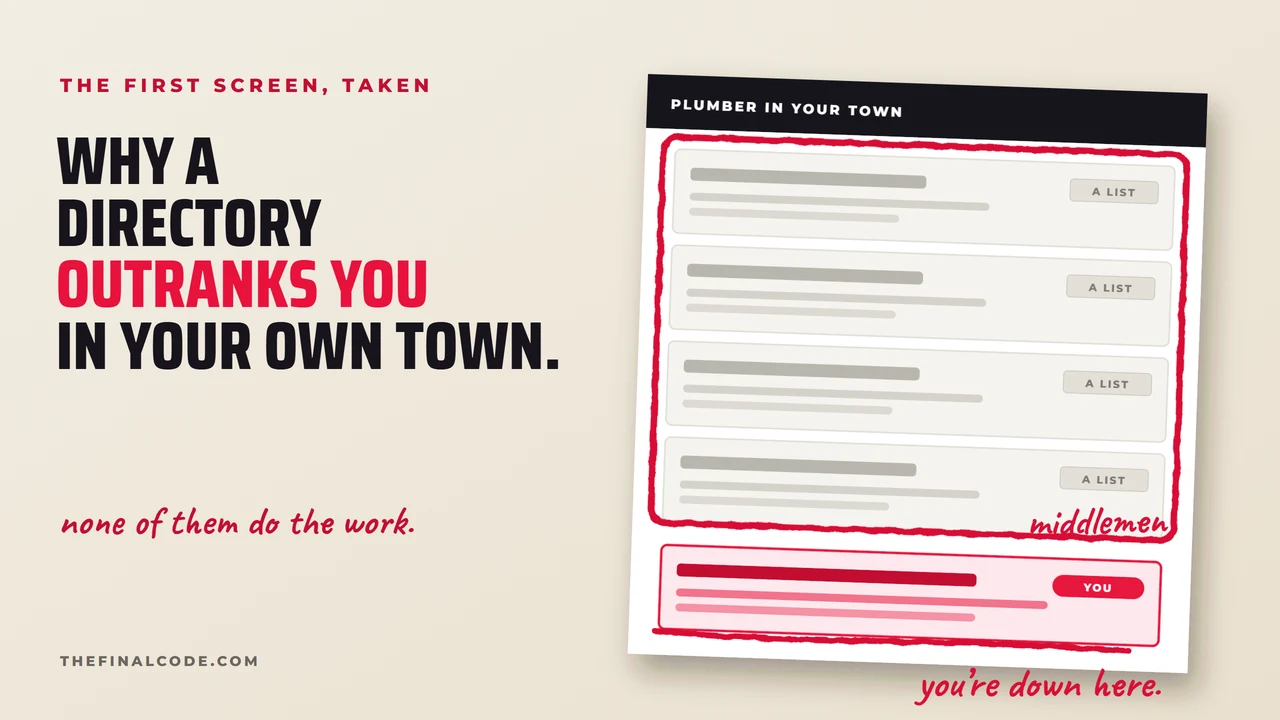
Do it now, on your own phone, standing where you are. Type your trade and your town. On most local searches the first thing you meet is not a business at all. It is Yelp, then Angi, then somebody’s list of the ten best in town, then Thumbtack, and somewhere below all of that, if you scroll, is a company that actually does the work. We are an SEO company in Ventura County, and this is the single most common thing an owner shows us on their phone before they have said a word.
The frustrating part is that none of those top results can fix a pipe, wire a panel or show up on a Tuesday. They are all middlemen. Here is what that page is really doing, and the one thing you have that none of them can copy.
Google is not punishing you. It answered a different question
This is the part that stings, so it is worth getting right. Nobody at Google decided your business was worse than Yelp. Google looked at the search and made a judgement about what the person wanted, and for a bare search like a trade and a town, it decided they wanted options.
Think about what that searcher actually said. They did not type your name. They typed a job and a place, which is the search equivalent of walking into a room and saying “who does this around here?” The honest answer to that question is a list. Google serves a list, because a list is what was asked for.
That has two consequences and they point in opposite directions. The bad one is that for the broadest, most obvious search in your trade, you are competing against companies whose entire business is being a list, and you will not out-list them. The good one is that the broad search is not the only search, and it is not the most valuable one. The moment somebody types anything more specific than a trade and a town, a list stops being the right answer.
There are two different middlemen up there, and only one is hard
People lump them together. They are not the same opponent and they do not take the same amount of work.
The first is the true aggregator. Yelp, Angi, Thumbtack, Houzz. These are enormous sites with millions of pages, decades of links and a page built specifically to rank for your trade in your town. You are not going to outrank Yelp by writing better than Yelp. That is not false modesty, it is arithmetic.
The second is the roundup, and this one is soft. “The 10 Best Plumbers in Your Town,” usually published on a news site, a lifestyle site, or somebody’s affiliate blog, often written by a person who has never set foot in your county. It ranks because of the site it is sitting on, not because of what it says. Google has a name for the worst version of this. Its spam policies describe site reputation abuse as what happens when content is published on a host site mainly to borrow the host’s ranking power.
The policy covers content “published on a host site mainly because of that host’s already-established ranking signals, which it has earned primarily from its first-party content.”
In plain terms: the roundup is not ranking because it is good. It is ranking because of the address it was posted at.
Google Search Central, spam policiesThat matters to you for a practical reason. Aggregators are permanent and you plan around them. Roundups come and go, they get demoted in updates, and the writer moves on. Chasing the aggregator is a waste of a year. Being the obvious answer that a roundup has to include, and that outlives it, is not.
What a list cannot say, and you can
A directory page about plumbers in your town has to cover forty companies. It gets a paragraph of throat-clearing, a list, and some filler underneath. That is the whole format, and the format is the weakness.
What their page can say
- Forty names in a column
- Stars other people left
- A phone number, sometimes a tracking one
- “Plumbing services in your town”
- Hours, if somebody kept them updated
- Nothing about the actual job
What your page can say
- What a slab leak under a 1960s foundation costs you in floor, and what you do about it
- Which neighborhoods still have galvanized pipe and what that means when it fails
- What happens on a Sunday call, who answers, how fast you are there
- The job you did on that street, in photographs
- Which water heater you fit in a garage that tight, and why
- The honest answer to the question they were too embarrassed to ask
Read the right hand column again and notice something. Not one of those lines can appear on a directory page, because a directory page has to be true of forty companies at once. Specificity is the one material they cannot work in.
That is also exactly what the more specific searches are asking for. Nobody types “slab leak repair 1960s foundation” and wants a list of forty names. They want the one person who clearly knows. Every one of those lines is a page, which is the argument we made in how many pages you need to rank. It is also why a trade with real depth to it can outrank a national directory on the searches that actually book work.
Being on the list is not the same as ranking
Here is the trap, and a lot of owners are already in it. You saw Yelp above you, so you claimed your Yelp page. Maybe you are paying them. Now you feel covered.
Look at what you actually bought.
You did not take the position. You rented a row inside somebody else’s position, underneath competitors who are paying more than you are, on a page where the owner of that page decides the order and can change it whenever they like. Every customer who arrives that way has already been shown your competitors on the way in.
None of that means unclaim your listings. Claim them, keep them accurate, they cost you nothing. Just be clear about what they are. They are a row on a page you do not own, and they are not a substitute for a position you do.
What actually takes a spot back
Three things, in the order they matter.
Stop fighting for the search you cannot win and start counting the ones you can. The broad trade-plus-town search is the most contested phrase in your market and the least specific thing your customers type. Underneath it are dozens of searches with the job in them, the problem in them, the brand of equipment in them, the neighborhood in them. Those are the ones where a real business beats a list, and almost nobody is fighting you for them.
Write the page that is actually about that thing. Not a service page with the phrase dropped in twice. The page that answers the exact question, with the detail only somebody who does the work could supply. That is the whole game against a directory, because it is the one contest where being small is the advantage.
Get the place right as well as the job. A page that says your town, once, in the footer, is not about your town. This is the same problem we went through in ranking in more than one city, and it is why a company two towns over with a proper page can beat you at home.
And to be clear about who you are fighting: a directory is a different opponent from the company down the road. If it is another business sitting above you rather than a list, the reasons are different and so is the fix, which we went through in why your competitor outranks you.
If it is your own name under theirs
Different problem, and a much smaller one, so do not spend your week on it. If somebody searches your business name and your Yelp page sits above your website, that is cosmetic. They were looking for you and they found you. You lost a click, not a customer. It is worth tidying up eventually, but the work lives on the profile and brand side rather than in your pages, and it is a separate job from the one described here. The search that costs you money is the one where the customer never learns your name at all.
Find out which of your searches are actually open
Twenty minutes, your own phone, no tools. Write down ten things customers call you about. Not services, the actual sentences people say on the phone. Search each one with your town on the end and write down what holds the top three.
| What you searched | What is holding the top | Verdict |
|---|---|---|
| plumber + your town | Four aggregators and a roundup | Held |
| emergency plumber sunday + your town | Two aggregators, then real companies | Half open |
| slab leak repair + your town | One directory, then a competitor's page | Open |
| why is my water heater leaking | Manufacturers and a forum | Open |
| repipe cost old house + your town | Nothing local at all | Wide open |
The pattern is the same in every trade we have ever run this on. The broad search is a wall. Two or three words later the wall is gone, because a list cannot be specific and a specific page is the only thing that answers a specific question. Those open rows are your work for the next six months, and each one is a page.
Send us your website and your town. We will search the things your customers actually type, from where they are typing them, and send back which searches are held by directories, which are open, and what it would take to have the page that wins them.
Get My Free Visibility ReportThe directories are not going anywhere, and you are not going to beat them at being a directory. You do not have to. They are a list of names, and you are the only result on that page who can show up on a Sunday and actually fix the thing. The work is making sure the page a customer lands on says so clearly enough that Google has a reason to put you there. That is most of what our SEO work is, one search at a time.