Will Google Penalize You for Duplicate Content? The Myth, and the Real Cost
Every so often a Santa Barbara business owner gets told, usually by somebody selling something, that Google is punishing their website for duplicate content. It sounds technical and scary, which is the point. As an SEO company in Santa Barbara, we would rather you hear what Google actually says, because the truth is less scary and more useful.
There is no duplicate content penalty waiting to fall on your site. But duplicate pages do cost you something real, and it is worth knowing what.
The myth, and what Google really says
Google penalizes websites for repeating content.
“Some duplicate content on a site is normal and it's not a violation of Google's spam policies.”
Google Search Central, What is canonicalizationNot a violation. Normal. Your printer-friendly pages, your site at both an old and a new address, a product description that appears in two categories: Google expects all of that, and it does not hold it against you.
So if somebody tells you your rankings are being punished for duplicate content, ask them to show you where Google says so. They will not be able to.
The real cost: Google picks one
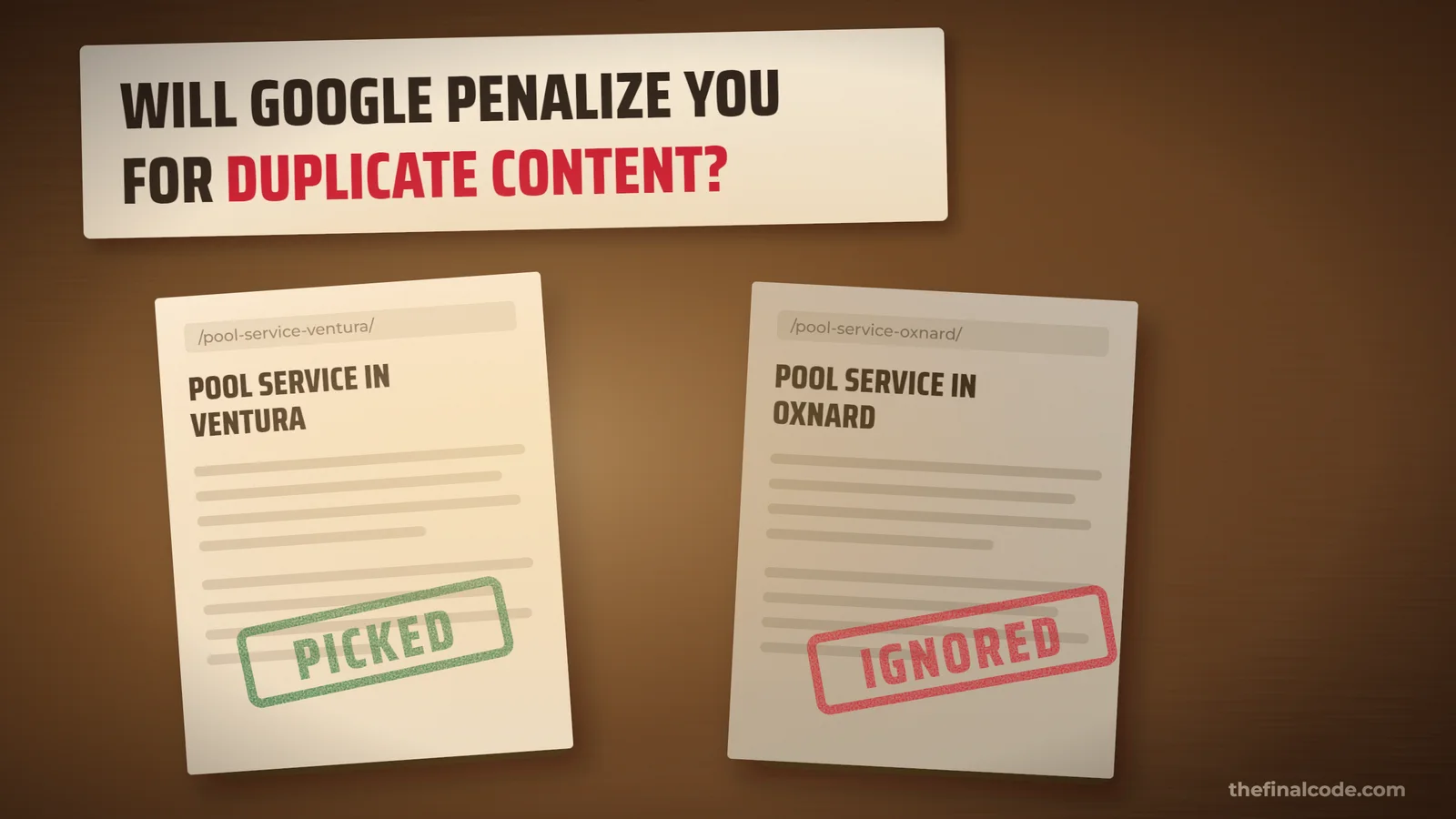
Here is what actually happens. When Google finds two or more pages that say essentially the same thing, it does not rank all of them. It chooses one to show and sets the others aside.
this process helps Google show only one version of the otherwise duplicate content in its search results.Google Search Central, What is canonicalization
That sounds harmless until you picture it on your own site.
Same page, town name swapped. Google keeps one and sets the other aside, and you do not get to choose which.
The page you were counting on to bring in Oxnard customers never shows up in Oxnard. Worse, Google might pick the page you care about least, and send your best search to the wrong place. If that sounds familiar, it is the problem we unpacked in Google showing the wrong page for your business.
Where duplicates come from on a small business site
Almost nobody duplicates content on purpose. It sneaks in.
- The copied city pagesOne service page, cloned for every town you serve, with only the town name changed. The most common one, and the costliest.
- The manufacturer's descriptionsProduct text pasted straight from the supplier, word for word the same as on every other store that sells it.
- Two addresses for one siteYour site answering at both
httpandhttps, or with and withoutwww, so every page exists twice. - The old site that never leftA redesign went live, but the old pages are still up at their old addresses, saying the same things.
How to fix it, without starting over
- Make each page earn its placeA town page should be about that town: the jobs you have done there, the neighborhoods, the questions people there ask. If you cannot say anything different, it probably should not be its own page.
- Point old pages to new onesWhen a page moves or is replaced, redirect the old address. Google calls a redirect “A strong signal that the target of the redirect should become canonical,” meaning the version that counts.
- Tell Google which version is the real oneWhere two pages have to stay, a canonical tag on the copy points Google at the original, so you choose instead of Google guessing.
- Pick one address for the whole siteOne version, https, with or without www, and everything else redirected to it.
The first fix is the one that matters most for a local business, and it is also the one that pays you back. Real, specific pages for each place you work are how you show up across several towns at once, which we walked through in whether you can rank in more than one city. Doing that properly, town by town, is the core of our local SEO work.
Send us your website. We will show you where your pages repeat each other, which ones Google is actually showing, and what to fix first so the right page turns up for the right search. No charge, and no obligation. Or call or text 805.243.8321.
Get My Free Visibility ReportDuplicate content will not get you punished. It just quietly leaves pages on the shelf. Making every page say something only it says is not a trick, it is plain good SEO.