Why Do I Only Rank for My Own Name?
Somebody tells you your website is doing well, and the proof is that you searched your company name and there you were, right at the top. That is the check almost every owner runs, and it is the one search on the internet that cannot tell you anything. We are an SEO company in Ventura County, and this is the gap we find most often: first for the name, invisible for the work.
Those are two completely different contests, and you have only entered one of them.
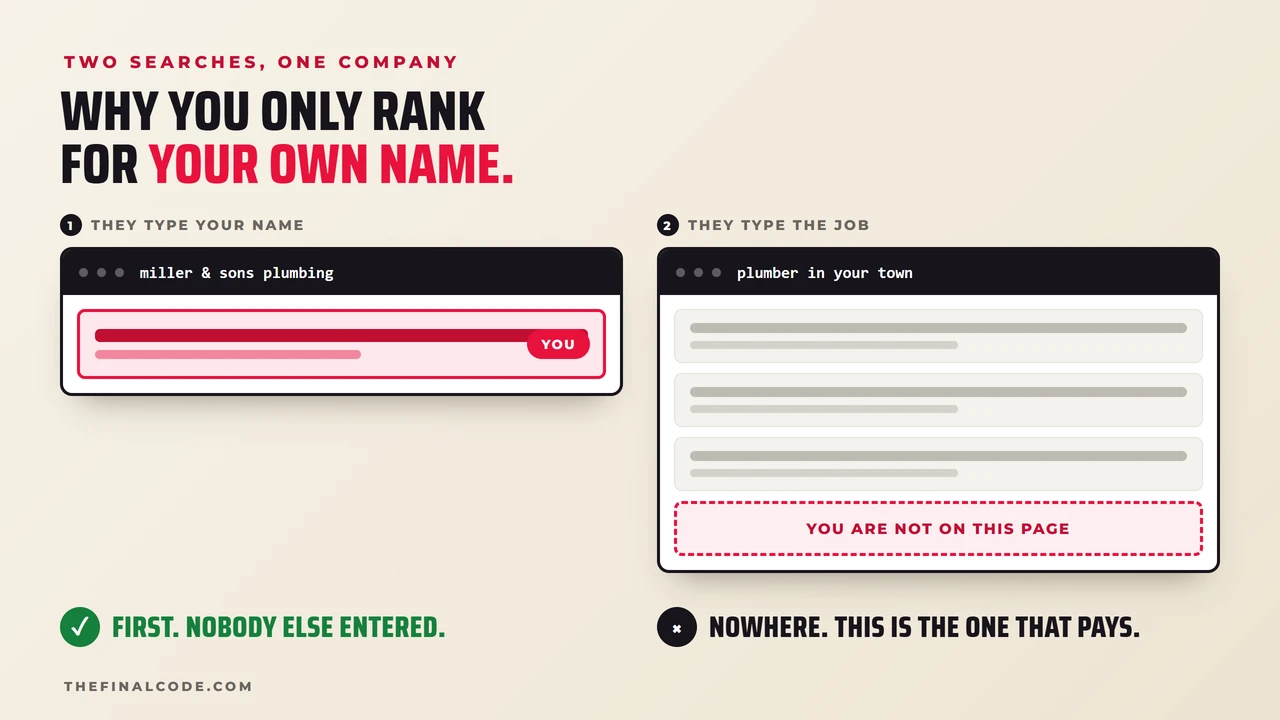
Your name is a search with one right answer
Think about what you are asking Google to do when you type your own company name. There is one business in the world with that name, you are it, and the only page on the internet that is genuinely about it is yours. Google is not choosing you over anybody. There is nobody else in the running.
That is why ranking for your name is not an achievement, it is a formality. It is the bar a website clears by existing and being crawlable. A brand new site with three pages and no work done to it will usually rank for its own name inside a few weeks, because nothing is competing with it.
So when you run that search and feel reassured, what you have actually confirmed is that Google knows you exist. You have confirmed nothing at all about whether Google knows what you do.
Everyone who searches your name already knows you
This is the part that costs real money, and it is worth sitting with for a second.
To type your company name into Google, a person has to already have your company name. They got it off the side of a van, from a neighbor, from an invoice in a drawer, from the guy who did their kitchen. They were already coming to you. You did not win that customer in the search. You had already won them, and the search was just how they found your phone number.
Now think about the customer you actually need. Their water heater is leaking, they have never heard of you, and they cannot type a name they do not know. They type the problem, or the job, and a town. That search is the one that grows a business, and it is the one you are not in.
miller & sons plumbing
Everyone who types this already had your name. You are first because there is no second.
plumber in your town
Every competitor, plus the directories. Hard, contested, and usually held by a list rather than a business.
water heater leaking from the bottom
The actual problem, in the customer's words, before they know who to call. Specific, valuable, and mostly empty.
Most of the businesses we look at are sitting at the top of the first box and have never written a page that belongs in the third. The work that grows the company is all in the bottom row.
Google reads your site and finds one subject: you
Here is the mechanical reason it happens, and it is not mysterious.
Open your homepage and read the title in the browser tab. For most small companies it says the company name, maybe with a tagline. Now read the first paragraph. It probably says who you are, how long you have been going, and that you are family owned and committed to quality.
None of that is what anybody searches. Google’s own starter guide is blunt about this, and it is worth reading the two sentences it puts next to each other.
On what to write: “Think about the words that a user might search for to find a piece of your content.”
On titles: “a good title is unique to the page, clear and concise, and accurately describes the contents of the page.”
Your homepage title accurately describes its contents. Its contents are your company name. So that is the search it wins.
Google Search Central, SEO starter guideThere is no penalty here and nothing is broken. Your site is ranking for exactly what it is about. The problem is that what it is about is your name, and your name is not what your customers type.
The trap if your name is the search
Some companies are called things like Ventura Plumbing, or Oxnard Roofing, or Camarillo Electric. If that is you, everything above still applies, but it is hidden from you, and that makes it worse.
Search your name and you are first. Except your name contains a service and a town, so it looks exactly like you are ranking for the service in the town. You feel covered. You are not. You are ranking for your name, and your name happens to be made of the same words.
There is a clean way to tell the two apart. Take the service out of your name and search it a different way.
ventura plumbing
You are first. This is your name, not a ranking.
emergency plumber ventura
Same service, same town, different words. If you vanish here, the first result was never a ranking.
plumber camarillo
Same service, a town your name does not contain. This is what you look like everywhere your name does not do the work for you.
Run those two and you will know in about a minute whether you have a ranking or a coincidence. Owners with a place name in their company name are usually the most surprised, because the false positive has been reassuring them for years.
One page cannot be about eleven things
The usual response to this is to add the services to the homepage. A list of everything you do, down the middle, with an icon next to each one. We see it constantly and it almost never works, because a page that is about eleven things is not clearly about any of them.
What most sites do
What actually ranks
Each of those pages can do the thing your homepage cannot: be entirely, obviously and only about one job, in the words somebody would use to describe that job when they are worried about it. That is the whole argument we made in how many pages you need to rank, and this is what it looks like when a business has not done it.
What to do about it, in order
Write down the ten jobs that pay your bills. Not your service categories, the jobs. What the customer calls about, described the way the customer describes it on the phone.
Search each one with your town on the end, from a phone, and see who is there. Expect the broad ones to be held by directories rather than by companies, which is a different problem with a different answer, and one we went through in why a directory outranks you.
Check them from where your customers actually are, not from your own desk, because the results move with the searcher and the page you see is not the page they get. That trap is the subject of why the rankings you see are not the ones your customers see.
Then take the jobs nobody has properly claimed and write a real page for each one. Not a paragraph on the homepage. A page, with the detail only somebody who does the work could supply.
Send us your website. We will send back what you currently rank for, which of it is just your own name, and the searches your customers are running that you do not appear on at all.
Get My Free Visibility ReportBeing first for your own name is worth having. Keep it. Just stop reading it as a scoreboard, because it is really a receipt: it tells you Google has your business on file. The question that decides whether the phone rings is a different one entirely, and it is whether Google has any idea what you do. Answering that, one job at a time, is most of what our SEO work actually is.