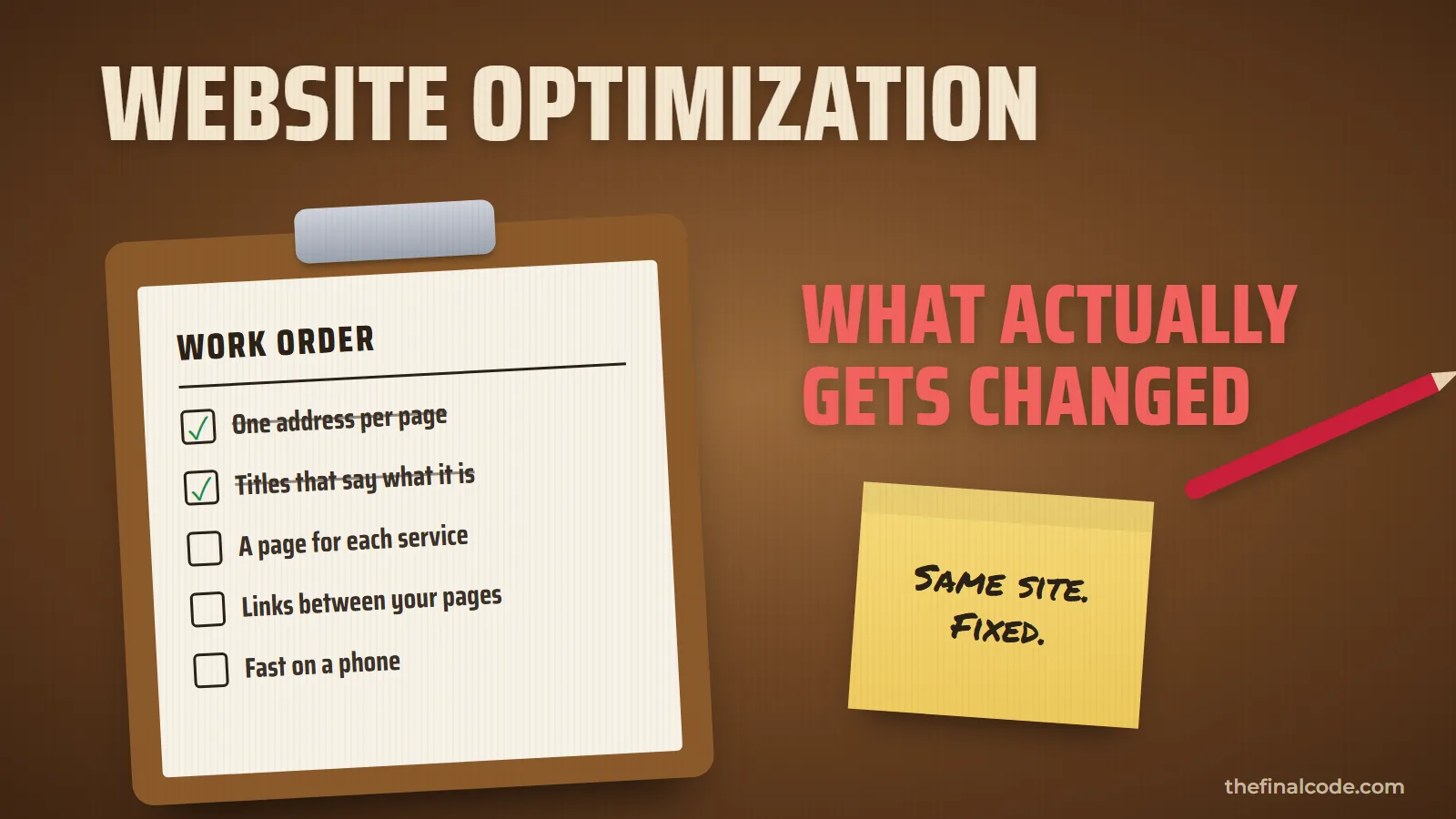
Website Optimization: What Actually Gets Changed on Your Site
Somebody calls and offers to “optimize your website.” You say yes. A month goes by. The site looks exactly the same, the invoice looks very real, and nobody can tell you what moved. As an SEO company in Santa Barbara, we think you should know what is being touched before you pay for it.
Optimization works on the site you already have
Website optimization is not a new website. Nobody is knocking down walls. It is fixing the plumbing in the house you already own, so Google can tell what each page is for and who it should be shown to.
That matters, because owners are often told the only fix is to start over, usually by somebody who sells new websites. Google does not say that. In its own starter guide, right after explaining how to organize a site, it adds this:
Don't drop everything and start reorganizing your site right now though: while these suggestions can be helpful long term (especially if you're working on a larger website), search engines will likely understand your pages as they are right now, regardless of how your site is organized.Google Search Central, SEO Starter Guide
That is Google, more or less, telling you to put the sledgehammer down. Most sites do not need tearing down. They need the parts Google reads put right. If you are unsure which camp you are in, we walked through it in should you rebuild your website or fix it.
The work, in the order it usually pays off
- One address per page
Google asks you to "ensure that each piece of content on your site is only accessible through one individual URL." When the same page answers at two addresses, the rankings can split between them.
- Page titles that say what the page is
Google: "a good title is unique to the page, clear and concise, and accurately describes the contents of the page." A surprising number of sites still say Home on every page. Google is now fairly confident you sell homes.
- One page for each service
A single services page that lists everything is a junk drawer. Google can tell there is a lot in there. It just cannot find the one thing somebody searched for. Splitting it up is often the biggest single change.
- Links between your own pages
"With appropriate anchor text, users and search engines can easily understand what your linked pages contain before they visit." Click here tells nobody anything. Here where?
- Speed and the phone
Google reads the phone version of your site first, so that is the version that gets fixed first.
- The words on the page
Saying, in plain words, what you do and where you do it. Not repeating one phrase twelve times like a late-night radio ad.
The bars are time, not money, and they are drawn, not measured. The short ones near the top are usually the ones that move first.
Each of those has its own post if you want the detail: how many pages you need to rank, what internal links are, Google reads your website on a phone first and whether a slow website is costing you rankings.
We found the first one on our own site
That first line is the easiest one to miss. We know, because we missed it. On our own site. Yes, the SEO company. This month we went through our own Search Console and found several of our pages answering at two addresses, one ending in a slash and one without. One of them was our Ventura County local SEO page.
/local-markets/ventura-county/local-seo12.0average position, 73 impressions/local-markets/ventura-county/local-seo/32.3average position, 769 impressionsOur own Google Search Console, September 15 to October 15, 2026.
Same page, same words, one forward slash apart. Google showed the weaker address ten times as often, which is the search version of handing out the business card with the old phone number on it. The fix was a redirect: the address without the slash now forwards to the one with it, so everything Google knew about the page counts toward one address instead of two. It is exactly what Google recommends:
If you have multiple pages that have the same information, try setting up a redirect from non-preferred URLs to a URL that best represents that information.Google Search Central, SEO Starter Guide
If it can happen to an SEO company, it can happen to a dentist. It is worth checking on yours. Why it hurts is covered in whether Google penalizes duplicate content.
What optimization is not
- A one-time job you never hear about again. If all you got was an invoice, that was not optimization. That was a subscription. You should get a list of what changed, page by page.
- A promise of first place. Nobody controls Google's results, and anybody guaranteeing them is guaranteeing something they do not own. That one and other warning signs are in 10 red flags your SEO company is wasting your money.
- Invisible. Every change on the work order shows up in Search Console. What Google Search Console is and what to look at shows you where.
How to tell the work is being done
Ask whoever is optimizing your site for three things before they start, and again every month. Good companies hand these over happily. The others suddenly get very busy.
- The list of pages they changed, and what changed on each one.
- The searches each page is meant to win, so you can check them yourself.
- Search Console numbers before and after, impressions and position for those pages. If a report leaves them out, read what your SEO report should actually show you.
Send us your website. We will look at the pages you count on, find the problems Google is tripping over, and put them in the order that pays off fastest. No charge, and no obligation. Or call or text 805.243.8321.
Get My Free Visibility ReportA website you already own is usually closer to ranking than it looks. Optimization is the part of SEO done properly that gets it there without starting over, and without anybody picking out new fonts.